Home › D › Dend (Brit T argentea Dec)
Dend (Brit T argentea Dec)
brit. 71 T. argentea Dec. 7718 heterophylla Vent. various-leaved tm 30 jn.au Y.G N. Amer. 1811.
L co Vent. diss. t. 5. 1187. COR CHORUS. W. CORCHORUS.
Tiliacea. Sp. 7-25. 7719 olitórius W. bristly-leaved w 2 jn.au Y India 1640. S co Camer.hort.t.12 7720 triloculáris W. three-celled w 1 jl.au Y 7721 æ'stuans W.
Hornbeam-lvd. w 2 jn.jl Y 7722 acutángulus W. acute-angled W 3 jn.jl Y 7723 capsuláris W. heart-leaved w 1½ jn.jl Y 7724 hirsútus W. woolly-capsul'd w 1 jn.jl Y Arabia 1790. S co S. Amer. 1731. S co E. Indies 1816. C co E. Indies 1725. C l.p S. Amer. 1752. S p.l Jac. vind.2. t. 173 Jac. vind. 1. t. 85 Plu.phyt.t.44.f.1 Ru.am.5. t.78.f.1 Jac. vind. 3. t. 57 7725 siliquósus W.
Germander-lv. un 3 jn.au R W. Indies 1732. C l.p Jac. vind. 3. t. 59 1188. GRI'AS. W.
ANCHOVY-PEAR.
Guttiferis affinis. Sp. 1. 7726 cauliflóra W. stem-flowering fr 50 W Jamaica 1768. C l.m Sl.hi.2.t.217.f.1,2 1189. CALOPHYLLUM. W. CALOPHYLLUM.
Guttiferæ. Sp. 2-9. 7727 Inophýllum W. sweet-scented 7728 Cálaba W.
Calaba-tree tm 90 tm 30 ... ... 1190. MAMME'A. W.
MAMMEE-TREE.
W E. Indies 1793. C s.1 W India 1780. C s.l Guttiferæ. Sp. 1-3.
Rhee.mal.4. t.38 Jac. amer. t. 165 7729 americána W.
American 오 fr 60 ... 7706 7713 W 7715 S. Amer. 1737. C s.l Ja. am. t. 182.f.82 7716 7705 7707 7709 7712 History, Use, Propagation, Culture, 1185. Grewia. So named by Linnæus, in honor of Nehemiah Grew, M. D., F. R. S., famous for his work on the Anatomy of Vegetables. The species are shrubs with elm-looking leaves, generally deciduous, and of no great beauty. Cuttings root in sand under a hand-glass in heat. Some of the kinds produce a sort of berry which is esteemed by the natives of the country where they grow. 1186. Tilia. A name the meaning of which is unexplained. Tilleul, Fr., Linden, Ger., and Tiglio, Ital. The species are graceful trees with highly odoriferous flowers, all the soft parts abounding in mucilage. T. intermedia is wild in Sweden, and will in some degree bear the smoke of London. It is a favorite avenue tree in Holland and Germany, and at Evelyn's suggestions (Sylva) was a good deal employed in this way in England. He describes some enormous lime trees in Switzerland, Germany, and Hungary, and speaks of its esteem in these countries, and by the Romans. "It is a shameful negligence," he says, " that we are no better provided of nurseries, for a tree so choice and universally acceptable:" for in his time they sent into Holland and Flanders, to our excessive cost, whilst our own woods spontaneously produce them, and though of somewhat a smaller leaf, yet altogether as good, apt to be civilized, and made more florid.
Lime-tree wood is turned into light bowls and dishes, and into boxes for the apothecaries. With the twigs they make baskets and cradles. Formerly the bark was used for writing tablets. Shoemakers make dressers of the plank to cut leather on. The truncheons make a far better coal for gunpowder than that of alder itself, and also scriblets for painters' first draughts. The wood is soft, light, and smooth, close grained, and not subject to the worm. The most elegant use to which it is applied is for carving. Many of Gibbon's beautiful works in lime-tree are dispersed about the kingdom in our churches and palaces; as in the choir of St. Paul's, the Duke of Devonshire's at Chatsworth, Trinity College Library at Cambridge, &c. Evelyn first recommended him to King Charles II. The sap inspissated affords a quantity of sugar. Boutcher remarks, that the timber is stronger and lighter than any sort of willow; and makes a proper lining for rooms, and when painted will last long.
In Lincolnshire, in the forest of Dean, and in various parts of the borders of South Wales they make ropes of the bark. This, by maceration, separates into thin rough layers, and is used for making the mats used by gardeners, and called in the north of Europe bast. They form a considerable part of the exports from Russia. This quality in the bark, and a great degree of viscidity in the whole tree, evince its acknowledged affinity to the mallow tribe. ORDER I.
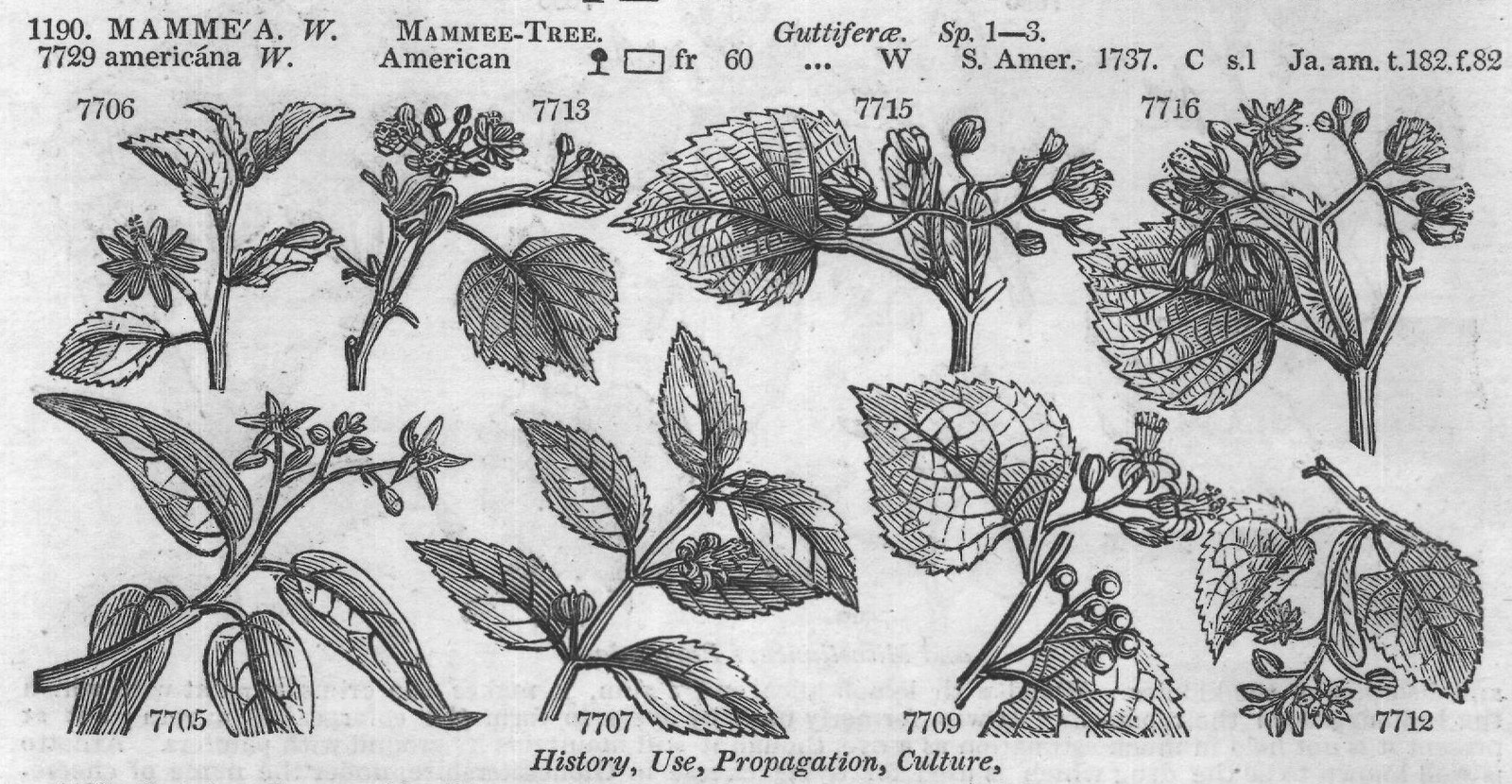
POLYANDRIA MONOGYNIA. 7703 Leaves lanc. ovate soft, Cal. very hairy, Pedunc. 3-flowered 7704 Leaves cordate ovate oblong crenated scabrous, Pedic. axillary 3-flowered, Fruit of 4 pieces 7705 Leaves ovate obl. acum. smooth nearly entire, Fl. terminal panicled 7706 Leaves roundish ovate blunt toothed smooth, Peduncles solitary 1-flowered 7707 Leaves ovate crenate rough on each side, Peduncles axillary 3-flowered 7708 Leaves ovate crenate rough thickish, Pedunc. 2-6-fl. axill. and term. Fruit pilose 7709 Leaves cordate roundish hoary beneath, Peduncles axillary about 4, longer than petiole 7710 Leaves cordate roundish smooth on each side, Peduncles shorter than petiole * Petals naked. 7711 Lvs. cord. uneq. at base, Petioles and suckers hairy, Axill. of veins beneath beard. Fruit globose smooth 7712 Lvs. cord. acum. ser. smth. twice as long as stalks, Axill. of veins beard. ben. Fr. 7713 Lvs. cord. acum. ser. smth. twice as long as stalks, Axill. of veins beard. ben. Fr. membr. obl. globose deform. 7713 Lvs. cord. round. acum. finely serr. smth. scarcely longer than stks. Ax. of veins ben. beard. Fr. round very 7714 Lvs. cord. round . acum, finely serr. a little downy ben. Fr. turb. woody with prominent ribs [thin & brittle ** Petals with a scale at base. 7715 Lvs. deeply cord. abruptly acum. finely serrated coriaceous smooth, Pet. trunc. at end cren. Fruit ov. ribbed 7716 Lvs. trunc. at base subcord. oblique dent. serr. pubescent beneath, Pet. emarginate, Fruit globose smooth ẞ Leaves thin deeply and rarely ely cut 7717 Lvs. cord. subacum. unequal at base serrated snow-white beneath smooth above, Fruit round with 5 ribs 7718 Lvs. ov. downy beneath, at base either cordate or obliquely or equally truncate, Fruit round with 5 ribs 7719 Caps. obl. ventricose, Lowest serratures of leaves setaceous 7720 Caps. 3-celled 3-valved 3-cornered, Angles bifid scabrous, Leaves obl. Lowest serratures setaceous 7722 7721 Caps. obl. 3-celled 3-valved 6-furrowed 6-pointed, Leaves cordate, Lowest serratures serratures setaceous about 1 seta at the base, Petioles hispid 7723 Caps. roundish depressed rugose, Lowest serratures of leaves setaceous 7724 Caps. roundish woolly, Leaves ovate obtuse downy equally serrated 7725 Caps. linear compressed 2-valved, Leaves lanceolate equally serrate 7726 Leaves 3 feet long obovate, Flowers growing out of the stem and old branches 7727 Leaves oval 7728 Leaves ovate obtuse 7729 Leaves very blunt striated, Peduncles short, Berries 4-seeded 7726 7727 7717 7720 7728 7725 7721 7729 and Miscellaneous Particulars.
The honey made from the flowers of the lime tree is reckoned the finest in the world. Near Kowno in Lithuania, there are large forests chiefly of this tree, and probably a distinct variety or species. The honey produced in these forests sells at more than double the price of any other , and is used exclusively in medicine and for mixing with liqueurs. (Encyc. of Agric.; Poland and Hungary.) 1187. Corchorus. Koρχoρoς, the Greek name of a culinary vegetable, supposed to be the same as that now known as C. olitorius. C. olitorius is sown in great plenty about Aleppo as a pot herb, the Jews boiling the leaves to eat with their meat, whence in French it is called Mauve-de-Juif . The other species are weeds. 1188.
Grias. From γρaω, to eat. The fruit is eaten in the West Indies under the name of the Anchovy pear. The uprightness of the growth and the largeness of the leaves give this tree a very elegant appearance.
The fruit is about the size of an alligator's egg, and much like it in shape, only a little more acute at one end, and of a brown russet color. It is frequent in many parts of Jamaica, and grows generally in low moist bottoms or shallow water, where the fruit is pickled and eaten in the same manner with the East Indian mango , which it exactly resembles in taste. It grows in a loamy soil, and large cuttings, Sweet observes, succeed best in the same soil under a hand-glass in heat. 1189. Calophyllum. From κaλoς, beautiful, and φuλλov, a leaf, on account of its large beautifully veined leaves. C. Inophyllum (15 1965, fibre, because the middle nerve of the leaf leaves. C. Inophyllum (65 LUGS, fibre, because the middle nerve of the leaf seems to ramify into a multitude of ) is a very large tree, with leaves like a water lilly, snow-white fragrant flowers, and fruit like a walnut.
The trunk when wounded exudes a viscid yellowish juice, frequently hardening to a gum. It is common in Malabar, in sandy soils, and bears fruit twice a year, in March and September , frequently to the age of three hundred years. An oil is expressed from the nuts to burn in lamps, to assuage pains, and to make ointments.
The bark and gum is also used for medical purposes. In Java, &c. they plant this tree about their houses, for the elegance of the shade and the sweetness of the flowers. C. Calaba (the name among the Caribs) branches from the ground upwards, and is therefore well adapted for tree hedges. It has a green fruit not unlike our cornelian cherry, which is eaten by the natives, and an tree hedges. It has a green fruit not unlike our cornelian cherry, which is eaten by the natives, and an oil is expressed from it for lamps. Both species grow freely in a light loamy soil, and ripe cuttings are readily struck in sand under a glass and plunged in heat. (Sweet.) 1190. Mammea. An alteration of its American name, Mamey. The name having some resemblance to the , on account of the large fleshy pointed nature of its fruit. Abricot-sauvage, Fr. A handsome tree with a spreading elegant head, like those Hh2 1191. OCH'NA. W. 7730 obtusáta Dec.
OCHNA. squarrose 7731 atropurpúrea Dec. purple-flower'd or or POLYANDRIA MONOGYNIA.
Ochnaceæ. Sp. 2-11. 4 jl.au Y Pu 1192. ELÆOCAR PUS. 7732 serrátus W. 7733 cyáneus B. M. blue-fruited W. ELEOCARPUS. saw-leaved 오 오 or 20 Elæocarpeæ.
W E. Indies 1790. C l.p C. G. H. 1816. Cl.p Sp. 2-10.
CLASS XIII.
Roxb. cor 1. t.89 Plu. al. 263. f.1,2 or 10 jn.au W E. Indies 1774. C p.l N. Holl. 1803. C p.1 Burm. zeyl. t.40 Bot. mag. 1737 E. reticuláta Smith. 1193. ALAN GIUM. J.
ALANGIUM. 7734 decapétalum W.
Sage-leaved 오 or 10 ...
Myrtaceæ. Sp. 1-2.
Pa.pu E. Indies 1779. C p.1 Rhee.mal.4. t.17 7735 áspera W. 7736 oligospérma Nutt. few-seeded 1194. MENTZELIA. W. MENTZELIA. 1195. LAGERSTRE MIA. W. LAGERSTREMIA.
Loaseæ. Sp. 2-3. rough or 3 jl.au Y America 1733. S co Plum. ic. 174. f.1 or 2 my.jn Y Louisiana 1812. D s.l Bot. mag. 1760.
Salicariæ.
Sp. 2-7. 7737 índica W.
Indian or 6 au.o Pu E.
E. Indies 1759. C s.l Bot. mag. 405 7738 Regínæ W. oblong-leaved or 12 ...
R E. Indies 1792. C p.I Roxb. cor. 1. t. 65 1196. ÆGLE. Correa.
BENGAL-QUINCE.
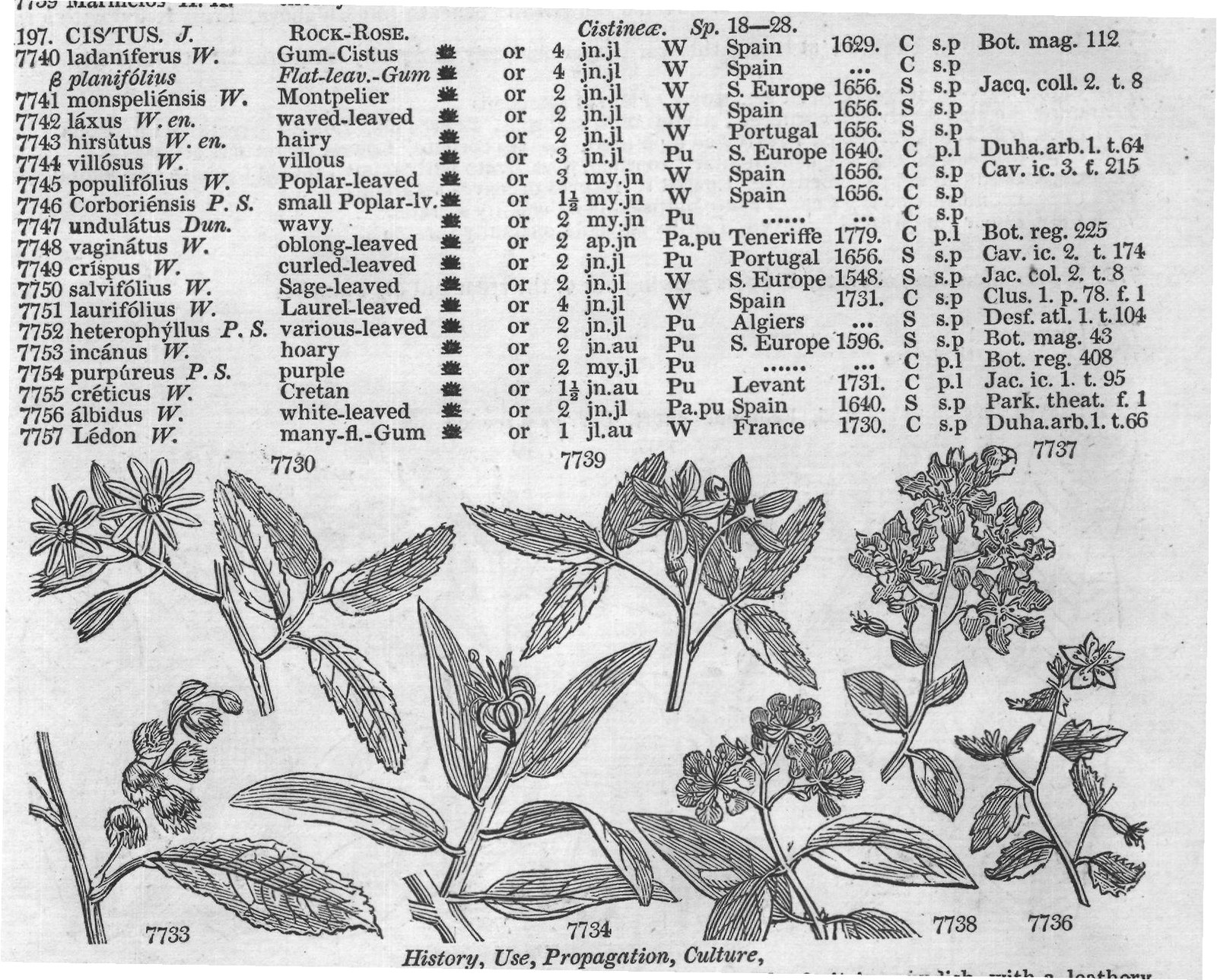
Aurantiaceæ. Sp. 1-2. 7739 Mármelos H. K. thorny fr 6 E. Indies 1759. C 1 Rox. cor.2. t. 143 ... 1197. CISTUS. J.
ROCK-ROSE.
Cistineæ. Sp. 18-28. 7740 ladaníferus W.
Gum-Cistus or 4 jn.jl W Spain 1629. C s.p Bot. mag. 112 B planifólius Flat-leav.-Gum or 4 jn.jl W Spain C s.p 7741 monspeliensis W.
Montpelier or 2 jn.jl W S. Europe 1656. S s.p Jacq. coll. 2. t. 8 7742 láxus W.en. waved-leaved or 2 jn.jl W Spain 1656. S s.p 7743 hirsútus W. en. hairy or 2 jn.jl W Portugal 1656. S s.p 7744 villósus W. villous or 3 jn.jl Pu S. Europe 1640. C p.1 Duha.arb. 1. t.64 7745 populifólius W.
Poplar-leaved or 3 my.jn W Spain 1656. C s.p Cav. ic. 3. t. 215 7746 Corboriénsis P. S. small Poplar-lv. or 1 my.jn W Spain 1656. C s.p 7747 undulátus Dun. wavy or 2 my.jn Pu ...
Cs.p 7748 vaginátus W. oblong-leaved or 2 ap.jn Pa.pu Teneriffe 1779. C p.1 Bot. reg. 225 7749 críspus W. curled-leaved or 2 jn.jl Pu Portugal 1656. S s.p 7750 salvifólius W.
Sage-leaved or 2 jn.jl W 7751 laurifólius W.
Laurel-leaved or 4 jn.jl W Spain 7752 heterophyllus P. S. various-leaved or 2 jn.jl Pu Algiers 7753 incánus W. hoary or 2 jn.au Pu 7754 purpúreus P. S. purple or 2 my.jl Pu 7755 créticus W.
Cretan or 1 jn.au Pu Levant 7756 álbidus W. white-leaved or 2 jn.jl Pa.pu Spain 7757 Lédon W. many-fl.-Gum or 1 jl.au W France 1640. S s.p 1730. C s.p 7730 7739 S. Europe 1548. S s.p 1731. C s.p ...
Ss.p S. Europe 1596. S s.p ...
Cp.l 1731. C p.1 Cav. ic. 2. t. 174 Jac. col. 2. t. 8 Clus. 1. p. 78. f. 1