Important: Safety Warning
This page prescribes plants as medicine according to pre-modern medical theory. Several of the plants named are toxic, correct identification is difficult, and the doses given have no scientific basis. Do not ingest or apply any preparation described here.
This page presents medical treatment from an era before modern medicine. The remedies described are ineffective against the conditions named, and some of the ingredients or doses are harmful. Do not use them to treat any illness; consult a qualified medical professional.
This information has been left in for historical purposes but should not be acted upon.
Home › E › Eng (Bot bulb sus W en)
Eng (Bot bulb sus W en)
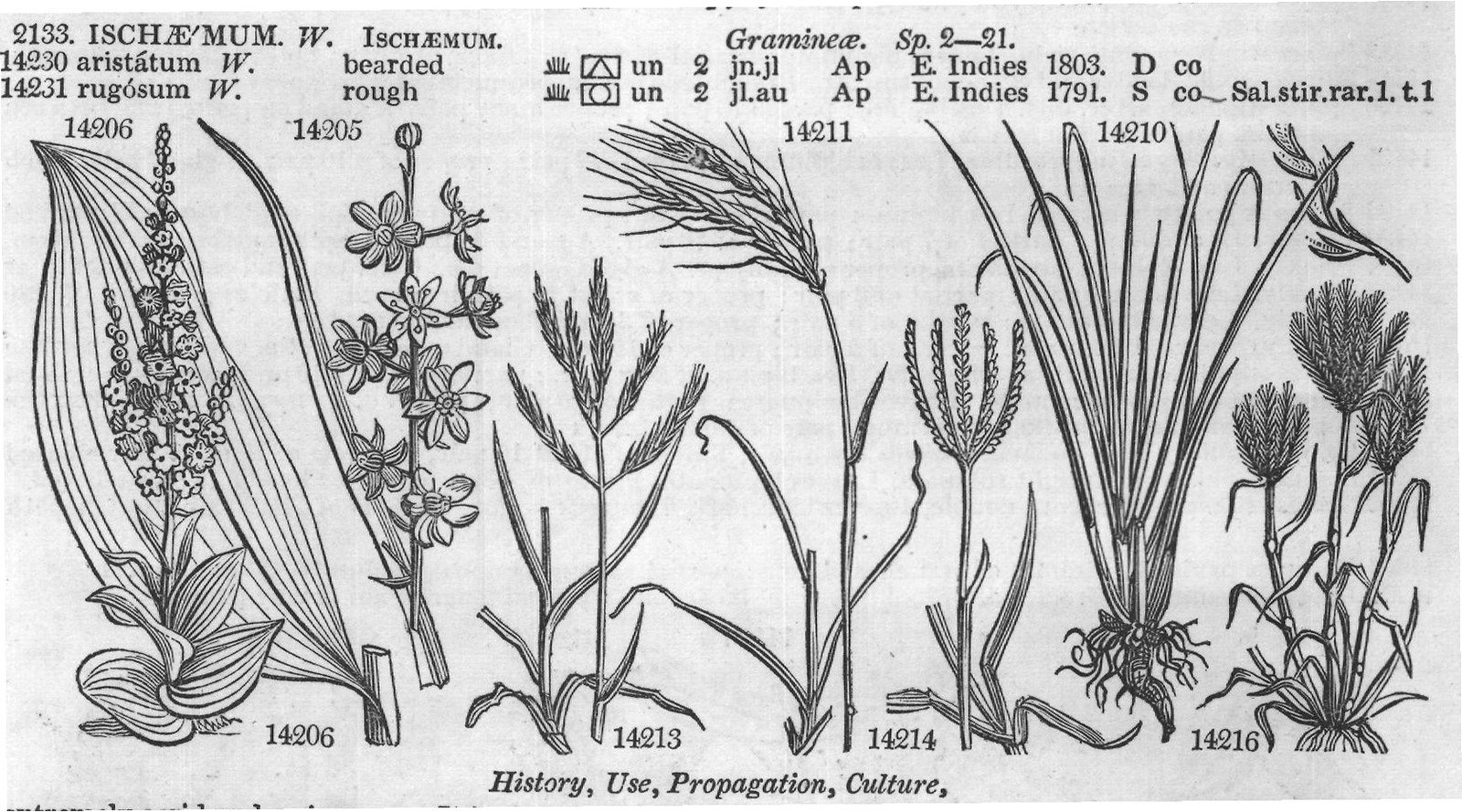
bot. 813 14228 bulbósus W.en. bulbous-rooted 3 jn.jl Ap D co .. ... 14229 odorátus W. sweet-scented f 1 jn.jl Ap N. Amer. 1777. D co 2133. ISCHEMUM. W. ISCHEMUM.
Gramineæ.
Sp. 2-21. 14230 aristátum W. bearded un 2 jn.jl Ap E. Indies 1803. D co 14231 rugósum W. rough un 2 jl.au Ap 14206 14205 14211 E. Indies 1791. S co Sal.stir.rar.1. t. 1 14210 14206 14213 14214 History, Use, Propagation, Culture, 14216 extremely acrid and poisonous. It is used in medicine, and its properties are found to depend on veratrine, the same alkaline principle which is the active ingredient of colchicum. Medicinally it is violently cathartic and sternutatory. When taken internally , even in moderate doses, its operation is violent and dangerous; producing besides hypercatharsis, with bloody stools and excessive vomiting, great anxiety, tremors, vertigo, syncope, sinking of the pulse, cold sweats, and convulsions, terminating, if the dose be large, in death. Its external application to an ulcerated surface also produces griping and purging. Notwithstanding these effects, Veratrum has been exhibited internally, and with advantage, in mania, epilepsis, scabies, lepra, and obstinate herpetic eruptions. But the most ordinary use of white hellebore is as a local stimulant. When taken inis a strong infusion of nut-galls. (Thom. Lond. Disp. p. 545.) V. nigrum is very nearly allied to album, but differs in color, and seems not to be so strong and acrid in its qualities; for when both sorts are placed near each other, snails will entirely devour the leaves of this species, ; for when both sorts are placed near each other, snails will entirely devour the leaves of this species, when they will scarcely touch those of the other. 2129. Andropogon. From avης, a man, and πωγωv, a beard. A hyperbolical comparison of the little tuft of hairs upon the flower to the beard of a man.
A. schænanthus has an agreeable smell, with a warm, bitterish, not unpleasant taste. It was formerly brought over from Turkey in bundles about a foot long, and kept in the shops to be employed as a stomachic and deobstruent, but it is now little used. All the species are of the easiest culture. 2130. Chloris. Derived from χλωρoς, green, on account of the color of its herbage. Pretty little grasses, with beautiful one-sided spikes of silky flowers. . 2131. Sorghum. Sorghi is the Indian name, according to Bauhin. S. vulgare, grand millet, Fr., Saggena or Sorgo, Ital., and alcandia, Span., is much cultivated in Arabia and most parts of Asia Minor. It has Sorgo, Ital., and alcandia, Span., is much cultivated in Arabia and most parts of Asia Minor. It has been introduced into Italy, Spain, Switzerland, and some parts of Germany; also into China, Cochin- China, and the West Indies, where it grows commonly five or six feet high or more, and being esteemed a Negroe Guinea corn. Its long awns or bristles defend it from the birds. In England, the autumns are seldom dry and warm enough to ripen the seeds well in the field. In Arabia it is called Dora or Durra. The flour is very white, and they make good bread of it, or rather cakes, about two inches in thickness. The bread which they make of it in some parts of Italy is dark and coarse. it is used chiefly for feeding poultry and pigeons; sometimes for kine, swine, and horses. Brooms are made In Tuscany of the spikes, which are also sent to this country for the same purpose. as the common sort (Panicum), is cultivated in some parts of North America, and has been tried in this The Indian millet, as well country, but it is only in the warmest autumns that it ripens its seeds. It might probably, however, be acclimated.
ORDER I.
POLYGAMIA MONŒCIA. 14205 Racemes panicled, Bractes shorter than peduncle, Petals with 2 glands at base 14206 Racemes supradecompound panicled, Bractes of branches linear-lanceolate very long 14207 Racemes panicled, Petals bearing the stamens on their claw 14208 Spike simple, Flowers twin: hermaphrodite sessile awned; male stalked, Outer valve of cal. nerved 14209 Spike simple, Lower flower beardless, Male and hermaphrodite calyxes hairy, Awns very long hirsute 14210 Spikes imbric. conjug. panic. bract. Fls. in 3s: midd. hermap. beard.: beard smooth: lat. stalk. male beardl. 14211 Spikes twin terminal, Florets twin bearded: hermaphrodite sessile; male bearded, Culm undivided 14212 Spikes digitate about 3, Florets alternate sessile beardless 14213 Spikes digitate about 8, Florets twin woolly at base: hermaphrodite sessile bearded; male stalked bearded 14214 Spikes 4-5-6 straight erect, Florets imbric. nearly smooth beardless, Outer valve of cal, beard. Culm compr. 14215 Spikes digitate about 5 erect, Glumes ciliated 14216 Spikes many fascicled nearly erect, Florets subulate smooth 14217 Spikes many fascicled, Glumes ciliated bearded, Male valves ventricose bearded 14218 Spikes many alternate panicled pendulous, Spikelets 4-flowered 14219 Panicle contracted ovate, Florets strigose with down black, Seeds white round 14220 Panicle contracted oblong, Florets obovate shining hairy, Seeds compressed 14221 Panicle spreading, Florets oblong acute shining ciliated 14222 Panicle effuse, Branches spreading, Florets villous oblong, Leaves broad lanceolate 14223 Panicle spreading, Branches rough, Florets lanc. acute silky shining, Leaves lanceolate rough at edge 14224 Panicle effuse spreading, Branches whorled 3-fl. Peduncles bearded, Leaves and sheaths hairy 14225 Glumes 2-fl. hermaphrodite, Sessile floret beardless stalked bearded, Beard longer than flower 14226 Glumes 2-fl.: hermaphrodite beardless, Beard of the male much shorter than flower recurved 14227 Male flowers with a jointed beard twice as long as calyx, Joints of culm smooth, Root nodose 14228 Male flowers with a jointed beard twice as long as calyx, Joints of culm villous, Root bulbous 14229 Panicle spread. Glumes 3-fl. beardl. Flor. heaped: hermap. in midd. diand.; male triand. ciliat. Hierochloe [Gm. 14230 Leaves lanc. Florets naked, Outer valve of cal. with 2 nodules on each side, Beard of cor. long twisted 14231 Leaves lanceolate, Neuter florets intermediate wrinkled across: two lateral smooth 14223 14225 14224 14226 14227 14231 14220 and Miscellaneous Particulars. 2132. Holcus. From έλκω, to extract. It was a popular notion among the ancients, that the leaves of the plant they called Holcus, which seems to have been a grass of some kind, had the property of extracting thorns from the flesh. H. mollis is distinguished by its creeping roots, which, when once in possession of the soil, as Mr. Sinclair observes, can hardly be again expelled without great labor and expence. It is the true couchgrass of light sandy soils, and underground stolones have been found five feet in length, the growth of a few months only. These root-shoots contain a very considerable quantity of nutritive matter, which has the flavor of new made meal. Pigs are very fond of the roots, and dig them up with eagerness; but the herbage is disliked by cattle, more than that of any other species of the genus, being extremely soft, dry, and tasteless. The best mode of banishing this weed from light arable lands, is to collect the roots with the fork after the plough. (Sinclair, Hort. Gram. 167.) H. lanatus has a fibrous root, and grows on all soils from the richest to the poorest, but attains to the highest degree of luxuriance on light moist peaty soils. Cattle prefer almost any other grass to this; it is seen in pastures with full grown perfect leaves, while the grasses that surround it are cropped to the roots. Its nutritive matter consists entirely of mucilage and sugar; while the nutritive matters of grasses most liked by cattle are either sub-acid or saline. Mr. Sinclair suggests, that this grass might probably be made more palatable to cattle, by being sprinkled over with salt. (Hort. Gram. 164.) H. avenaceus, the Avena elatior of Linnæus, Curtis, and Host, is a bulky productive grass, eaten by horses, cattle, and sheep, but less nutritious than many other grasses. It pushes rapidly after being cropped; and though later in flowering than many other species, produces an early and plentiful supply of herbage in the spring. These properties would entitle it to rank high as a grass adapted for the alternate husbandry, but its nutritive matter contains too large a proportion of bitter extractive and saline matters to warrant its cultivation, without a considerable admixture of different grasses; and the same objection extends to its culture for permanent pasture. It is always present in the composition of the best natural pastures, and, as before mentioned, eaten in common with other grasses. It does not, however, constitute a large proportion of the herbage, but rather the least of any of the more valuable grasses that have been mentioned. (Hort. Gram. p. 171.) This grass and Triticum repens are the two species eaten by dogs to excite vomiting. One variety has bulbous roots, and is a noxious weed in arable lands. H. odoratus is one of the earliest flowering grasses; but it is tender, the spring produce of herbage is inconsiderable, and its powerful creeping roots render it unfit for agricultural purposes. (Hort. Gram. 169.) 2133. Ischæmum. From iσχω, to stop, and aiμa, blood. Pliny says, that the Thracians first discovered that the woolly seed which is borne by the Ischæmum, if introduced into the nostrils, has the power of stopping the bleeding at the nose. Useless grasses.
POLYGAMIA MONECIA.
HARD-GRASS. oval-spiked long-spiked 2134. ÆGILOPS. W. 14232 ováta W. 14233 triunciális W. 14234 cylíndrica W. 14235 squarrósa W. 14236 caudáta W.
Cretan cylindrical rough-spiked 2135. MANISU'RIS. W. MANISURIS. 14237 granuláris W. round-grained 2136. VALAN'TIA. W. VALANTIA.
Crosswort wall bristly least 14242 pedemontána W. Piedmont Galium verrucósum E.B. 2137. PARIETA'RIA. 14250 judáica W. 14251 pensylvánica W. 14252 urticæfólia W. un للاد Gramineæ. jn.jl Ap un jl.au Ap un 1 jn.jl Ap Sp. 5.
S. Europe 1683. S co S. Europe 1739. S co Europe Hungary 1805. S co Levant 1794. S co Candia 1739. S co Gramineæ. Sp. 1-2. cu 1 jn.jl Ap Rubiaceæ.
Aor 1½ my.jn Y un my.jl G Oun 1 my.jl G.Y jl.s G.Y jl G.Y my.jn G.v jn.au G.Y از E. Indies 1784. S co Sp. 10.
Britain D co ...
S. Europe 1739. S co S. Europe 1768. S co Canaries 1780. S co Hungary 1799. S co Levant 1780. Sco Britain ...
Sco Egypt 1752. S co S. Europe 1731. D co Siberia 1804. D co E. Indies 1790. D co Britain walls. D co Germany 1728. S co Pensylva. 1821. S co Bourbon 1700. S co Spain 1710. S co Armenia 1728. S co CLASS XXIII.
Fl. græc. 1. t. 93 Sch.gr. 1. t.10. f.1 Host.gram.2. t.7 Sch.gr.2. t.27. f.2 Fl. græc. 1. t. 95 Roxb.cor.2.t.118