Home › E › Eng (Bot History Use Propagation)
Eng (Bot History Use Propagation)
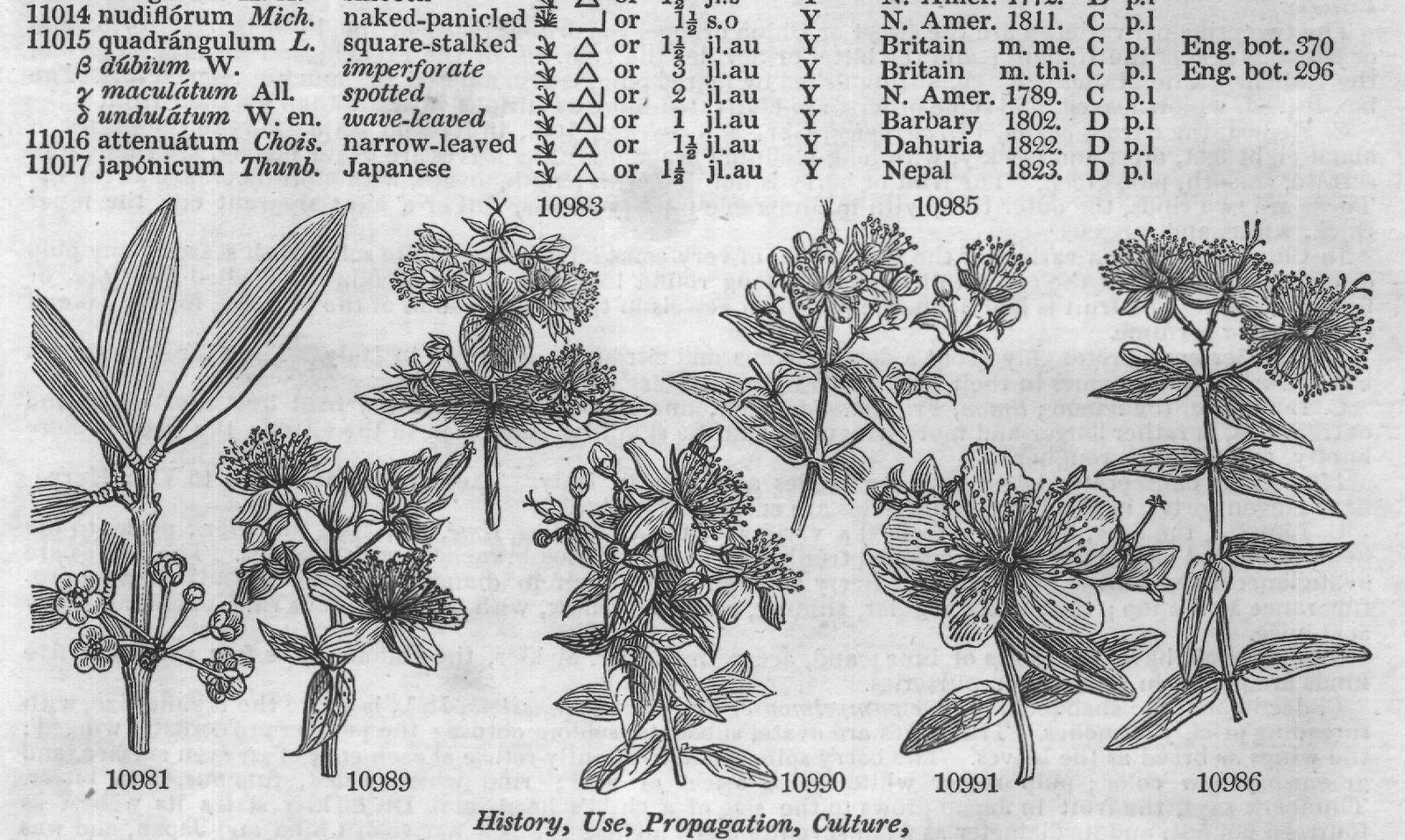
bot. 296 10981 10989 10990 10991 10986 History, Use, Propagation, Culture, in a shady place, and if a frame be ready with bottom heat, plunge the pots to the brim. Shade them well with a double mat, which may remain till they have struck root; when rooted, take the sand and cuttings out of the pot, and plant them into single pots, in the proper compost. Plunge the pots with the young plants again into a frame, and shade them for four or five weeks, or till they are taken with the pots; when they may be gradually exposed to the light. From various experiments, I found that pieces of two year old wood struck quite well; and in place, therefore, of putting in cuttings six or eight inches long, I have taken off cuttings from ten inches to two feet long, and struck them with equal success. Although I at first began to put in cuttings only in the month of August, I now put them in at any time of the year, except when the plants are making young wood. By giving them a gentle bottom heat, and covering them with a hand-glass, they will generally strike root in seven weeks or two months. The citron is most easily struck, and is the freest grower; I , therefor therefore , frequently strike pieces eighteen inches long, and as soon as they are put into single pots, and taken with the pots, they are grafted with other sorts, which grow freely. I am not particular as to the time either of striking cuttings or of grafting." (Caled. Hort. Mem. iii. 308.) At Genoa and Florence, citrus trees are grown in a strong yellow clay, which is richly manured; and this soil is considered by the first Italian gardeners as best suited to their natures. The French gardeners, in preparing a compost for the orange-tree, endeavour to compensate for quantity by quality; because the pots or boxes in which the plants are placed ought always to be as small as possible, relatively to the size of the tree. The following is the composition recommended: to a fresh loam, which contains a third of clay, a third of sand, and a third of vegetable matter, and which has lain a long time in a heap, add an equal bulk of half-rotten cow-dung. The following year turn it over twice. The succeeding year mix it ORDER II. 10981 Leaves oblong POLYADELPHIA POLYANDRIA. 10982 Leaves smaller oval blunt §1. Sepals united at base and unequal. Stamens 00. Styles 3-5. ASCYREIA. 10983 Young stem winged, Lvs. ov. obl. acute dilated at base somew. emarg, revolute at edge, Fl. corymbose 10984 Branches double-edged, Lvs. ov. elongated blunt at end narrow at base, Fl. large subsolitary 10985 Branches double-edged, Lvs. obl. ellipt. bluntish at end narrowed at base with a crisp revolute edge 10986 Branches winged, Lvs. emarg. at base dilated sess . acute at end ovate lanc. glandular at edge 10987 Branches winged, Lvs. sess. open ovate obl. somewhat acute slightly perforated 10988 Stem round, Lvs. sess. lanc. not dotted numerous, Peduncles dilated at end 10989 Stem round, Lvs. ellipt. ovate bluntish with pellucid dots, Calyx ovate acute 10990 Stem obsoletely quadrangular, Branches compressed, Lvs. ov.-lanc. acute, Cal. blunt ovate 10991 Stem round, Lvs. ellipt. blunt a little dotted with black, Styles united 10992 Stem round shrubby, Lvs. ov. amplexicaul. cordate not dotted clustered, Flowers few 10993 Stem winged, Lvs. amplexicaul. obl. lanc . acute revolute at edge, Pedunc. short thick 10994 Stem square herbaceous simple erect, Leaves amplexicaul lanc. acute with pellucid dots 10995 Stem winged at base square at end herbaceous simple, Lvs. obl. lanc, acute 10996 Stem round suffruticose purple, Lvs. ovate lanc. acute narrowed at base revolute at edge with pellucid dots 10997 Branches square, Lvs. lin. lanc. Flowers in terminal corymbs 10998 Styles 5, Fl. solitary, Segm. of the cal. unequal obovate obtuse, Lvs. obl. Stem shrubby branched square 10999 Stem square warted, Lvs. ovate blunt amplexicaul. warted 11000 Styles 3, Caps. pulpy, Stem shrubby compressed, Cal. leaflets unequal, Leaves ovate sessile §2. Sepals 5, equal, entire. Stamens deeply triadelphous; parcels pencilled at end. Styles 3. TRIDESMOS. 11001 Flowers trigynous, Leaves subpetiolate very dense, Pedunc. about 5-fl. axillary Flowers trigynous, Leaves subpetiolate very dense, Pedunc. about 5-fl. axillary §3. Sepals 5, equal, entire. Styles 3. Filaments definite in number, 9-15-18, deeply united. ELODEA. pellucid dots 11002 Stem herbaceous round, Leaves oblong blunt narrowed into a stalk with pellu 11003 Stem round half-shrubby, Leaves oblong blunt amplexicaul. with pellucid dots 4. Sepals 5, equal, sometimes entire, sometimes toothed, or with glandular teeth, Stamens 00. Styles usually 3. PERFORARIA. * Sepals entire. 11004 Stem herbaceous square erect, Leaves distant long ovate amplexicaul sinuated at edge acute not dotted 11005 Stem round black dotted, Leaves ovate-lanc. somewhat acute amplexicaul. dotted with black 11006 Stem erect purple, Leaves lin. lanc. reflexed with pellucid dots, Flowers corymbose 11007 Stem procumbent square herbaceous, Leaves linear-lanceolate blunt revolute at edge with pellucid dots 11008 Stem round straight, Leaves amplexicaul. blunt ovate revolute at edge, Styles united 11009 Stem straight square, Leaves ovate-lanceol. slightly amplexicaul, dotted with black revolute at edge 11010 Stem round, Leaves ovate cordate amplexicaul. or cuneate lanc. revolute at edge 11011 Stem round, Branches angular, Lvs . linear lanc. revolute at edge with pellucid dots, Styles often united 11012 Stem round, Leaves cordate amplexicaul. blunt revolute at edge glaucous with pellucid dots 11013 Flowers trigynous, Styles united, Lvs. ovate subamplex. Sepals ov. acute, Middle flower of panicle sessile 11014 Stem square and winged, Leaves ovate obl. blunt needle-dotted 11015 square and winged, Leaves ovate obl. blunt needle-dotted not pellucid, Panicle naked branched, Leaves ovate with pellucid dots, Cal. lvs. lanc. ẞ Stem obsoletely quadrangular, Leaves elliptical ovate obtuse destitute of pellucid dots, Cal. lvs. elliptical lanc. 11016 Stem round dotted with black, Leaves ovate obl. blunt amplexicaul. dotted with black 11017 Stem weak square smooth, Leaves ovate subcordate blunt revolute at edge scarcely dotted beneath 10996 10998 11011 11000 11015 11015 β and Miscellaneous Particulars. 10999 with nearly one-half its bulk of decomposed horse dung. Turn it over twice or three times, and the winter before using add a twelfth-part of sheep dung, a twentieth of pigeon dung, and a twentieth of dried ordure. Henderson, already mentioned, takes one part of light-brown mould from a piece of ground that has not been cropped nor manured for many years one part of peat earth, such as is used for growing heaths two cropped nor manured for many years; one part of peat earth, such as is used for growing heaths; two parts of river sand, or pit sand, if it be free from with parts of river sand, or pit sand, if it be free from mineral substances and one part of rotted hot-bed dung, all well together, so as to form a compost-soil of uniform quality. (Caled. Hort. Mem. iii. 502.) Though orange-trees will grow exceedingly well in large pots and boxes, yet to have them produce the finest crop of fruit they should be planted in the ground like peach-trees, and trained like them, or as standard cherof fruit they should be planted in the ground like peach-trees, and trained like them, or as standard cherries in a conservatory. The latter has by far the best effect, especially when the stems of the trees are seven or eight feet high, and the head forins a handsome cone; but the largest fruit is produced when the trees are planted against the back-wall trellis of a narrow house, and treated like peach-trees. Henderson grows his largest fruit in this manner, and we have seen them fully as large as any we ever saw at Genoa or Naples. 1616. Xanthochymus. From ξavθoς, yellow, and χῦμa , any thing which exudes: in allusion to the color of the juice which flows from the ripe fruit when wounded, and which, being inspissated, yields a material for the which flows from the ripe fruit when wounded, and which, being inspissated, yields a material for watercolor painting which is as good as Gamboge. Handsome plants, of the usual culture in light loam, and propagated by cuttings in sand under a hand-glass. 1617. Hypericum. A name of unknown meaning. The species are chiefly under-shrubs, generally with dotted leaves, and almost, without exception, yellow flowers. The hardy species are useful for the fronts of leaves, and almost, without exception, yellow flowers. The hardy species are useful for the fronts of Uu POLYADELPHIA POLYANDRIA.
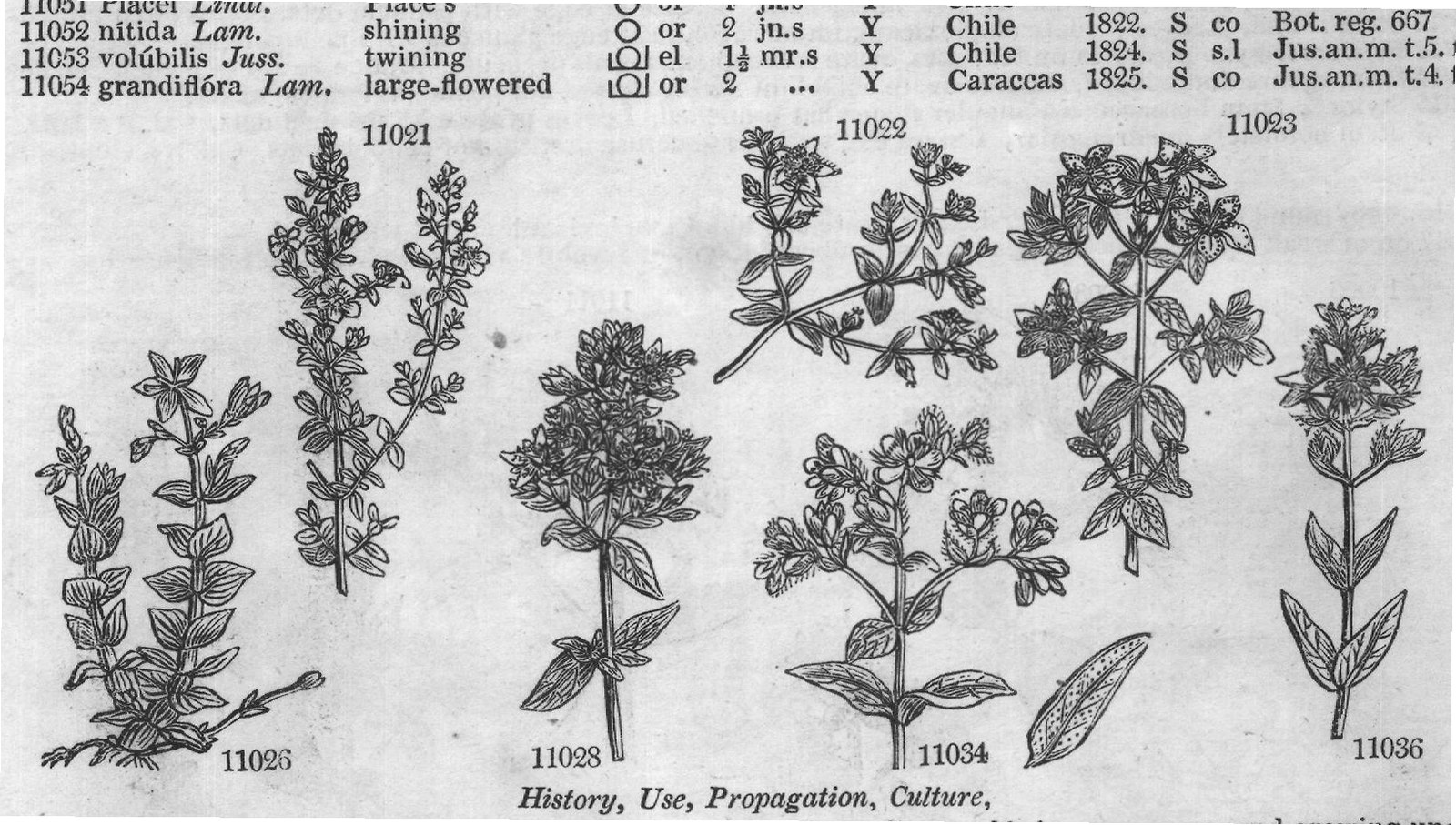
CLASS XVIII. 11018 críspum L. curl-leaved ✓ or 1 jl.au Y 11019 setósum H. K. unbranched ✓ or 1 jl.au Y 11020 heterophýllum Vent. various-leaved or 2 jl.au Y Greece 1688. C p.1 Carolina 1759. D p.l Persia Bocc. mus. t. 12 1812. D I.p 11021 ægyptíacum L.
Egyptian or 2 jn.jl Y Egypt 11022 humifúsum L. trailing or jl.au Y Britain 11023 perforátum L. perfoliate Aor 1 jl.au Y Britain 1787. C p.1 pas. D co bu.pl. D p.1 Vent. cels. t. 68 Bot. reg. 196