Home › E › Eng (Bot phleo des W)
Eng (Bot phleo des W)
bot. 1257 10839 phleoídes W.
Cats'-tail-head. un my.jl W.Y Spain 1818. S co 10840 stríctum L. upright pr my.jl W Spain 1805. S co Mic. gen. t.25.f.7 1601. LOTUS. W.
BIRD'S-FOOT TREFOIL.
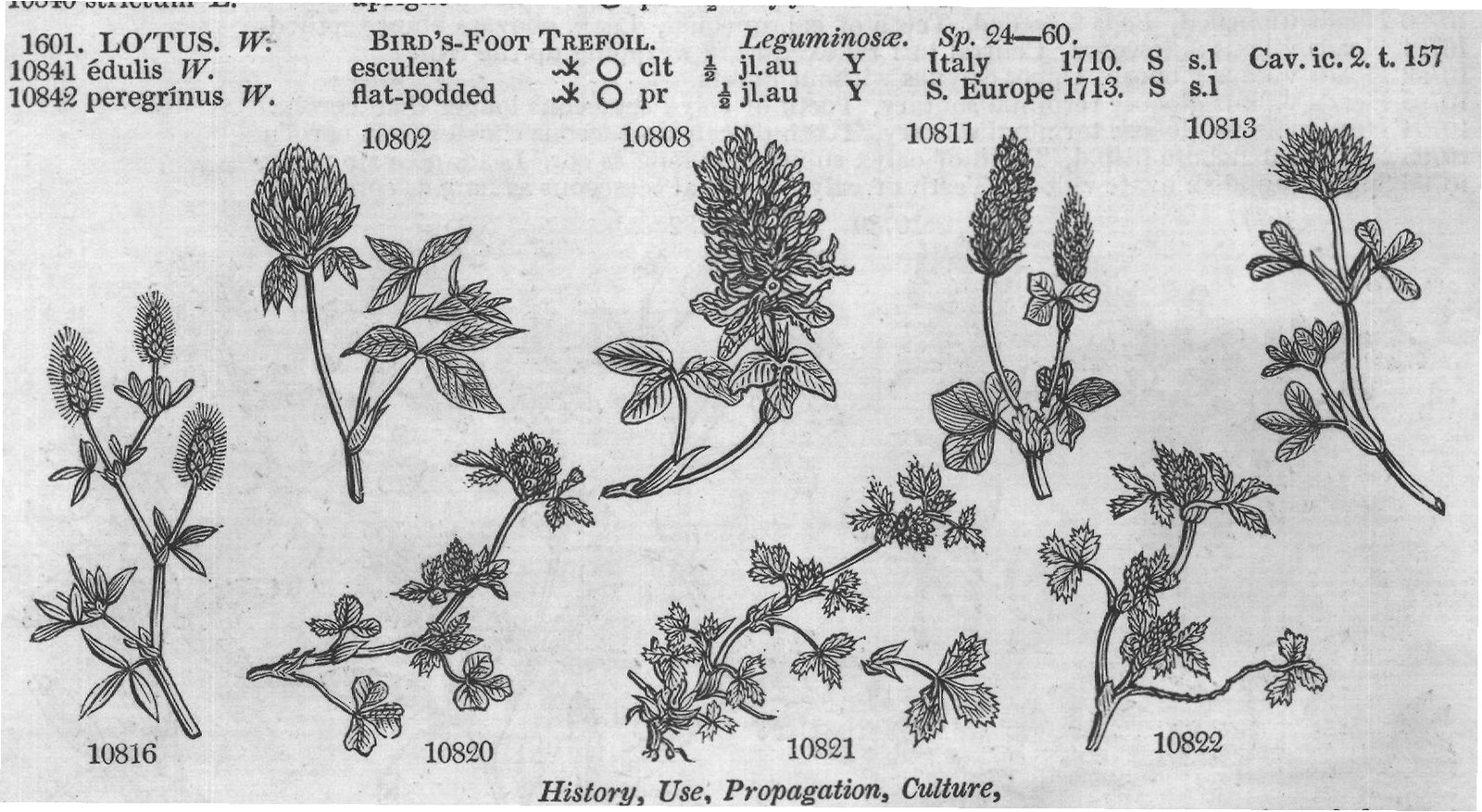
Leguminosæ. Sp. 24-60. 10841 édulis W. esculent clt jl.au Y Italy 1710. S s.l Cav. ic. 2. t. 157 10842 peregrínus W. flat-podded pr jl.au Y S. Europe 1713. S s.l 10802 10808 10811 10813 10816 10820 10821 History, Use, Propagation, Culture, 10822 The quantity of seed varies from eight to fourteen pounds per acre, according to the intention of the crop, the quantity of grass-seeds sown, &c. The after culture of clover and rye-grass consists chiefly of picking off any stones or rather hard bodies which may appear on the surface in the spring succeeding that in which it was sown, and cutting out by the roots any thistles, docks, or other large grown weeds. After this, the surface should be rolled once to smooth it for the scythe. This operation is best performed in the first dry weather of March. Some give a top-dressing of soot, gypsum, common lime, peat, or wood-ashes, at this time or earlier; gypsum has been particularly recommended as a top-dressing for clovers and the other herbage legumes, because as their ashes afford that substance in considerable quantities, it appears to be a necessary ingredient of their food.
The taking of the clover, or clover and rye-glass crop, is either by cutting green for soiling, by making into hay, or by pasturing. It is observed in The Code of Agriculture, that it is a most important point to ascertain, in what cases cutting or feeding is most beneficial. If fed, the land has the advantage of the dung and urine of the pasturing stock; but the dung being dropt in irregular quantities, and in the heat of summer, when it is devoured by insects, loses much of its utility. If the dung arising from the herbage, whether consumed in soiling, or as hay, were applied to the land in one body and at the proper season, the operation would be more effectual. The smother of a thick crop, continued for any time upon the ground, greatly tends to promote its fertility; and it has been pretty uniformly found, after repeated trials, upon soils of , upon soils of almost every description, that oats taken after clover that has been cut, either for soiling or hay, is superior to the crop taken after clover pastured by sheep.
The produce of clover-hay, without any mixture of rye-grass, on the best soils, is from two to three tons per acre, and in this state in the London market it generally sells twenty per cent. higher than meadow-hay, or ORDER IV.
DIADELPHIA DECANDRIA. 10797 Spikes term. globose hairy subsessile, Leafl. oval entire and stem densely villous 10798 Heads villous globose term. solitary, Teeth of calyx setaceous shorter than cor. Leafl. obovate entire 10799 Stem flexuose hairy, Leafl. obcord. hairy, Cal. camp. lined 10800 Leaves obovate hirsute, Heads lateral and terminal minute, Stem erect 10801 Spikes cylindr. obl. Teeth of cal. villous; lower as long as monopetalous unequal cor. 10802 Spikes dense ovate, Stipules awned, Leafl. oval nearly entire 10803 Leafl. ovate ellipt. blunt entire, Stipules awned, Spikes ovate cylindr. solitary dense 10804 Spikes lax subglobose sol. Stipules subulate, Leafl. ellipt. finely serrulate, Stems branched flexuose 10805 Spikes dense subglobose twin, Stipules setaceous, Leafl. lanc. finely serrulate, Stems quite simple 10806 Spikes ovate conical dense sol. sessile, Corolla monopetalous, Leafl. ovate blunt 10807 Spikes dense obl. ellipt. solitary, Leafl. obl. lanc, entire emarg. vill. Stem simple straight 10808 Spikes ovate lax sol. Leafl. obovate emarg. villous, Stem simple ascending 10809 Spikes subglobose dense, Leafl. obovate lanc. serrulate at end hairy 10810 Spikes obl. somewhat hairy, Lower tooth of cal. very long reflexed, Stem herbaceous erect 10811 Spikes obl, villous blunt leafless, Leafl. roundish obcordate ovate crenate villous 10812 Spikes sol. roundish, Stipules membranous, Leafl. roundish, Edge of corolla bearded inside 10813 Spikes villous elliptical, Stem erect branched downy, Leafl. obl. lower obcordate 10814 Spikes vill. conical obl. Teeth of cal. setaceous nearly equal, Leafl. linear 10815 Stem erect hairy, Leafl. linear, Calyx hairy with lanc. subulate spreading teeth 10816 Heads very hairy subcylindrical, Cal. teeth setaceous longer than the cor. Leafl. narrow obovate 10817 Spikes hairy ovate, Calyxes much spreading, Stem diffuse, Leafl. obcordate 10818 Spikes ovate, Calyxes spreading: lower tooth very large lanc. Leafl. obovate 10819 Spikes subglobose stalked, Cal. spreading: lower tooth subulate linear, Leafl. oblong 10820 Heads term. and axill. sess. ov. Cal. teeth unequal narr. lanc. rigid at length recurved, Leafl. obcor. serru. 10821 Heads round axill. sessile, Teeth of cal. equal subulate spreading rigid, Leafl, obovate serrulate 10822 Heads term, and axill. ov. subsol. subsess. Cal. striat. hairy with unequal straight teeth. Leafl. obcor. nearly 10823 Heads obl. stalked, Cal. vill.: teeth subul. unequal, Upper lvs. opp. Leafl, ellipt. toothletted [entire pubesc. 10824 Heads sessile lateral roundish smoothish, Teeth of cal. lanc. acute recurved longer than cor. 10825 Heads orbicular stalked in a round toothed involucre, Stipules awned 10826 Heads ovate, Cal. in fruit ovate ventricose smooth, Comm. involucre membranous 5-leaved 10827 Heads roundish, Cor. resupinate, Cal. of fruit inflated membranous downy, Leafl. obovate acute 10828 Heads ov. obl. Cal. of fruit inflated naked, Branches recurved, Leafl. setaceous serrulate 10829 Heads round, Cal. of fruit inflated membranous downy, Teeth obliterated [creep. Leafl. obcord. serrated 10830 Heads upon long stalks round. Cal. after flow. inflat. membran. pubesc.: two of teeth setaceous reflex. Stems 10831 Spikes about 3 somewhat imbricated, Standard subulate withering, Cal. naked [upwards 10832 Spikes round imbr. Standard deflexed persistent, Leafl, obcord. serrate, Stem hirsute 10833 Spikes oval imbr. Vexillum deflexed persistent, Leafl. obovate: intermediate sessile 10834 Spikes obl. with reflexed flowers, Standard roundish flat toothletted persistent, Stem flexuose 10835 Spikes oval imbr. Standard deflexed persistent, Teeth of cal. subulate unequal smooth 10836 Spikes oval imbr. Standard deflexed persistent sulcated, Stems procumbent, Leafl. obovate 10837 Spikes capit. hemisphærical, Pedunc. straight, Standards smoothish, Stems procumb. Petiole lengthened 10838 Heads lax of few-fl. Pedunc. capillary flexuose, Standards smooth, Stems procumb. Leafl. subsessile 10839 Heads obl. Cal. teeth subulate unequal rigid spreading, Leafl. obl. nearly entire emarg. 10840 Heads ellipt. Pods 2-seeded, Cal. length of cor. Leafl. lanc. blunt serrulate 10841 Pods subsolitary gibbous incurved 10842 Pods subbinate compressed lin. cernuous, Leafl, obovate hairy, Stem procumbent 10836 10824 10837 10830 10828 10835 10841 10832 and Miscellaneous Particulars. clover and rye-grass mixed. The weight of hay from clover and rye-grass varies according to the soil and the season, from one to three tons per English acre, as it is taken from the tramp-ricks; but after being stacked, and kept till spring, the weight is found to be diminished twenty-five or thirty per cent. The value of clover and rye-grass hay, in comparison with the straw of beans or pease, may be in the proportion of three to two; and with the finest straw of corn crops, in the proportion of two to one. One acre of red or broad clover will go as far in feeding horses or black cattle, as three or four of natural grass. And when it is cut occasionally, and given to them fresh, it will probably go still much farther, as no part of it is lost by being trod down.
The saving of clover seed is attended by considerable labor and difficulty. Clover will not perfect its seeds, if saved for that purpose early in the year; therefore it is necessary to take off the first growth either by feeding or with the scythe, and to depend for the seed on those heads that are produced in the autumn. The produce in seed may generally be from three to four or five bushels per acre, when perfectly clean, weighing from two to three hundred weight. But there is great uncertainty in the produce of clover-seed, from the lateness of the season at which it becomes ripe; and the fertility of the soil is considerably impaired by such a crop. Yet the high value of the seed is a great inducement to the saving of it, in favorable situations.
T. incarnatum is sometimes sown as a border flower. 1601. Lotus. Λωτoς, in Greek. There were three sorts of Lotus distinguished by the ancients; viz. their tree lotus, which was our Zizyphus lotus; the marsh lotus, which was our Nymphæa lotus; and the herbaceous lotus, which appears to have been the present genus. The pods of L. edulis are still eaten in Candia, by the poorer inhabitants. Lotus rectus has by some been Tt2 10847 diffúsus W. 10848 coimbrénsis W. 10843 glaúcus W. 10844 anthylloídes V. 10845 angustíssimus W. 10846 gracilis W. & K.
DIADELPHIA DECANDRIA. glaucous Anthyllis-like narrow-podded slender slender-podded Portugal CLASS XVII. pr 1 jn.au Y Madeira 1777. C s.l pr jn.au Y C. G. H. 1812. S s.l Vent.malm. t.92 pr 1 jl.au Y France 1683. S s.l Bauh. hist. 2. f.2 pr 1 jl.au Y Hungary pr 1½ my jn Y Oprjn.jl W 10849 arábicus W. red-flowered pr jl.s Pk 10850 austrális H. K.
New Holland ☐ el 2 my.s Pk 10851 Dioscóridis W.
Dioscorides's pr 1 jn.jl Y 10852 ornithopodioídes W. claw-podded pr jn.au Y 10853 jacobæ'us W. dark-flowered or 2 ja.d ẞ lúteus yellow-flowered 10854 créticus W. silver-leaved pr1 jn.s Y 10855 ténuis W. & K. slender Apr 1 jn.au Y 10856 hirsútus W. hairy pr 2 jn.au W 10857 réctus W. upright 10858 odorátus H. K.
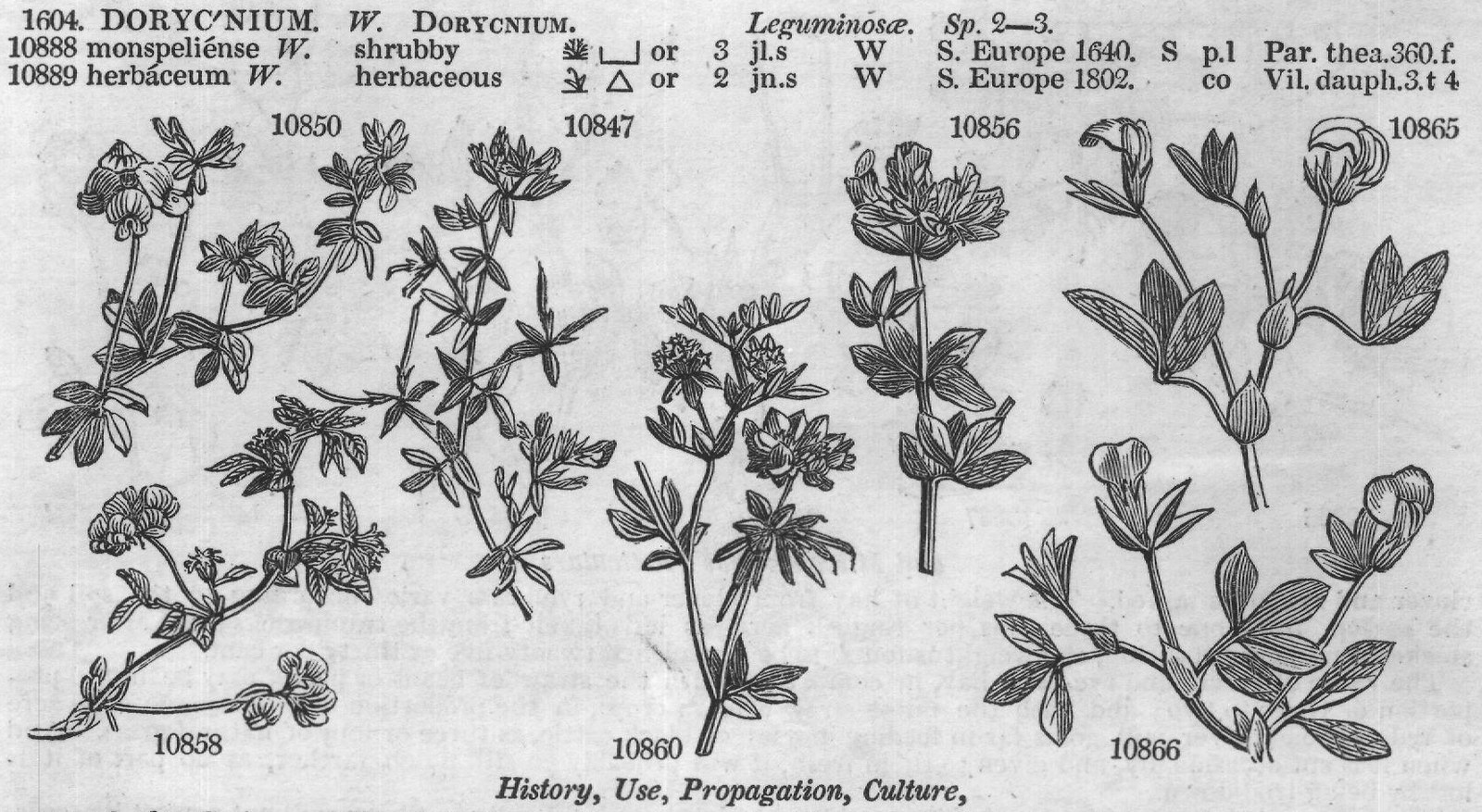
A pr 3 jn.au F sweet-scented ft 1 jn.au Y 10859 pedunculátus W. long-peduncled pr 1 jn.au Y 10860 májor E. B. greater ag 1 jn.au Y 10861 corniculátus E. B. common ag 12 jn.au Y 10862 cytisoídes W. downy pr 1 jl.au Y 10863 parviflórus Desf. small-flowered un 1 jl.au Y 10864 Gebélia Vent.
Aleppo ed 1 my.jn Pk Aleppo ...
England rocks. S s.l Portugal 1800. S s.l Arabia 1773. S s.l N. S. W. 1803. S s.p Crete 1658. S s.l Sicily 1683. S s.l D.Br C. Verd. Is.1714. Cr.m Levant 1680. C p.l Hungary 1816. D p.l S. Europe 1683. C p.l S. Europe 1640. D co Barbary 1804. D s.l Spain 1814. D s.l Britain w.sh.g. Ds.l Britain pas. Dco S. Europe 1752. D co Barbary 1810. S co Jac. vind. 2.t:155 Bot. mag. 1365 Al.ped. 1.t.59.f.1 Cav. ic. 2. t. 163 Bot. mag. 79 Cav. ic. 2. t. 156 Waldst. & Kit.t.
Bot. mag. 336 Mor. s.2.t. 18.f.13 Bot. mag. 1233 Cav. ic. 2. t. 164