Female
Style 1. Stigmas 2. Drupe with an arilled 1-seeded nut. Seed large, veiny, variegated in the inside. 2121. Nepenthes. Cal. 4-parted, spreading, colored inside. Cor. O. Filament columnar. Anthers 15-17, connate. Stigma peltate, sessile. Caps. 4-celled, many-seeded. 2122. Cluytia. Male. Cal. 5-leaved. Petals 5. Disk glandular. Stamens 5, inserted into the rudiment of an ovarium. Female. Styles 3. Capsule 3-celled. Seed 1. 3G2 DICECIA MONANDRIA.
Pandaneæ. Sp.7-25.
CLASS XXII. 2041. PANDA'NUS. W. SCREW-PINE. 13683 odoratíssimus W. green-spined or 20 W 13684 útilis W.en. red-spined or 20 W E. Indies 1771. Sr.m Rox.cor.1. t.94-6 Bourbon ...
Sr.m Ja.fra. t. 13,14.f.1 13685 spirális R. Br. spiral or 20 W ... 13686 húmilis W. dwarf or 8 W N. S. W. 1805. S r.m Mauritius ... ...
Sr.m Jac.frag. t. 14. f.2 13687 amaryllifólius Roxb. entire-leaved or 20 ... W E. Indies 1820. Sr.m 13688 candelábrum Beauv. Candlestick or 15 W ...
Guinea 1822. S r.m Fl. d'Oware, t.21 13689 fasciculáris W. fascicled or 20 W E. Indies 1822. S r.m Rheede. 2. t. 6 ...
DIANDRIA. 2042. SA'LIX. W.
WILLOW.
Amentaceæ.
Sp. 125-163. 13690 triándra W. long-leaved tm 30 my.au Ap Britain riv.ba. C m.s Eng. bot. 1435 13691 lanceoláta sharp-leaved tm 30 ap.my Ap England mea. Cm.s Eng. bot. 1436 13692 Hoppeána W.
Hoppe's Y tm 30 ap.my Ap Austria 1820. C m.s 13693 unduláta W. wave-leaved tm 30 ap.my Ap 13694 Villarsiána W.
Villars's or 6 ap.my Ap Germany Cm.s ...
S. France 1818. C m.s 13695 amygdalína W.
Almond-leaved or 6 ap.my Ap Britain mar. Cm.s Eng. bot. 1936 13696 decípiens E. B. varnished 13697 Russelliána W.
Bedford or 8 my Ap tm 40 ap.my Ap 13698 Humboldtiána W. Humboldt's or 10 ...
Ap England woods. C m.s Eng. bot. 1937 England mar. C m.s Eng. bot. 1808 Peru 1823. Cm.s 13699 tetraspérma W. four-seeded 오 or 20 ...
Ap E. Indies 1796. C 11.3 Rox. cor. 1. t. 97 13700 nígra W. black Y or 20 my Ap N. Amer. 1811. C m.s An.bot.2. t.5. f.5 13701 pentándra W.
Bay-leaved or 15 mr.jn Ap 13702 nigricans W. dark broad-lvd. 13703 phylicifólia W.
Tea-leaved or 10 ap Ap or 1½ my Ap Britain riv.ba. Cm.s Eng. bot. 1805 England os.hol. C m.s Eng. bot. 1213 Scotland sc.alp. C. m.s Eng. bot. 1958 13704 Wulfeniána W.
Wulfen's or 6 my Ap Carinthia 1818. C m.s 13705 silesíaca, W.
Silesian or 6 my Ap Silesia 1816. Cm.s 13706 Pontederána W.
Pontedera's or 3 my Ap Switzerl. 1821. C m.s 13707 laurína W. two-colored or 13708 tenuifólia W. thin-leaved 8 ap.my Ap or 2 my.jn Ap England ...
Cm.s Eng. bot. 1806 Ap Britain 13709 Ammanniána W. Ammann's or 20 my.jn Ap sto.hi. C m.s Eng. bot. 2186 Austria 1821. Cm.s H. sal. t. 17,18,19 13710 hastáta W. halbert-leaved or 15 my Ap 13711 serruláta W. serrulate or 8 my Ap Lapland 1780. C m.s Fl. lapp. t. 8. f. g Lapland 1810. C m.s Fl. dan. t. 1238 13683 13691 13686 13689 13684 History, Use, Propagation, Culture, 13690 2041. Pandanus. The Malay name of the genus is Pandang, which is said to signify, being interpreted, something to be regarded, and to have been so named on account of the beauty of the tree, and its exquisite odor. P. odoratissimus is a large spreading branching bush, with stem-clasping imbricated leaves, bearing some resemblance to those of the pine-apple; from three to five feet long, and placed in three spiral rows round the extremities of the branches. It grows in all soils and situations in the warmer parts of Asia, and is much employed there for hedges. It grows readily from branches, whence it is rare to find the full-grown ripe fruit. The tender white leaves of the flowers, chiefly those of the male, yield that most delightful fragrance, for which they are so generally esteemed, and for which the plant is cultivated in Japan. Of all the perfumes, it is by far the richest and most powerful. The lower pulpy part of the drupe is sometimes eaten by the natives in times of scarcity and famine. The tender white base of the leaves is also eaten raw or boiled, at such times of scarcity and famine. The tender white base of the leaves is also eaten raw or boiled, at such melancholy times. The taste of the pulpy part of the drupe is very disagreeable. The roots are composed of tough fibres, which basket-makers use to tie their work with; they are so soft and spongy as to serve the natives for corks. The leaves are composed of longitudinal, tough, useful fibres. In the South Sea Islands, where the Pandanus is also a native, this or some other species or variety is used for making mats. The leaves are beautifully white and glossy. In the Sandwich islands these mats are handsomely worked in ORDER I.
DIECIA MONANDRIA. 13683 Leaves at back and edges spiny-toothed, Fruit globose solitary 13684 Leaves at back and edges spiny-toothed, Fruit globose, Branches ternate dichotomous 13685 Stem without stolones, Clust. of drupes with from 9 to 20 cells obtuse depressed and tessellate at end 13686 Leaves at back and edges spiny-toothed, Fruit globose aggregated 13687 Leaves quite entire 13688 Leaves at edge and back serrate-spiny, Branches of stem erect 13689 Leaves and edges spiny-toothed, Spines distant, Drupe oblong solitary, Fruits fascicled DIANDRIA. 1. Leaves smooth-serrated. 13690 Leaves lin. obl. serr. smooth rather unequally sloping at base, Catkins accompanying the leaves triandrous, Ovary stalked ovate compressed smooth, Stigma nearly sessile 13691 Leaves lanceolate tapering ring toward each end serrat. smooth Footst. decurr. Catk, accompanying the leaves triandrous, Ovary stalked oblong constricted smooth 13692 Leaves lanceolate tapering at each end serrated glaucous beneath, Catkins accompanying the leaves triandrous polygamous, Ovary stalked oblong lanceolate smooth, Stigmas sessile 13693 Leaves lanceolate pointed obtuse at the base smooth wavy and serrated, Footstalks decurrent, Catkins accompanying the leaves triandrous, Ovary stalked elliptic oblong, Style blong, Style elongated aucous white beneath, Catkins accompanying 13694 Leaves elliptical roundish at the base serrated pointed glaucous white beneath, Catkins accompanying the leaves triandrous, Ovary stalked ovate smooth, Stigmas sessile 13695 Leaves ovate unequal at the base serrated smooth, Catkins accompanying the leaves triandrous, Ovary stalked ovate compressed smooth, Stigmas nearly sessile, Young branches furrowed 13696 Lvs. lanc. serrate quite smooth, Petioles somew. glandular, Ovary narrowed stalked, Branches varnished 13697 Leaves lanceolate acuminate serrated smooth, Ovaries pedicellate subulate smooth 13698 Lvs. lin. pointed finely serrat. smooth, Stam. about 6, Ovary stalked round.-ovate smooth, Stigmas sessile 13699 Leaves elliptic-lanceolate pointed finely serrated smooth glaucous beneath, Catkins following the leaves, Stamens about 6 deflexed, Ovary stalked ovate smooth, Style elongated 13700 Leaves ovato-lanc. pointed serrated green on both sides smooth with a downy rib and footst. Catkins accompanying the leaves vill. Stam. about 5 bearded at base, Ovary stalked ov. lanc. smooth, Stigm. divid. 13701 Leaves elliptic-lanceolate or ovate pointed crenate glandular smooth, Footstalks glandular at the top, Catkins following the leaves, Stam. 5 or more hairy, Ovary ovate smooth nearly sessile 13702 Leaves ellipt. lanc. acute cren. smooth glaucous beneath, Catkins before leaves, Ovary stalked lanc. downy 13703 Leaves elliptical lanceolate with wavy serratures smooth glaucous beneath, Stipules somewhat lunate glandular on the inside, Ovary stalked siłky, Style longer than the stigma 13704 Leaves obovate bluntish serrated smooth glaucous beneath, Catkins dense with fringed scales, Ovary 13705 Leaves elliptical acute at each end smooth serrat. green on both sides: midrib footstalks as well as young stalked awl-shaped nearly smooth, Style longer than the stigmas foliage downy, Catkins before the leaves, Ovary ovato-lanceolate long stalked smooth foliage hairy, Ovary oblong downy 13706 Leaves elliptical acute serrated smooth obtuse at base glaucous beneath: midrib footstalk as well as young 13707 Leaves elliptical acute tooth-serrated smoothish glaucous beneath, Ovary lanceolate silky 13708 Lvs. ellipt. acute serrat. smoothish glaucous ben. Stip. small or none, Catk. hairy, Caps. sess. very smooth 13709 Leaves oblong elliptical acute serrated smooth glaucous beneath, Footstalks elongated downy, Stipules ovate toothed permanent, Catkins before the leaves, Ovary lanceolate smooth 13710 Lvs. ovate acute serrated undulate crackling smooth heart-shaped at the base glaucous beneath, Stipules unequally heart-shaped longer than the broad footstalks, Catkins very woolly, Ovary lanc. smooth 13711 Lvs. ovate acute serrated smooth glaucous beneath, Footstalks very short smooth, Stipules ovate serrated permanent, Catkins accompanying the leaves, Óvary lanceolate nearly sessile 13695 13703 13710 13697 13707 13701 13702 13699 and Miscellaneous Particulars. a variety of patterns, and stained of different colors. The branches being of a soft spongy juicy nature, cattle will eat them very well when cut into small pieces. They call it Wharra tree at Otaheite. (Hawksw. Voy. ii. 217.) 2042. Salix. From the Celtic sal, near, and lis, water. Our common name osier, seems to be a slight alteration of the Greek oiσia, which means the same thing. This is a numerous and difficult genus of trees and shrubs, with one or two exceptions limited in their range to the temperate regions of Europe and America. Many of the species are distinguished by such delicate shades, that only the most acute botanists can recognize them. Soil, situation, and climate produce so considerable a change in their appearance, as to render it difficult to determine what are species and what varieties. Those species which attain a timber size, are chiefly valued for the rapidity of their growth; they produce a great bulk of trunk and lop in a short time, and the bark of most of the species has recently been used in tanning; being, at an average of sorts, about half as valuable as that of the oak. S. alba is considered the most valuable timber tree of the genus; it has a branching stem, and tapering flame-shaped head. It may be seen pollarded by way-sides in most parts of Europe, in which state it is very productive of poles, fence wood, crate ware, fuel, and bark for the tanner, which is considered nearly as good as that of the oak. A variety of this species, called by Pontey, the red 3G3 DIECIA DIANDRIA.
CLASS XXII. 13712 prinoídes Ph.
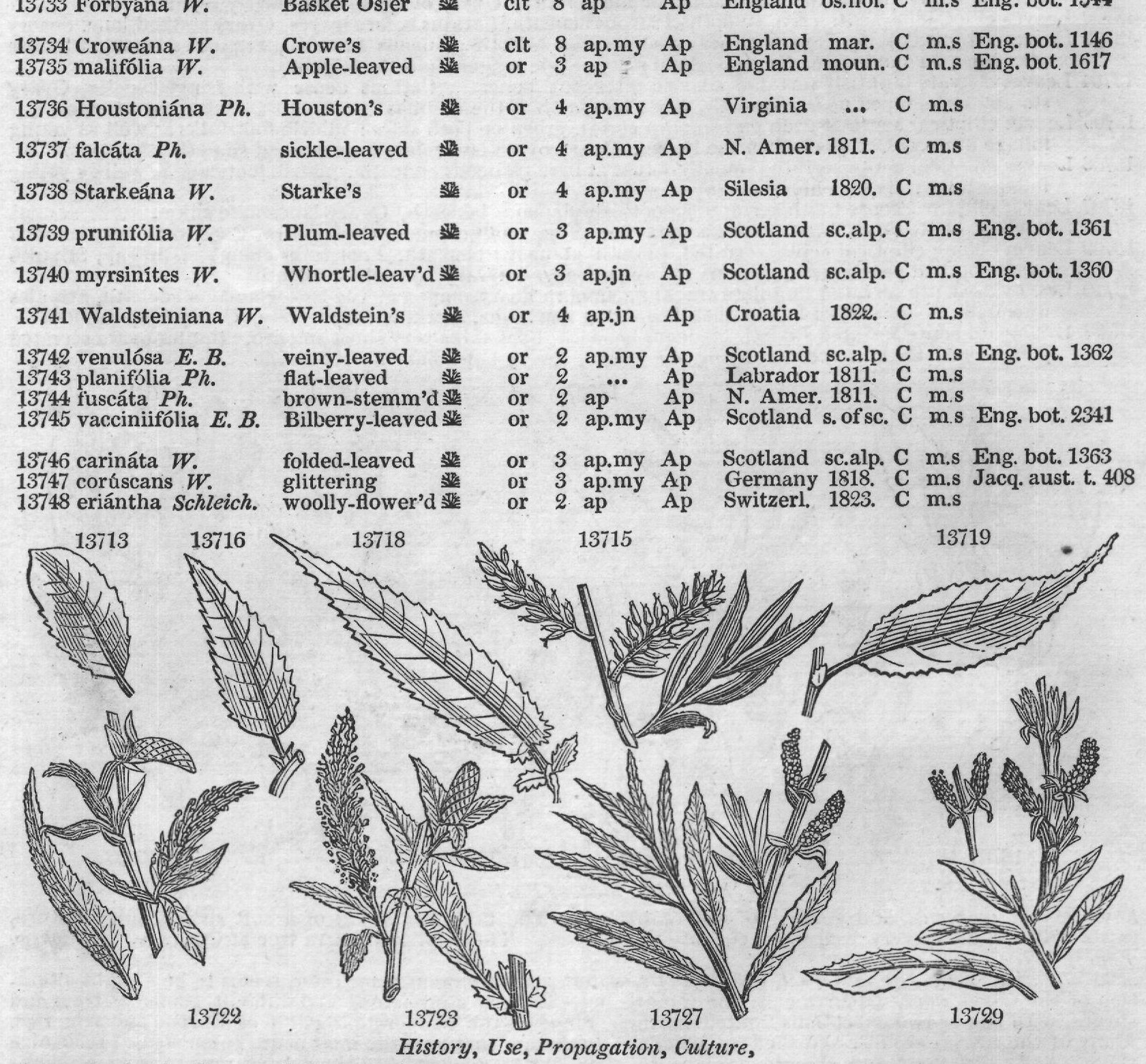
Prinos-like or 10 mr.ap Ap N. Amer. 1811. C m.s 13713 díscolor W. brown-branch. or 8 ap N. Amer. 1811. C m.s Ann.bot.2.t.5.f.1 13714 angustáta Ph. narrow-leaved or 10 mr.ap Ap Pensylv. 1811. C m.s 13715 petioláris W. dark long-leav. or 10 ap Ap England mar. C m.s Eng. bot. 1147 13716 myricoídes W.
Gale-like or or 8 ap Ap N. Amer. 1811. C m.s Ann.bot.2.t.5.f2 13717 cordáta W. heart-leaved 业 or 6 ap.my Ap N. Amer. 1811. C m.s Ann.bot.2.t.5.f.8 13718 rígida W. rigid or 15 ap.my Ap N. Amer. 1811. C m.s Ann.bot.2.t.5.f.4 13719 lúcida W. shining or 8 my Ap N. Amer. 1811. Cm.s Ann.bot.2.t.5.f.7 13720 ambígua Psh. doubtful 1 or 20 ap Ap N. Amer. 1821. Cm.s 13721 acutifólia W. sharp-leaved or 8 ap Ap Casp. Sea 1823. C m.s 13722 vitellína W. yellow-branch. clt 15 mr.my Ap England mar. C m.s Eng. bot. 1389 13723 frágilis W. cracking or 15 ap.my Ap Britain mar. Cm.s Eng. bot. 1807 13724 præ'cox W. early Y or 20 ap.my Ap Austria 1820. C m.s 13725 Meyeriána W.
Meyer's * or 20 ap.my Ap Germany 1822. C m.s 13726 babylónica W weeping el 30 my Ap Levant 1692. Cm.s Rauw.it. 183.t.25 13727 purpúrea W. bitter purple 8 mr Ap 13728 pomeránica W.en.
Pomeranian or 10 my Ap England mar. C m.s Eng. bot. 1388 Pomeran. 1822. C m.s 13729 Hélix W.
Rose or 10 mr.ap Ap Britain mar. Cm.s Eng. bot. 1343 13730 Lambertiána W.
Boyton clt 10 mr.ap Ap England riv.ba. C m.s Eng. bot. 1359 13731 tetrapla Link. pretty or 4 mr.ap Ap .. 1825. Cm.s 13732 rúbra W.
Green Osier clt 8 ap.my Ap England os.hol. C m.s Eng. bot. 1145 13733 Forbyána W.
Basket Osier业 clt 8 ap Ap England os.hol. C m.s Eng. bot. 1344 13734 Croweána W.
Crowe's clt 8 ap.my Ap England mar. C m.s Eng. bot. 1146 13735 malifólia W.
Apple-leaved or 3 ap Ap England moun. C m.s Eng. bot. 1617 13736 Houstoniána Ph. Houston's or 4 ap.my Ap Virginia ...
Cm.s 13737 falcáta Ph. sickle-leaved or 4 ap.my Ap N. Amer. 1811. C m.s 13738 Starkeána W.
Starke's or 4 ap.my Ap Silesia 1820. Cm.s 13739 prunifólia W.
Plum-leaved or 3 ap.my Ap Scotland sc.alp. C m.s Eng. bot. 1361 13740 myrsinítes W.
Whortle-leav'd or 3 ap.jn Ap Scotland sc.alp. C m.s Eng. bot. 1360 13741 Waldsteiniana W. Waldstein's or 4 ap.jn Ap Croatia 1822. C m.s 13742 venulósa E. B. 13743 planifólia Ph. veiny-leaved flat-leaved or or 2 2 ap.my Ap Scotland sc.alp. C m.s Eng. bot. 1362 Ap Labrador 1811. C m.s 13744 fuscáta Ph. brown-stemm'd ... or 2 ap Ap N. Amer. 1811. C m.s 13745 vacciniifólia E. B. Bilberry-leaved or 2 ap.my Ap 13746 carináta W. folded-leaved or 3 ap.my Ap 13747 corúscans W. glittering 13748 eriántha Schleich. woolly-flower'd 13713 13716 or 13718 or 3 ap.my Ap 2 ap Ap 13715 Scotland s. of sc. C m.s Eng. bot. 2341 Scotland sc.alp. C m.s Eng. bot. 1363 Germany 1818. C m.s Jacq. aust. t. 408 Switzerl. 1823. C m.s 13719 13722 13723 13727 13729 History, Use, Propagation, Culture, twigged upland willow, and the S. Russelliana, are considered the two next best species of the tree kind, and indeed, greatly resemble each other.
The best willows for hoops and basket work are S. viminalis, stipularis, rubra, Forbyana, triandra, mollissima, and vitellina. S. triandra is the most common, and is grown both for basket work and hoops. S. Forbyana is the best for the finer sorts of basket work. S. stipularis is the species commonly cultivated in Holland for hoops and rods. S. purpurea is one of the toughest of willows, and the extreme bitterness of the leaves and twigs renders it valuable for the tanner, for withs and basket work, not being liable to be eaten by vermin, and for hedges which cattle will not brouse on. In bands for thatching, Linnæus says, it lasts above ORDER II.
DIECIA DIANDRIA. 13712 Lvs oval-obl. acute with distant wavy serratures smooth glauc. ben. Stipules heart-shaped deeply toothed, Catkins villous before the leaves, Ovary stalked ovate pointed silky, Style elongated, Stigma cloven 13713 Leaves ovato-lanceolate smooth bluntly serrated glaucous beneath, Catkins before the leaves, Scales short rounded hairy, Ovary awl-shaped silky on a stalk thrice the length of the scale 13714 Lvs. lanc. acute very long gradually tapering at base finely serrated quite smooth scarcely paler beneath,