Fir-woods Musc
brit. t. 22 Sp. 3.
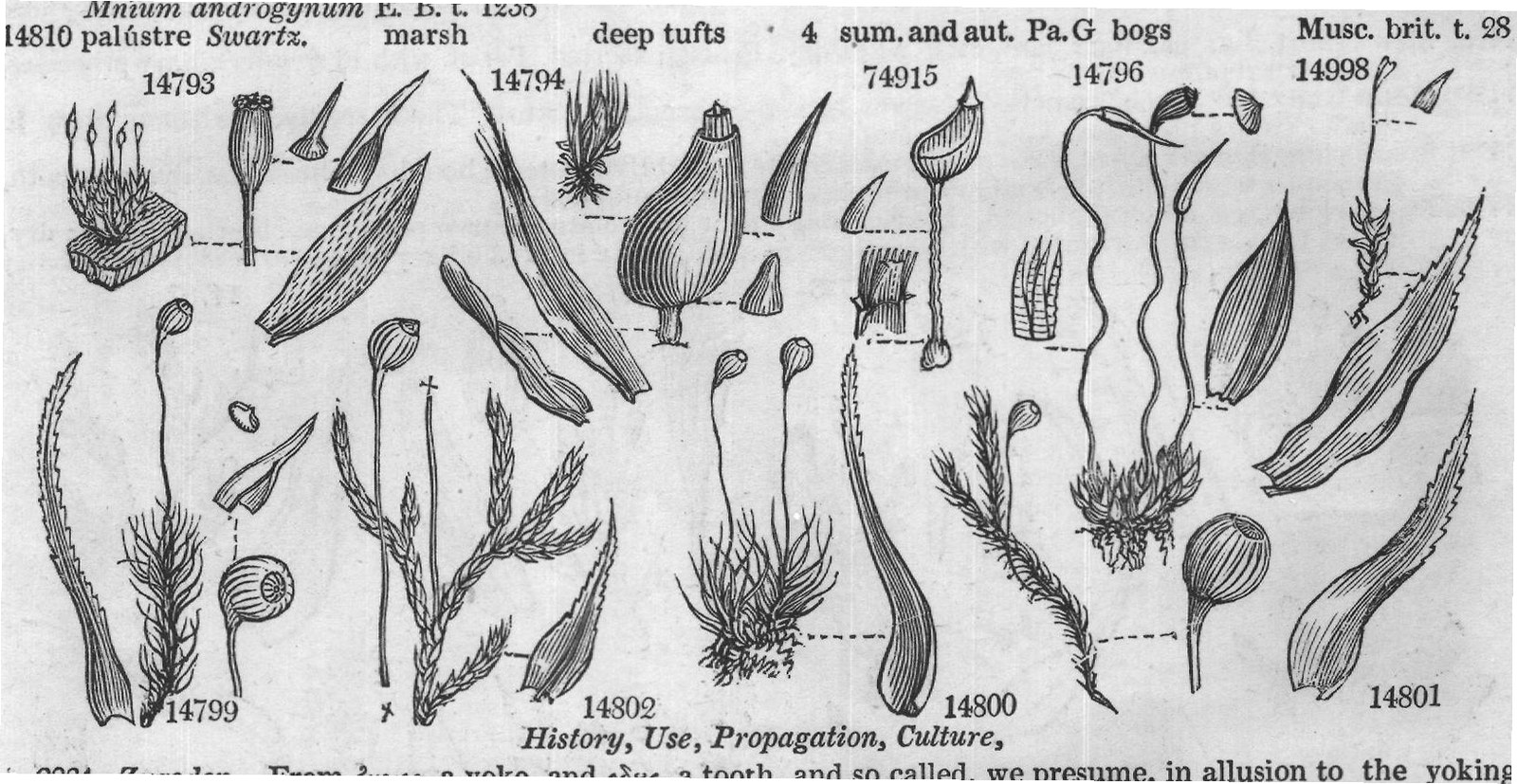
Buxbaumia foliosa E. B. t. 329 2236. BUXBAU'MIA. L. BUXBAUMIA. 14796 hygrométrica Hedw. Hygrometrical tufts 14797 Muhlenbérgii Turn. Muhlenberg's tufts 14798 hibérnica Hook.
Irish 2238. BARTRA'MIA. Hedw. BARTRAMIA. 14799 pomifórmis Hedw. a minor Hooker ẞ májor Hooker 14800 ithyphýlla Brid. 14801 grácilis Flærke 14802 fontána Swz. a májor Hooker Brýum fontánum E. B. t. 390 1½ winter spring spring Sp. 6-11.
Pa.G everywhere Musc. brit. t. 20 Pa. G rocks Musc. brit. t. 20 Pa. G cottage roofs Musc. brit. t. 20 Bt. G heaths Bt. G heaths Bt. G alp. heaths Bt. G dry banks Dp. G alpine rocks Musc. brit. t. 23 Eng. bot. 998 E. b. 1526. B.cris.
Musc. brit. t. 23 Musc. brit. t. 23 Musc. brit. t. 23 Dill.mus.t.44.f.2 2 summer 1½ summer 2 summer 1 summer 3 summer Bt. G wet places 6 summer Bt. G wet places A márchica Swz. dwarf tufts 1 summer Bt. G wet places Eng. bot. t. 2074 14803 Halleriána Hedw.
Haller's deep patches 6 sum. and aut. Bt. G moun. rocks 14804 arcuáta Brid. arcuate loose tufts 4 sum. and aut, Bt. G mountains Musc. brit. t. 23 Musc. brit. t. 23 2239. POH'LIA. Hedw.
POHLIA.
Sp. 4-13. 14805 inclináta Schwægr. inclined thin tufts 2 summer Pa.G wet sandy pl. Musc. brit. t. 29 Brýum turbinátum E. B. 1572 Brýum nígricans E. B. 1528 14806 elongáta Hedw. long subsolitary 1½ summer Bt. G mountains Musc. brit. t. 30 Brýum elongátum E. B. t. 1663 14807 cæspitícia Schw. tufted patches 1 all seasons Bt. G everywhere Musc. brit. t. 29 a major Hooker large patches 1½ all seasons Bt. G everywhere Eng. bot. t. 1904 ẞ minor Hooker small patches 1 all seasons Bt. G everywhere Eng. bot. t. 1601 Br. bícolor Eng. Bot. 14808 ventricósa Schw. ventricose deep tufts 4 spr. and sum. Br mar. ground Musc. brit. t. 30 Brýum ventricósum E. B. t. 2270 Brýum bímum E. B. t. 1518 Brýum cubitále E. B. t. 2554 2240. BRY'UM. Hedw. BRYUM.
Sp. 22-43. 14809 andrógynum Hedw. androgynous Mnium andrógynum E. B. t. 1238 patches 1 spring Y.G wo. and ban. Musc. brit. t. 28 14810 palústre Swartz. marsh deep tufts 14793 14794 74915 4 sum. and aut. Pa. G bogs 14796 Musc. brit. t. 28 14998 14799 14802 14800 History, Use, Propagation, Culture, 14801 2234. Zygodon. From ζuγoς, a yoke, and oδες, a tooth, and so called, we presume, in allusion to the yoking together by pairs of the outer teeth ; but the name is unexplained by its authors. A singular plant, which was referred to Bryum by Dickson, and to Mnium by Smith. The stems grow in a tufted manner like Gymnostomum viridissimum, but rarely exceed half an inch in length. The peristome is double; the outer consisting of sixteen short obtuse teeth approaching in pairs, which at length become recurved; inner of as many alternate ciliæ lying horizontally over the mouth of the theca. 2235. Diphyscium. From dis, twice, and φuσκiov, a vesicle, in allusion to the double nature of the shell of the theca. A little plant found in woods, and on rocks in alpine situations. The stems are exceedingly short, and grow in densely matted patches. The theca is large, ovate, gibbous, and oblique. Dr. Hooker denies the existence of a double peristome, while Hornschuch asserts its presence. 2236. Buxbaumia. A very singular plant, destitute of apparent leaves, and resembling a minute fungus rather than a moss. It was named in honor of John Christian Buxbaum, a German botanist, who published, in 1728, an account of the plants of Asia Minor in five centuriæ of figures of little merit.. This plant was originally discovered in the vicinity of Astrachan, afterwards in a fir-wood near Norwich, and lately in two stations in Scotland. Its minute size and want of foliage may have caused it to be overlooked 2237. Funaria. From funis, a rope, in allusion to the twisted nature of the strongly hygrometrical fruitstalk. This genus, though sufficiently characterized by the interior teeth or ciliæ being oblique and placed ORD. V. TRIBE II. MUSCI VAGINULATI OLOCARPI. 14793 The only species 14794 The only species 14795 The only species 14796 Leaves very concave ovate apiculate entire, Nerve excurrent, Fruitstalk curved flexuose 14797 Stems short, Lvs. conc. ov. suddenly acuminat. serrat.: the nerve disappear. below point,