Populus
(the ancient Latin name = palpulus, akin to palpitare, to tremble; probably so called from its trembling leaves). Poplar. ORD. Salicineae. A well-known genus of hardy, deciduous trees, with terete or angular branchlets, and having scaly buds, covered with resin; eighteen species have been described, natives of Europe, Central or mountainous and Northern Asia, and North America, including Mexico. Catkins loose, appearing before the leaves, the males often pendulous; flowers of both sexes usually shortly pedicellate, the females some-times on an elongated pedicel, racemiform. Leaves alternate, sometimes on laterally compressed, tremulous petioles, usually broad, penniveined, and trinerved at the base, entire, toothed or lobed; stipules narrow, membranous, fugacious. Some of the Poplars are amongst the most rapid growers of all hardy forest-trees. They thrive under a variety of conditions as regards soil, &c., but do best in damp situations, such as along watercourses, &c. All are readily increased from cuttings, inserted in the open ground; soon after the leaves have fallen is the best time to do this. The weeping forms are generally grafted on tall, straight stems of the common upright-growing ones.
Fungi. Many kinds of Fungi live on dead branches and stems of Poplars, and a good many also on living parts; but the only one of the latter that is usually very noticeable in gardens is that known as Exoascus aureus (Taphrina aurea). This Fungus produces very conspicuous spots on the leaves of Populus nigra. These spots bulge on one surface, usually the upper, so as to appear almost hemispherical, and may be from 1/4in. across up to a much larger size, when two or more fuse together. The spots are usually duller green above, bright golden-yellow below; but sometimes the yellow colour is on the upper surface. The microscope shows that the colour is due to a layer of rather long cells, fixed to the surface cells of the leaf by one end, but free in the rest of their length. Each is full of a large number of small, round cells or spores, which escape by bursting the wall of the containing cell. When abundant, this Fungus is very conspicuous from its colour, and is very hurtful to the young trees, which it chiefly affects.
The best remedy is the removal and destruction of the leaves, or of the branches, and even the whole trees if much infested, as soon as the Fungus appears. Perhaps the application of solutions of potassium sulphide or potassium permanganate might destroy the Fungus.
Insect Pests. Poplars are liable to the ravages of a considerable variety of insects, mostly beetles and moths. A number of them are described elsewhere, and these species are merely mentioned here, the reader being referred to the fuller information given under the headings quoted. The wood of the trunks is bored into by the Poplar Hornet Clearwing Moth (Sesia apiformis, see Fig. 251), the larvae of which live for about two years in the trees. See Sesia. The larvae of the Goat Moth (which see) are even more destructive. The young branches and the twigs are bored into by the larvae of certain beetles of the genus Saperda. The insects are rather slender, and nearly cylindrical, and of the general form shown in Fig. 252. S. carcharias is about 5/6in. to 1 1/4in. long, dusky-black, with grey or yellow pubescence, and rather long antennae ringed with grey and black; the wing-cases are narrowed towards the tips. S. populnea is about 1/2in. long, black, slightly hairy, and marked with pits over the surface; the thorax bears three yellowish lines; the wing-cases are not narrower behind; they are covered with a yellowish pile, and bear three or four large, yellowish spots; the antennae are ringed with ashy-grey and black. The larvae of this species live in gall-like swellings in the branches (see Fig. 252) of Poplars and of Willows. There are a few other species of Saperda, but they do not call for special mention. Branches tenanted by the larvae (shown by their galled or withered state) should be cut off; this is usually sufficient to kill the larvae, but it is well to have the branches burned. The leaves are devoured by several beetles of the family Chrysomelidae--the leaf-eating beetles par excellence. Lina Populi is frequently very abundant on Poplars. This beetle is nearly 1/2in. long, oval, and shining blue-black; the wing-cases red, except a black tip, and very finely pitted; feet, and tips of antennae, black. The larvae are shaped much like those of Coccinella (see Ladybird); the head, the hinder part of the body, and the legs, are black; the rest of the body is pale, with rows of black, bristly warts. The larvae, when touched, emit an ill-smelling, milky fluid. The pupae are suspended from the leaves by the tail, and are coloured like the larvae. The larvae feed in groups on the leaves, gnawing them into holes, so that only the network of veins is left. L. Tremulae is a nearly allied species common in some localities. It agrees with L. Populi, except in being slightly smaller and greenish-blue, with the wing-cases coarsely pitted, more yellowish-red, and not tipped with black; and the antennae are tipped with brown. Another nearly allied insect, of similar habit, is Phratora vitellinae. The same remedies may be employed against all the three species. See Phratora.
Numerous species of Sawflies (chiefly of the genus Nematus) feed, as larvae, on Poplars, and most of these feed on Willows also; but none of them have been observed to do damage enough to require special measures to be taken against them. The same may be said of those Lepidoptera that feed, as larvae, on the leaves of Poplars. If any remedy is required, hand-picking, or mere shaking them off the branches, is usually sufficient. Further information in regard to several of them is given under the following heads: Lackey Moth, Liparis, Puss Moth, Sphingidae (Poplar Hawk Moth), and Tussock Moths; though, under several of these heads, Poplars are not specially mentioned in connection with the insects, which, in these instances, feed on many kinds of plants. In addition to these, a very large number of moths live on Poplars, but do not call for mention individually.
Poplars, including among them the Aspen, bear galls of various forms. Among the commonest of these are the hard, pea-like swellings on the leaf-stalks, formed by a midge (Diplosis Tremulae); the rather conical, hollow galls on leaf-stalks, tenanted by Aphides (Pemphigus bursarius); the curious, spirally-twisted leaf-stalk galls of another kind of Aphides (Pemphigus spirothecae); and the mite galls of Aspens, which vary in size from the galls of Heliaczeus Populi (about the size of pin-heads, at the base of the leaf-blade) to those of Batoneus Populi, which form masses, up to 3in. in diameter, on the young twigs or the trunk--fleshy, and green or red when fresh, but becoming hard, dry, and friable. These mite-galls are, in reality, the work of mites of the genus Phytoptus (see Mites), though the galls have received special names. Galls of all kinds do comparatively little harm to the trees, except rendering them unsightly. They should be cut off and destroyed, if it is desired to free the trees from them.
P. alba (white).* Abele; White Poplar. fl., catkins 2in. to 4in. long, females shorter. March and April. l. on the branches 1in. to 3in. long, broadly ovate-cordate, sinuate-lobed, glabrous in age; petioles very short, slender, compressed; leaves on the suckers, which are numerous, deltoid-ovate, lobed and toothed, 2in. to 4in. in diameter. Branches spreading; buds cottony. h. 60ft. to 100ft. Northern hemisphere (Britain). The wood of this tree is white in colour, light, and useful, but does not burn easily. (Sy. En. B. 1299.)
P. a. Bolleana (Bolle's).* A remarkable form, of columnar or pyramidal habit, the counterpart (under P. alba) of the Lombardy Poplar. (G. C. n. s., xviii. 557.)
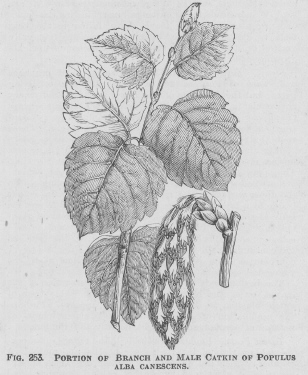
P. a. canescens (hoary). Grey Poplar. l. of the branches hoary beneath or glabrous; those of the suckers, angled and toothed. The wood of this variety is said to be superior to that of the type. See Fig. 253. (Sy. En. B. 1300.)
P. angulata (angular). A synonym of P. monilifera.
P. balsamifera (balsam-bearing).* Balm of Gilead; Balsam Poplar; Tacamahac. l. ovate, gradually tapering, and pointed, finely serrate, smooth on both sides, whitish, and reticulately veined beneath. Branches round; buds large, copiously varnished with fragrant resin. h. 70ft. North America, 1962.
P. b. candicans (whitish). l. broader, and more or less heart-shaped, pointed, serrate; petioles usually hairy. SYN. P. macrophylla.
P. b. laurifolia (Laurel-leaved). l. oval, oblong, and long-acuminate or lanceolate, sometimes sub-cordate, toothed; younger ones (and branches) slightly pilose. Siberia. SYN. P. laurifolic.
P. b. suaveolens (sweet-smelling). l. broadly elliptic, acuminate, obtuse, toothed, slightly pubescent on the nerves and petioles. Rocky Mountains.
P. b. viminalis (twiggy). l. long-lanceolate. Branches angular, elongated, slender.
P. canadensis (Canadian). A synonym of P. monilifera.
P. c. aurea (golden). A synonym of P. monilifera aurea.
P. dilatata (dilated). A synonym of P. nigra pyramidalis.
P. fastigiata (pyramidal). A synonym of P. nigra pyramidalis.
P. graeca (Grecian). A synonym of P. tremuloides.
P. grandidentata (large-toothed). fl., male catkins 3in. to 4in. long; females 1 1/2in. to 2in. long. March. l. roundish-ovate, with large and irregular, sinuate teeth, when young 2in. to 3in. long, densely covered with white silky wool, at length smooth on both sides, 1in. to 3in. long. Branches and branchlets cylindrical; buds pubesecent, sometimes slightly glabrous. h. 60ft. North America, 1772. (E. T. S. M. ed. ii. 278.) Of this species there is a weeping variety (pendula) in cultivation.
P. heterophylla (variable-leaved). fl., male catkins thick, 3in. to 4in. long, dense; females 2in. long, loose. March. l. 6in. to 12in. long, 4in. to 8in. broad, cordate or roundish-ovate, obtuse, serrate, white-woolly when young, at length nearly smooth, except on the elevated veins beneath. Branches round, pale; buds highly pubescent, thick, short, obtuse. h. 40ft. to 60ft. North America, 1765.
P. laurifolia (Laurel-leaved). A synonym of P. balsamifera laurifolia.
P. macrophylla (large-leaved), of Lindley. A synonym of P. balsamifera candicans.
P. monilifera (beaded).* Necklace Poplar. l. on young plants and suckers, heart-shaped, 7in. to 8in. long and wide; those on full-grown trees, only one-fourth that size, and commonly without the sinus; all crenate-serrate, or with obtuse, cartilaginous teeth. Branches acutely angular or winged. h. 80ft. or more. North America, 1738. SYNS. P. angulata, P. canadensis.
P. m. aurea (golden). A very useful, ornamental tree, only differing from the type in the decided golden-yellow tint of the leaves. SYN. P. canadensis aurea.
P. nigra (black).* Black Poplar. fl., male catkins 2in. to 3in. long, cylindrical; females shorter, ascending, the peduncle curved in front. April. l. 1in. to 4in. long, rhombic, deltoid, or sub-orbicular, finely crenate-serrate, the angles rounded, acuminate; young ones silky beneath and ciliate; petioles slender, compressed. Branches greenish-white; branchlets pubescent when young, and, as well as the highly viscous buds, yellowish. h. 50ft. to 60ft. Europe, North Asia. The Black Poplar is of rapid growth and short duration; the wood is light, and is much used for carving, charcoal-making, &c.; the bark is employed in tanning. (Sy. En. B. 1302.) For figure and dimensions of an enormous specimen of this tree, see G. C. n. s., xxi. 641.
P. n. pyramidalis (pyramidal).* Lombardy Poplar. Young leaves and branchlets glabrous. Habit pyramidal. SYNS. P. dilatata, P. fastigiata.
P. Simonii (Simon's). l. thick, sub-erect, 5in. to 6in. long, about 3in. broad, ovate-elliptic, equally attenuated at each end, dentate, crisped, intense green above, glaucous-white beneath. Branches elongated; bark reddish-brown. China, 1867. A tall tree.
P. tomentosa (tomentose). l. oval, 4in. to 5in. long, 2in. to 2 1/2in. broad, usually cordate at base, very acutely toothed, intense green above, white-tomentose beneath. Young branchlets tomentose, adult ones glabrous; buds thick, conical, woolly-tomentose. China, 1867.
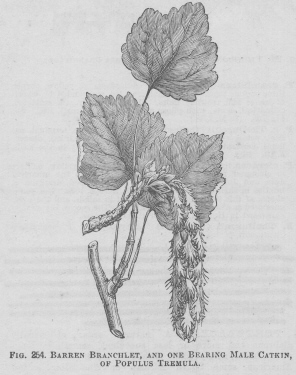
P. Tremula (trembling).* Aspen. fl., catkins 2in. to 3in. long, cylindric. March and April. l. 1in. to 4in. long; those of the shoots cordate, acute, entire, cottony beneath; those of the branches sub-orbicular-ovate, sinuate-serrate, with incurved teeth, glabrous or silky beneath; petioles very long, slender, glabrous; compressed branches spreading; buds pubescent, not viscid. h. 40ft. to 80ft. Arctic Europe (Britain), Africa, Asia. A well-known, erect tree, with white wood and grey bark. See Fig. 254. (Sy. En. B. 1307). The varieties villosa and glabra have respectively villous and more glabrous foliage than the type.
P. T. pendula (pendulous). A variety only differing from the type in its very pendulous branches. It makes a small, round-headed tree, and is best grafted on tall stems of the type.
P. tremuloides (Tremula-like). American Aspen. l. roundish-cordate, with a short, sharp point, and small, somewhat regular teeth, smooth on both sides, with downy margins; petioles long, slender, and laterally compressed. Adult branches glabrous; buds also glabrous, viscous. h. 20ft. to 50ft. North America. (E. T. S. M. 280, under name of P. tremuliformis.) SYN. P. graeca.