Sagittaria
(from sagitta, an arrow; alluding to the prevalent form of the leaves). Arrow-head. ORD. Alismaceae. A genus consisting of about fifteen species of stove, greenhouse, or hardy, marsh-loving, usually erect, perennial herbs, inhabiting temperate and tropical regions. Flowers white, usually ternately whorled, spicate or panicled, pedicellate, three-bracted (in one species one-bracted) at the nodes; perianth segments six, in two series, the outer ones persistent, the inner ones larger, petaloid, deciduous; stamens nine or more, usually numerous; scape erect, slender or robust. Leaves on long or often thick petioles, elliptic-lanceolate or sagittate, often pellucid-dotted or lineolate. The under-mentioned species are hardy, except where otherwise stated. They require a loamy soil, and may be readily increased by division. All flower in summer.
S. acutifolia (acute-leaved). A synonym of S. graminea.
S. graminea (grass-like). fl., lower whorls fertile; bracts usually connate; pedicels slender; scape very slender, erect, 1ft. to 2ft. high. l. varying from ovate-lanceolate to linear, or reduced to broad and acute phyllodes, scarcely ever sagittate. North America, 1812. SYN. S. acutifolia.
S. heterophylla (variable-leaved).* fl. of the lowest whorl fertile and almost sessile, the sterile ones on long pedicels; bracts obtuse; scape weak, 2ft. to 3ft. high, at length procumbent. l. lanceolate or lanceolate-oval, entire or with one or two narrow, basal, sagittate, appendages. North America, 1822.
S. h. rigida (rigid). l. rigid, narrowly lanceolate, acute at both ends; petioles stout. A tall form. (B. M. 1632, under name of S. rigida.) S. lancifolia (lance-leaved). fl. on slender pedicels; several of the lower whorls fertile; bracts acute or acuminate; scape 2ft. to 5ft. high. l. lanceolate or lanceolate-oblong, rarely linear, all with a tapering base, 6in. to 18in. long, on long, stout petioles, never sagittate. North America and West Indies, 1787. Greenhouse. (A. B. R.333; B. M. 1792.)
S. I. angustifolia (narrow-leaved). A variety having the blades of the leaves very narrow or all deficient. Plant much smaller, in all its parts, than the type. (B. R. 1141, under name of S. angustifolia.)
S. montevidensis (Monte Video).* fl. white, with a crimson spot at the base of each petal, large, in lax whorls, borne on a tall scape; scapes bearing the female flowers much stouter, and the pedicels shorter, than those of the males. l. sagittate. South America, 1884. An exceedingly handsome, free-flowering, stove or greenhouse aquatic. (B. M. 6755; Gn. xxvii. p. 8; I. H. 1884, p. 189.)
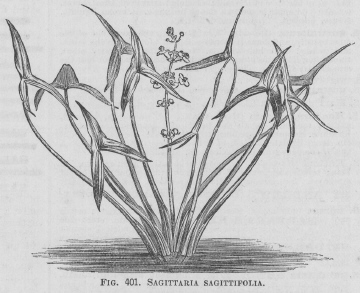
S. sagittifolia (Arrow-leaved).* Common Arrow-head. fl. 1/2in. in diameter, males large; petals with purple claws; whorls three to five, distant, three to five-flowered; scape 6in. to 18in. high. l., blade hastate, obtuse or acute, 2in. to 8in. long, erect, the lobes long, more or less diverging, acuminate, the first developed submerged; petioles stout, 8in. to 18in. long. Stems swollen at base, stoloniferous. Europe (Britain), &c. See Fig. 401. (Sy. En. B. 1436.) S. diversifolia is a variable-leaved form. (B. M. 1631, under name of S. sinensis.)
S. variabilis (variable). fl., one or more of the lower whorls fertile; petals with white claws; filaments about twice the length of the anthers; pedicels of the fertile flowers about half the length of those of the sterile ones; scape 3in. to 4ft. high. angled. l. very variable, almost always sagittate. North America, 1818.
S. v. flore-pleno (double-flowered). A form with double flowers.
S. v. hastata (halberd-shaped). l. narrow, halberd-shaped or sagittate. S. v. latifolia (broad-leaved). l. broad, acute, sagittate.
S. v. obtusa (obtuse). l. broadly sagittate, obtuse, 6in. to 12in. long.