Vaccinium
(the old Latin name, used by Virgil and Pliny). Bilberry; Blueberry; Cranberry; Huckleberry. Including Epigynium (in part). ORD. Vacciniaceae. A large genus (about 100 species) of mostly hardy, branched shrubs, rarely trees, very rarely epiphytal, inhabiting North temperate regions and tropical mountains. Flowers white, pink, or red, disposed in axillary or terminal racemes or axillary fascicles, rarely solitary, often bracteate and bibracteolate; calyx tube terete, globose, hemispherical, or turbinate, the limb of four or five short, very rarely unequal lobes; corolla urceolate, campanulate, or rarely nearly tubular or conical, terete, very rarely ribbed or angled, the limb of four or five short, rarely elongated and revolute lobes or teeth; stamens eight or ten, free, or shortly adhering at the base of the corolla tube; filaments short or elongated, often hairy; anthers awned on the back or awnless; bracts sometimes foliaceous. Berry globose, four or five (or apparently eight or ten) celled, the cells few or many-seeded. Leaves persistent, rarely membranous or deciduous, often thickly coriaceous, entire or serrated. All the Vacciniums require peat; the hardy ones thriving in any fairly damp, peat border. They may be propagated most readily from seeds, sown under glass, in spring, and the seedlings gradually hardened off when large enough. The greenhouse species should be placed in the open sir during the summer months, in order to get their wood well ripened. The best-known species are here described. Except where otherwise indicated, they are hardy, deciduous shrubs, from North America; the flowers appear in spring, and the berries, which are sweetish or sometimes acid, and mostly edible, ripen in summer or autumn.
V. albiflorum (white-flowered). A synonym of V. corymbosum pallidum.
V. amaenum (pleasing). A variety of V. corymbosum.
V. angustifolium (narrow-leaved). A form of V. pennsylvanicum. V. arboreum (tree-like). Farkleberry. fl. profuse, axillary along the branches and leafy-racemose; corolla white, moderately five-lobed. fr. black, small, globose. l. obovate or round-oval to oblong, thinnish-coriaceous, very smooth and shining above, reticulate-veined. obscurely glandular-denticulate or entire. Branches spreading, glabrous or somewhat pubescent. h. 6ft. to 25ft. 1765. (L. B. C. 1885.) SYN. V. diffusum (B. M. 1607)
V. Arctostaphylos (Arctostaphylos). A synonym of V. maderense.
V. caespitosum (tufted). fl. solitary in the earliest axils, usually five-parted; corolla rose-coloured or nearly white, ovate or ovoid-oblong. fr. blue, with a bloom, proportionately large, sweet. l. obovate to cuneate-oblong, obtuse or rarely somewhat acute, thickly serrulated, bright green on both sides, reticulate-veined. h. 3in. to 6in. 1823. (B. M. 3429; II F. B. A. ii. 126.)
V. canadense (Canadian). fl. few in the clusters; corolla greenish-white, shorter, and more open-campanulate. l. elliptic or oblong-lanceolate, entire, and, as well as the branchlets, downy with soft, spreading pubescence. Otherwise resembling V. pennsylvanicum. 1825. (B. M. 3446.)
V. caracasanum (Caraccas).* fl. secund, with eight to ten anthers; corolla reddish-white, campanulate; racemes axillary, twice as long as the leaves; bracts lanceolate, nearly equalling the pedicels. July. l. elliptic, acute, crenulate, coriaceous, glabrous, shining above. Stem shrubby, erect. h. 4ft. Caraccas, 1825. Greenhouse.
V. corymbosum (corymbose).* fl. more often racemosely than corymbosely disposed on the naked twigs; corolla white or obscurely rose-coloured, turgid-ovate to cylindraceous-campanulate, three to four lines long. fr. usually blue-black, with a copious bloom. l. ovate or oblong to elliptic-lanceolate. Branchlets yellowish-green, turning brownish. h. 5ft. to 10ft. 1765.
V. c. amaenum (pleasing). l. ciliate-serrulated or bristly-ciliated, rather bright green, slightly or sparsely pubescent. SYNS. V. amaenum (A. B. R. 138; B. R. 400), ? V. c. fuscatum (B. M. 3433).
V. c. pallidum (pale). A pale and very glaucous or glaucescent form, with or without some pubescence, generally low; otherwise nearly as in the preceding variety. SYN. V. albiflorum (B. M. 3428).
V. crassifolium (thick-leaved). fl. few and almost sessile, in small, axillary clusters; corolla nearly white, globose, campanulate. fr. black. l. 1/4in. to 1/2in. long, oval to narrow-oblong, sparsely mucronate-serrulate or entire, shining. Stems slender, trailing, 2ft. to 3ft. long. 1787. Evergreen. (A. B. R. 105; B. M. 1152.)
V. diffusum (diffuse). A synonym of V. arboreum.
V. dumosum (bushy). A synonym of Gaylussacia dumosa.
V. erythrinum (red-twigged).* fl. numerous, moderately large, secund, drooping; corolla deep coral-red, urceolate, the limb of five small, reflexed segments; pedicels red; racemes clustered, terminal, 2 1/2in. to 3in. long, sessile or nearly so. October. l. alternate, coriaceous, glossy, 13/4in. to 2in. long, ovate, rather obtuse, quite entire; young ones stained with red. Young branches red. h. 1 1/2ft. Java, 1852. A handsome, warm green-house, evergreen shrub. (B. M. 4688; F. d. S. 1115; L. J. F. iv. 364.)
V. formosum (beautiful).* fl. in loose clusters; calyx and tardily deciduous bracts red or reddish; corolla rose-red, four to five lines long, cylindrical. fr. blue, sweet. l. ovate or oblong, entire, 1in. to 2in. long, smooth and bright green above, glabrous or pubescent beneath, rather firm in texture. h. 2ft. to 3ft. (A. B. R. 97.)
V. frondosum (leafy). A synonym of Gaylussacia frondosa.
V. fuscatum (fuscous). A form of V. virgatum.
V. Imrayi (Dr. Imray's). fl. large: corolla yellow-green, rather thick; corymbs many-flowered, axillary or terminal, leafy, compact. l. shortly petiolate, ovate, acuminate, entire or obsoletely serrated, penninerved, glossy, coriaceous. h. 2 1/2ft. to 3ft. Dominica, 1860. A handsome, stove, evergreen shrub. (B. M. 5279.) The correct name of this plant is now Hornemannia martinicensis.
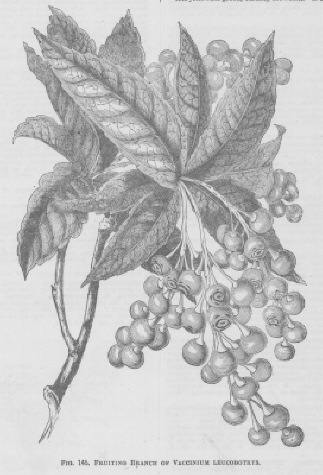
V. leucobotrys (white-clustered).* fl. glabrous; corolla white, waxy, sub-diaphanous, conico-urceolate; racemes copious from among the leaves, and longer than them, drooping, secund, many-flowered. Summer. fr. pure white, with five dark spots in a circle below the apex, copious, about the size of peas. l. oblong-lanceolate, deeply serrated, very shortly petiolate. Branches whorled. h. 4ft. to 7ft. Bengal, 1859. Greenhouse, evergreen shrub. See Fig. 146. (B. M. 5103, under name of Epigynium leucobotrys.)
V. leucostomum (white-mouthed). fl. three or four in a short, erect, fascicled raceme: corolla scarlet, tipped with white, urceolate-campanulate, with a short limb; bracts small, subulate. l. oblong, nearly sessile, thick, slightly crenate, obsoletely nerved, 1/2in. to 1in. long. Branches erect, angled. Peruvian Andes, 1848. A glabrous, evergreen shrub. (G. C. 1848, p. 7.)
V. macrocarpum (large-fruited). A synonym of Oxycoccus macrocarpus.
V. maderense (Madeira). fl. on axillary, dropping pedicels; corolla greenish-white, campanulate, sub-cylindrical; racemes leafy. l. oblong, attenuated at both ends, serrulated, pubescent beneath. Stem arborescent. h. 6ft. Madeira, 1777. SYN. V. Arctostaphylos (A. B. R. 30; B. M. 974).
V. Mortinia (native name).* fl. in very short, drooping racemes, crowded, shortly pedicellate; corolla rose-pink, 1/3in. long, with five small, recurved teeth. l. rather crowded, 1/2in. to 3/4in. long, spreading and reflexed, ovate--or lanceolate-oblong or ovate, acute, thickly coriaceous, slightly serrated; petioles very short. Branches pubescent or nearly glabrous. h. 2ft. to 3ft. Andes, 1884. Half-hardy shrub. (B. M. 6872.) V. Myrsinites (Myrsinites). fl. in fascicles or very short racemes, shortly pedicellate; corolla white or rose-coloured, five-toothed, at length cylindraceous, two to three lines long; bracts reddish, tardily deciduous. fr. blue, globose. l. obovate and obtuse to oblong-lanceolate and acute or spathulate, often cuspidate, 1/3in. to 1in. long, sometimes denticulate, mostly shining above, dull or paler and sometimes glaucous beneath. Branchlets puberulent when young. h. 9in. to 2ft. 1794. Evergreen. (? B. M. 1550, under name of V. nitidum decumbens.) SYN. V. Sprengelii (of gardens).
V. myrtilloides (Myrtillus-like). fl. solitary in the earliest axils, usually five-parted; corolla yellowish--or greenish-white, tinged with purple, globose-urceolate, nearly two lines long. fr. purplish-black, rather acid. l. ovate or oval and oblong, sharply serrulated, membranous, green on both sides but not shining, 1in. or more long, the larger or later ones mostly acute or acuminate. Branchlets slightly angled. h. 1ft. to 5ft. (B. M. 3447.)
V. Myrtillus (Myrtillus). Bilberry: Bleaberry; Blueberry; Common Whortleberry, &c. fl. solitary, on naked peduncles, 1/4in. long; corolla rosy, tinged with green globose, 1/4in. in diameter. fr. dark blue, 1/3in. in diameter, glaucous. l. ovate, 1/2in. to 1in. long, serrated, reticulate-nerved, rosy when young. Stems many, erect, 6in. to 2ft. high. Europe (Britain), Asia, and America. (F. D. 974; Sy. En. B. 879.)
V. nitidum (shining). fl. in fascicles or very short racemes; calyx teeth and almost persistent bracts very obtuse; corolla rose-red or turning white, rather broad, two lines long. fr. black, some-what pear-shaped. l. obovate to oblanceolate-oblong, 1/4in. to 1/2in. long, thick-coriaceous, shining, at least above, obscurely denticulate and glandular. h. 1ft. to 2ft. 1794. A diffuse, much-branched, very leafy, evergreen shrub. (A. B. R. 480.) V. ovatum (ovate-leaved). fl. in short and close, axillary clusters; corolla rose or flesh-coloured, campanulate, two lines long, five-parted. fr. reddish, turning black, small, rather sweet. l. thick and firm, very numerous, oblong-ovate to oblong-lanceolate, acute, minutely and acutely serrated, glabrous or nearly so, 1in. or so long, bright green on both sides. Branchlets pubescent. h. 3ft. to 5ft. 1826. An erect, rigid, evergreen, shrub. (B. R. 1354; L. B. C. 1605; L. J. F. iv. 424.)
V. Oxycoccus (Oxycoccus). A synonym of Oxycoccus palustris.
V. pennsylvanicum (Pennsylvanian).* fl. on very short pedicels, in fascicles or short racemes; corolla white or obscurely rose-coloured, campanulate with the orifice slightly contracted, barely 1/5in. long. fr. bluish-black and glaucous, large and sweet, ripening early. l. oblong-lanceolate or oblong, green and somewhat shining on both sides, glabrous or sometimes hairy on the midrib beneath, distinctly serrulated with bristle-pointed teeth. Stems green and warty, mostly glabrous. h. 9in. to 12in. or more. 1772. (B. M. 3434.)
V. p. angustifolium (narrow-leaved). Bluets. A dwarf form (9in. or less in height), with lanceolate leaves. SYN. V. angustifolium.
V. reflexum (reflexed-leaved). fl., corolla red, coriaceous, rather acutely five-angled; corymbs small, short, few-flowered, or many-flowered and then sub-globose, sub-terminal and axillary. January. l. small, reflexed or horizontally spreading, 1/2in. to 3/4in. long, almost sessile, oblong-lanceolate, acute, sharply serrated except at the base; young ones bright pale red. Stem branched from the base; branches 1ft. to 2ft. long, sparingly divided, leafy, pendulous. Bolivia, 1869. Greenhouse evergreen. (B. M. 5781.)
V. resinosum (resinous). A synonym of Gaylussacia resinosa. V. Rollisoni (Rollison's). fl. on spreading pedicels, drooping; corolla rich scarlet, the limb of five acute lobes; racemes always terminal, nearly sessile, four to six-flowered. l. about 3/4in. long, obovate, sub-cuneate, coriaceous, glossy, entire, sometimes retuse. Branchlets angled. h. 2ft. or more. Java, 1851. An erect, much-branched, slightly hairy, leafy, stove, evergreen shrub. (B. M. 4612.)
V. rugosum (wrinkled). A synonym of Pentapterygium rugosum.
V. Sprengelii (Sprengel's). A garden synonym of V. Myrsinites.
V. stamineum (thready).* Deerberry; Squaw Huckleberry. fl. nearly all axillary; corolla dull purplish or yellowish-green, deeply five-cleft; awns of the anthers very much shorter than the elongated tubes. fr. greenish or yellowish, large, pear-shaped or globular, mawkish. l. pale and dull or glaucous, especially beneath, oval to lanceolate-oblong. Branches diverging, minutely pubescent or at length glabrous. h. 2ft. to 3ft. 1772. (A. B. R. 263.)
V. tenelium (tender). A variety of V. virgatum.
V. uliginosum (swamp-loving). fl., corolla pale pink, 1/6in. long sub-globose; peduncles one to three together, 1/8in. long, one-flowered. fr. smaller than in V. Myrtillus. l. oblong or obovate, 1/2in. to 1in. long, obtuse or acute, quite entire, coriaceous, glaucous beneath. Stems 6in. to 10in. long, naked below, procumbent; branches ascending. Arctic regions of Northern hemisphere. (F. D. 231; Sy. En. B. 878.) V. virgatum (twiggy). fl. on short pedicels; corolla rose-coloured, three to four lines long; clusters sometimes twiggy on naked branches.* fr. black, sometimes with a bloom. l. obovate-oblong to cuneate-lanceolate, or oblong-lanceolate, usually acute or pointed and minutely serrulated, rather thin, 1in. or so long. h 3ft. Shrub more or less pubescent. (A. B. R. 181; B. M. 3522; W. D. B. i. 33, 34.) V. fuscatum (B. R. 302) is a form of this species, having deep rose-coloured flowers and red pedicels and bracts, approaching V. formosum.
V. v. tenellum (tender). fl. nearly white, in shorter or closer clusters; corolla barely 1/4in. long. l. mostly small. A low form.
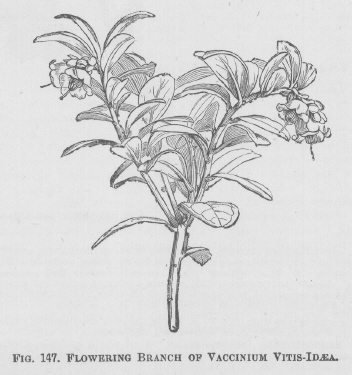
V. Vitis-Idaea (Vine of Mount Ida).* Brawlins; Cowberry; Flowering Box, &c. fl. crowded in short, terminal, drooping racemes; corolla pink, campanulate. fr. red, globose, 1/3in. in diameter, acid. l. obovate, 1/2in. to 11/4in. long, green above (like Box), dotted beneath, very coriaceous, bifarious, the margins revolute, thickened, entire or minutely serrulated. Stems wiry, tortuous, procumbent; branches 6in. to 18in. long, trailing or ascending. Europe (Britain). Evergreen. See Fig. 147. (F. D. 40; Sy. En. B. 877.)