Vanessa
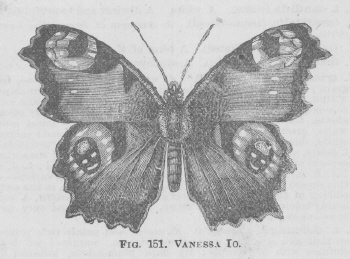
A genus of Butterflies, conspicuous by their size (varying from 2 1/4in. to 2 3/4in. in spread of wings), their bright colours, and the bold markings on the upper surface of the wings; the lower surface is dull-coloured for concealment. The front wings have a distinct tooth above the middle of the hind margin, and the inner margin is nearly straight. The hind wings usually have a short tooth in the hind margin (see Fig. 151). In the middle of the hind wing is a space bounded on all sides by the wing veins; the sixth and seventh veins are not united, but arise directly from the vein bounding the space. The antennae have the terminal club rather long. The front legs are small and useless for walking. The larvae are long and worm-like, but covered with stiff spines on all but the first ring. The pupae are angular; they hang by the tip of the body, and frequently bear golden or silvery-metallic spots here and there, or over most of their surface. The Butterflies are single-brooded each year, except the Small Tortoiseshell, which has a succession of broods. Most of the species hybernate as Butterflies, appearing on warm days during winter. There are five British species of the genus, viz., V. Antiopa (Camberwell Beauty), V. Atalanta (Red Admiral), V. Io (Peacock, see Fig. 151), V. polychloros (Great Tortoiseshell), and V. Urticae (Small Tortoiseshell). Of these V. Antiopa feeds on various Willows, and V. polychloros on Elm; but both are local or scarce in Britain. The other Vanessae feed on Nettles. The Butterflies may be distinguished from one another by the colour of the upper surface of the wings. V. Antiopa (rarely seen in England) has a span of about 3in. across the wings; the latter are purplish-brown, with broad, yellow or yellowish-white borders, margined on the inner side with a broad, black band, in which are six or seven blue spots.
V. Atalanta has the wings nearly black, with a broad, deep red band across the middle of the front wings, and round the hind margin of the hind wings; the band on the hind wings has four black spots in it. Each front wing bears six white spots near the tip, and there is a blue and black spot at the hind angle of each hind wing.
V. Io is of the size and form shown in Fig. 151; the ground-colour is dull red, the margins are brown, the eye-like spots on the wing are variously shaded with black, lilac, red, yellow, and white; those on the hind wings are bordered with grey-brown.
V. polychloros and V. Urticae are very like one another, both having tawny-orange wings, with a dark border inclosing blue spots; and in both there are three large, black spots, separated by yellow spots, on the front border, and two small, black spots near the middle, of the front wings; and the basal part of the hind wings is dark. The two species differ as follows: V. polychloros is usually over, and V. Urticae is under, 2 1/2in. in spread of wings. The latter species has a white spot on the front margin of the front wings, near the tip, where the former species has a yellow spot, and in V. polychloros there is a black spot more on the inner border of the front wings, and the blue spots in the dark borders of the front wings are faint or absent. V. Urticae is one of the earliest of British Butterflies, and is conspicuous in almost all parts of the country.
Those species of Vanessa that feed on Nettles are beneficial; while the others are never numerous enough in Britain to call for a special remedy.