Home › E › Eng (Bot History Use Propagation) (IV)
Eng (Bot History Use Propagation) (IV)
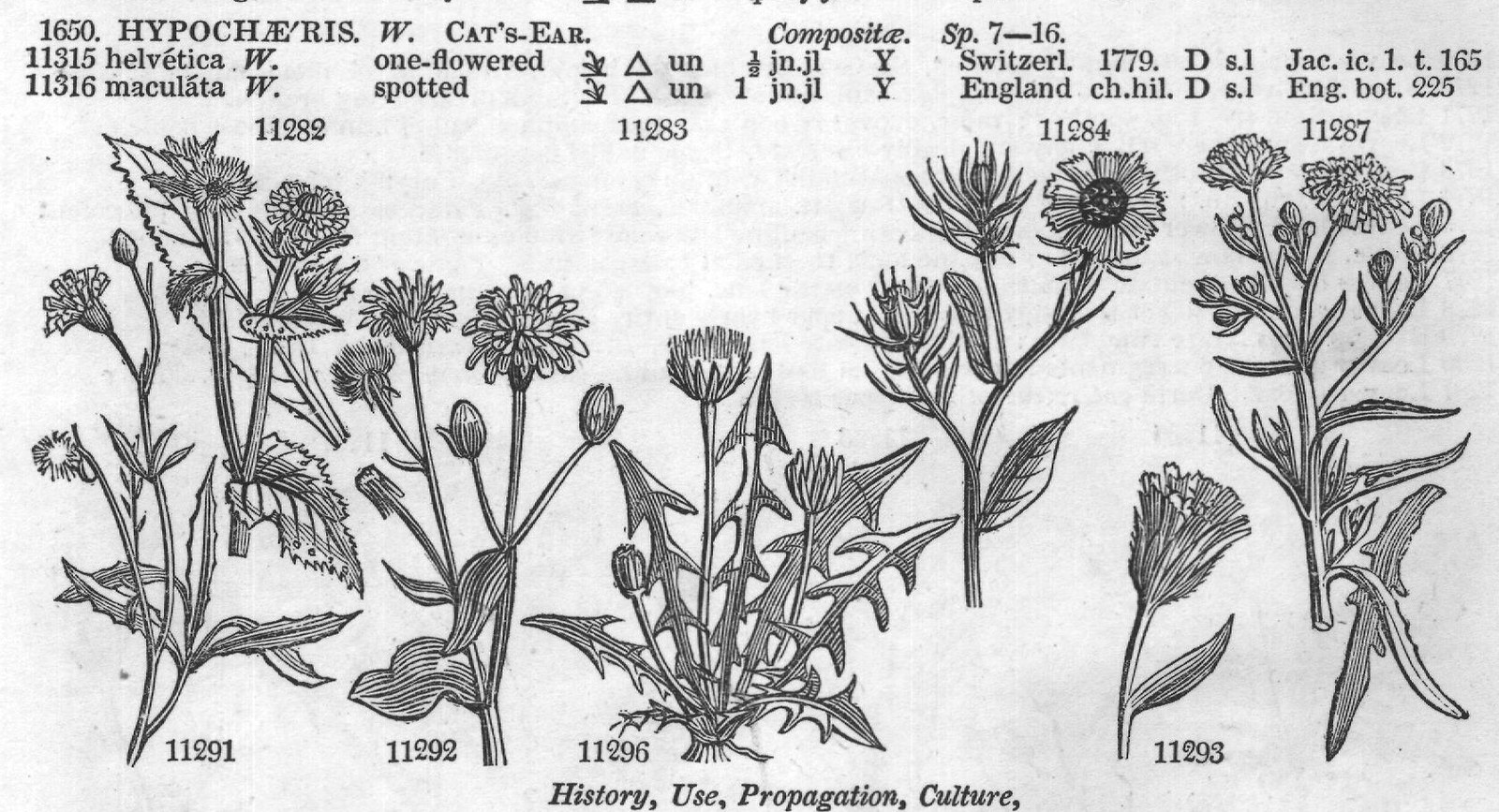
bot. 225 11287 11291 11292 11296 History, Use, Propagation, Culture, 11293 1639. Helminthia. An abridgment of Helminthotheca, a name employed for this genus by Vaillant. It is derived from ἑλμivς, a worm, and θηκη, a case: in allusion to the corrugated seeds, which may be fancied to resemble bundles of little worms. The genus was united by Linnæus with Picris, but has been again separated by modern botanists. 1640. Myoseris. So named from μuς μuoς, a mouse, and σερiς, lettuce ; a name invented for the purpose of maintaining a resemblance in nomenclature with Hyoseris, Lagoseris, and other similar plants. 1641. Tolpis. A name invented by Adanson, ahd supposed to have no meaning. Handsome annual flowers. 1642. Andryala. A name, the meaning of which has not been discovered. Rather pretty plants, natives of the south of Europe and north of Africa. 1643. Rothia. Named by Schreber, in honor of Dr. A. G. Roth, author of a Flora Germanica, in 1788, Catalecta Botanica, in 1797, and other works. It has been united with Andryala by Richard. 1644. Krigia. Named after Dr. Krieg, a German botanist, who accompanied Mr. Vernon to America in search of plants. See Vernonia. A pretty little North American plant, with grassy leaves and bright yellow neat flowers.
ORDER I.
SYNGENESIA ÆQUALIS. 11282 Involucrum large prickly, Leaves repand 11283 Leaves runcinate pinnatifid: lobes oblong acute toothed spreading, Scape naked many-fl. smooth 11284 Leaves obl. toothed, Pedunc. 1-flowered 11285 Leaves lanc. oblong: lower sinuate-toothed, Pedunc. proliferous 11286 Leaves obl. linear scabrous toothed, Stem branched divaricating, Lower scales of invol. downy 11287 Leaves gland. downy: lower runcinate toothed; upper ovate lanc. entire, Stem and pedunc. glandular 11288 Leaves downy pinnatifid, Invol. downy pilose, Hairs rigid 11289 Leaves pinnated linear downy 11290 Leaves pinnatifid lyrate, Flowers corymbose aggregate, Pedunc. and invol. hispid 11291 Leaves downy oblong: lower toothed, Stem branched, Branches 1-flowered 11292 Leaves ovate woolly: lower somewhat toothed, Corymb terminal, Pedunc. about 2-flowered 11293 Stem branched at base diffuse, Leaves downy ovate lanceolate amplexicaul. nearly entire 11294 Stem erect corymbose, Leaves somewhat downy linear sinuate-toothed sessile: upper entire 11295 Stem erect corymbose, Leaves downy sessile: lower obl. runcinate, Pedunc. gland. villous 11296 The only species 11297 Scapes 1-fl. naked, Leaves smooth lyrate runcinate toothed: term. lobe trifid 11298 Scapes 1-fl. naked, Leaves smooth lyrate runcinate somewhat fleshy: segm. angular imbricated 11299 Scapes 1-fl. naked thickened at end, Leaves lyrate pinnatifid toothed ciliated roughish 11300 Stem branched leafy diffuse, Leaves amplexicaul. oblong toothed scabrous ciliated at edge 11301 Scapes 1-fl. hispid, Leaves obl. runcinate toothed hispid, Hairs forked 11302 Stem diffuse branched, Leaves obl. toothed narrowed at base sessile, Scales of invol. in fruit smooth 11303 Stem diffuse branched, Lvs. obl. toothed narr. at base sess. Scales of invol. in fruit hairy 11304 Stem diffuse branched, Lvs. obl. toothed subcordate amplexicaul. Scales of invol. in fruit smooth 11305 Related to the last, but the leaves are deeply toothed with 3-forked hairs 11306 Leaves somewhat toothed, Hairs simple, Pedunc. very thick 11307 Stem erect branched, Lvs. obl. somew. toothed subcordate amplex. Scales of invol. in fruit alternately setose 11308 Stem erect panicled, Lvs. obl. hispid deeply toothed, Scales of invol. in fruit smooth muricated at the end 11309 The only species 11310 Smooth, Leaves obovate toothed 11311 Hispid, Leaves obovate somewhat toothed 11312 Stinging, Stem branched, Leaves toothed 11313 Radical leaves spatulate toothed pilose, Stem ascending smooth, Pappus stalked 11314 Hairy with very short stellate hairs and bristles, Lvs. lanc. entire, Pedunc. term. thickened upwards 1-fl. 11315 Stem simple leafy 1-fl. Leaves lanc. toothed 11316 Stem almost leafless solitary, Leaves ovate-oblong undivided toothed (spotted above) 11310 11297 11311 11298 11303 11314 11309 11316 and Miscellaneous Particulars. 1645. Hyoseris. From us vos, a hog, and σερiς, the Greek name of the Lettuce, or of a plant resembling it: hogs-lettuce, in allusion to the abominably fetid smell of the plant. 1646. Hedypnois. Under this name, a kind of wild endive, the medicinal qualities of which he much extols, is described by Pliny. Dalechamp, his commentator, derives the word from ήδuς, sweet, and πvεω, to breathe, on account of a pleasant flavor communicated to other vegetables in cookery. But the modern genus, which consists of uninteresting weeds, has not been discovered to possess this quality. 1647. Robertia. Named by the authors of the Flore Française, after M. Robert, a Corsican botanist. A small weedy plant resembling Dandelion. 1648. Seriola. A diminutive of σερiς, chicory. Small chiccraceous weeds of the south of Europe. S. Alliatæ is not, as its name would lead one to suspect, named from any smell of garlic which it possesses, but in honor of Prince Joseph Alliata, a Sicilian nobleman, and patron of Bivona Bernardi. 1649. Soldevilla. So named by Lagasca, apparently in honor of some botanist. A little Spanish weed with terminal solitary flowers. 1650. Hypochæris. From uπo, for, and χoiρoς, a pig; Porcelle, Fr., for the same reason, viz., that pigs eat the roots with avidity. All the species are uninteresting weeds. Xx 3 SYNGENESIA ÆQUALIS.
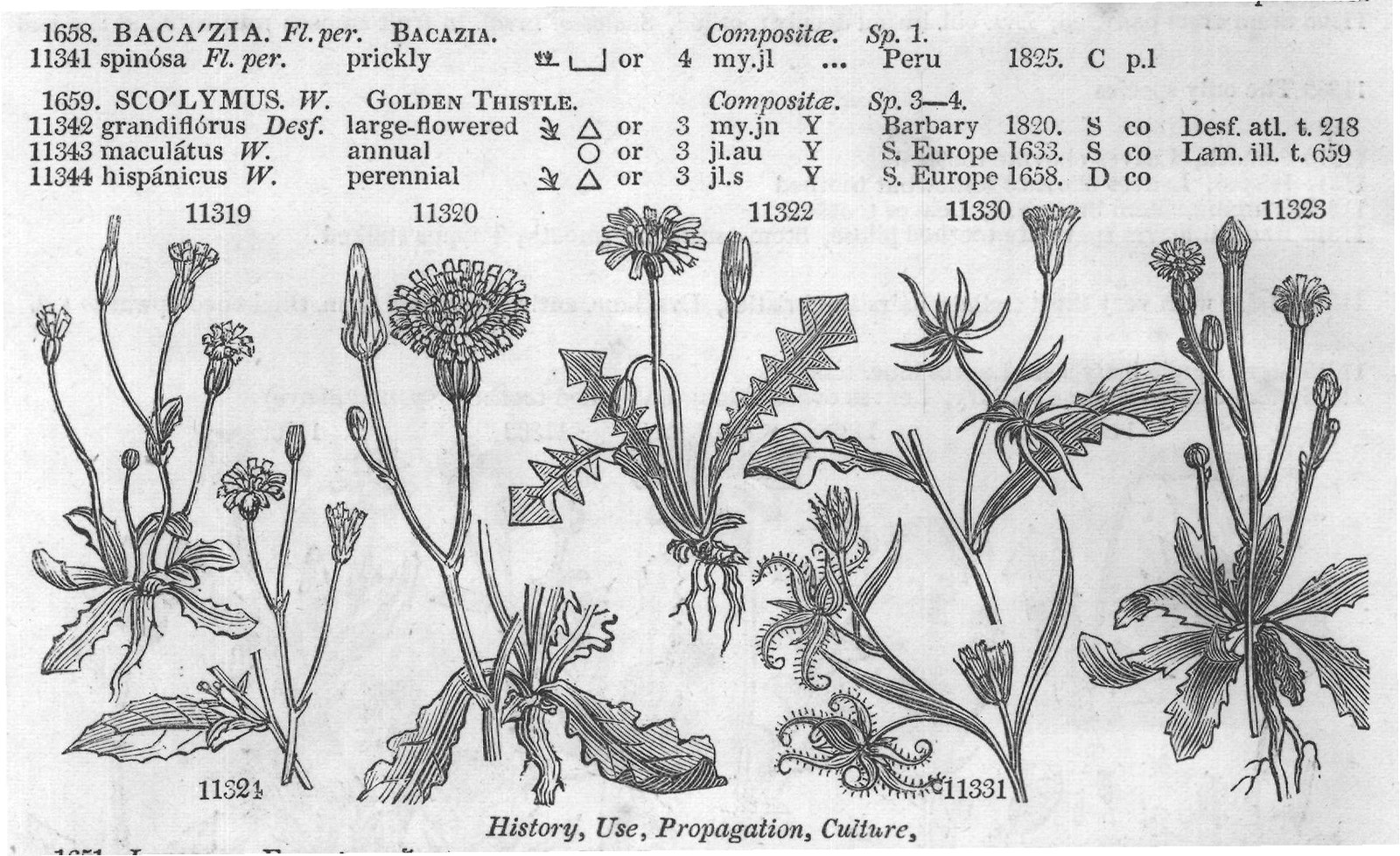
CLASS XIX. 11317 mínima W. 11318 híspida W.en. least un jl.au Y Barbary 1797. S co bristly un jl.au Y 11319 glábra W. smooth un jl.au Y S. Europe 1804. D co Britain sa.hea. S co W.hor.be.1. t.16 11320 radicáta W. long-rooted un 1 jn.s Y 11321 Balbísii W.
Balbis's un 1 jn.s Y 1651. LAPSA'NA. W. NIPPLEWORT.
Composite. 11322 fœtida W. stinking un jl.au Y Britain me.pa. D s.l Italy 1824. D co Sp. 6-10.
Italy