Eng (II)
bot. 255 842. LICHTENSTEI'NIA. W. LICHTENSTEINIA.
Melanthacea. Sp. 1. 4951 lævigáta W. smooth pr 1 ... 843. MYRSIPHYLLUM. W. en. MYRSIPHYLLUM. 4952 asparagoides W. en. broad-leaved $ cù 4953 angustifolium W. narrow-leaved B C. G. H. 1824. S s.l Smilaceæ. Sp. 2. 6 mr.o G.w C. G. H. 1702. cu 6 mr.d G.w C. G. H. 1752.
R. s.p. Her. lugd. t. 681 R s.p, Til. p. 17. t.12. f.2 844. TOFIEL DIA. Hud. TOFIELDIA.
Melanthaceæ. Sp. 2-7. 4954 alpina Smith Scotch cu jl.au G Britain bgs. m. S m.s Eng. bot. 536 4955 pubéscens Mich. downy cu ap.my W N. Amer. 1790. S m.s Pl. ma. t. 342. f.3 845. MELANTHIUM. L. MELANTHIUM.
Melanthaceæ. Sp.6-12. 4956 púmilum W. dwarf cu my.jn W C. G. H. 1800. O s.l 4957 gramíneum Cav. grassy cu 1 my.jn W Mogador 1823.
O s.l Cav. ic.t. 587. f.1 4958 júnceum W.
Rush-leaved cu jn.n Pk C. G. H. 1788.
O s.p Bot. mag. 558 4959 secúndam W. side-flowering cu 1 jn.n W C.G.H. 1812.
O s.p La. ill. t. 269. f.2 4960 uniflórum W. yellow cu jn.jl L.Y C. G. H. 1787.
O s.p 4961 víride W. branching cu o.n G C. G. H. 1788.
O s.p Bot. mag. 767 Bot. mag. 767 Bot. mag. 994 846. MEDE/OLA. W. en. MEDEOLA.
Smilaceæ. Sp. 1. 4962 virgínica W.
Indian Cucum. cu jn Y.G Virginia 1759. R s.p Bot. mag. 1316 847. XEROPHYLLUM. Mich. XEROPHYLLUM.
Melanthacea. Sp. 1. 4963 setifólium W. bristle-leaved cu 2 my.jn W N. Amer. 1823.
R s.p Bot. mag. 748 848. WURMBEA. L.
WURMBEA.
Melanthaceæ. Sp. 3. 4964 longiflóra W. bell-flowered cu my.jn W C. G. H. 1788.
O s.l Bot. mag. 1291 4965 spicáta B.M. spiked cu my.jn Pu C. G. H. 1788. O s.l Bot. mag. 694 4966 capensis W. spotted-flower. cu my.jn Br.y C. G. H. 1768.
O s.p 849. ANDROCYM'BIUM. W. ANDROCYMBIUM.
Melanthaceæ. Sp. 1. 4967 eucomóides W. dwarf cu mr.my G C. G. H. 1794.
O s.p Bot. mag. 641 850. TRIL/LIUM. W.
TRILLIUM.
Melanthaceæ. Sp. 9-10. 4968 séssile W. sessile-leaved or ap.my Br N. Amer. 1759.
R s.p Bot. mag. 40 4969 petiolátum Ph.
Plantain-leaved or ap.my Br N. Amer. 1811.
R s.p 4970 erythrocárpum Mi. painted-flower. or my.jn W N. Amer. 1811. R s.p 4971 ovátum Ph. purple-flower.or my.jn P.Pu N. Amer. 1812.
R s.p 4972 púmilum Ph. dwarf or my.jn R Carolina 1812.
R s.p 4973 cérnuum W. drooping-flow.or 1 ap.my W N. Amer. 1758.
R s.p Bot. mag. 954 4974 eréctum W. stinking or ap.my Br N. Amer. 1759.
R. s.p Bot. mag. 470 ẞ album white-flowered or ap.my W N. Amer. ...
R s.p Bot. mag. 1027 4975 péndulum Ph. pendulous or ap.my W N. Amer. 1805.
R s.p W. ho. b. 1. t. 35 4976 grandiflórum Ph. large-flowered or ap.jn W N. Amer. 1799.
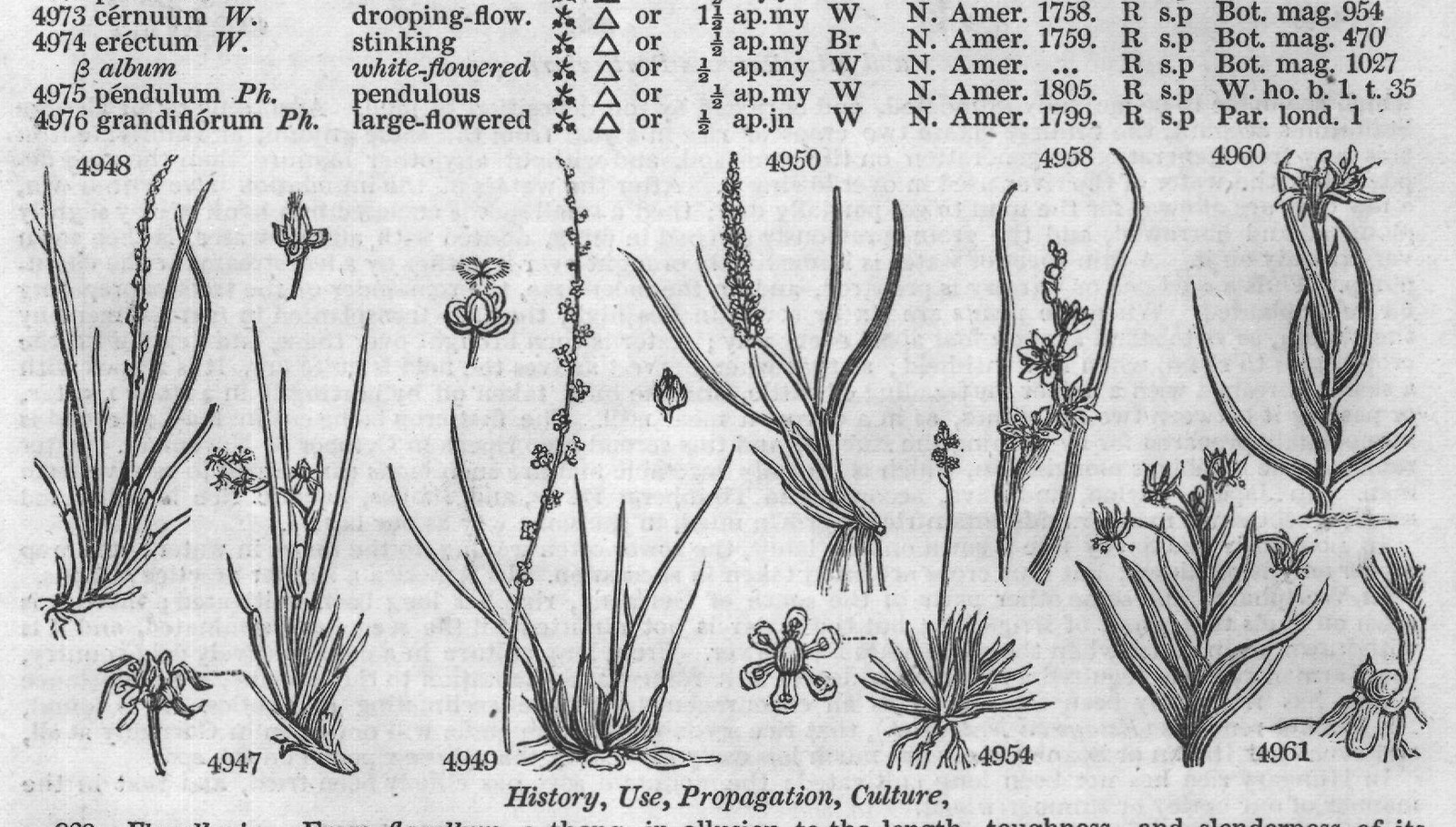
R s.p Par. lond. 1´ 4948 4950 4958 4960 4947 4949 4954 4961 History, Use, Propagation, Culture, 839. Flagellaria. From flagellum, a thong, in allusion to the length, toughness, and slenderness of its shoots. 840. Scheuchzeria. So named by Linnæus, in memory of the two brothers, John James Scheuchzer, professor of mathematics at Zurich, author of Itinera Alpina; and John, professor of physic at Zurich, author of a famous Treatise on Grasses. A curious little marsh plant. 841. Triglochin. From τρεiς, three, and γλωχiς, a point, in allusion to the three angles of the capsule. All domestic cattle are fond of the hardy species, which afford an early bite on the sides of Highland mountains, and are greedily eaten where they occur in salt marshes. 842. Lichtensteinia. Named after M. Von Lichtenstein, a Prussian traveller at the Cape of Good Hope. 843. Myrsiphyllum. From μuρσίvη, a myrtle, and φuλλov, a leaf, in allusion to the resemblance between the leaves of the species and those of myrtle. 844. Tofieldia. Named by Hudson, after a Mr. Tofield, a country gentleman living near Doncaster. ORDER III.
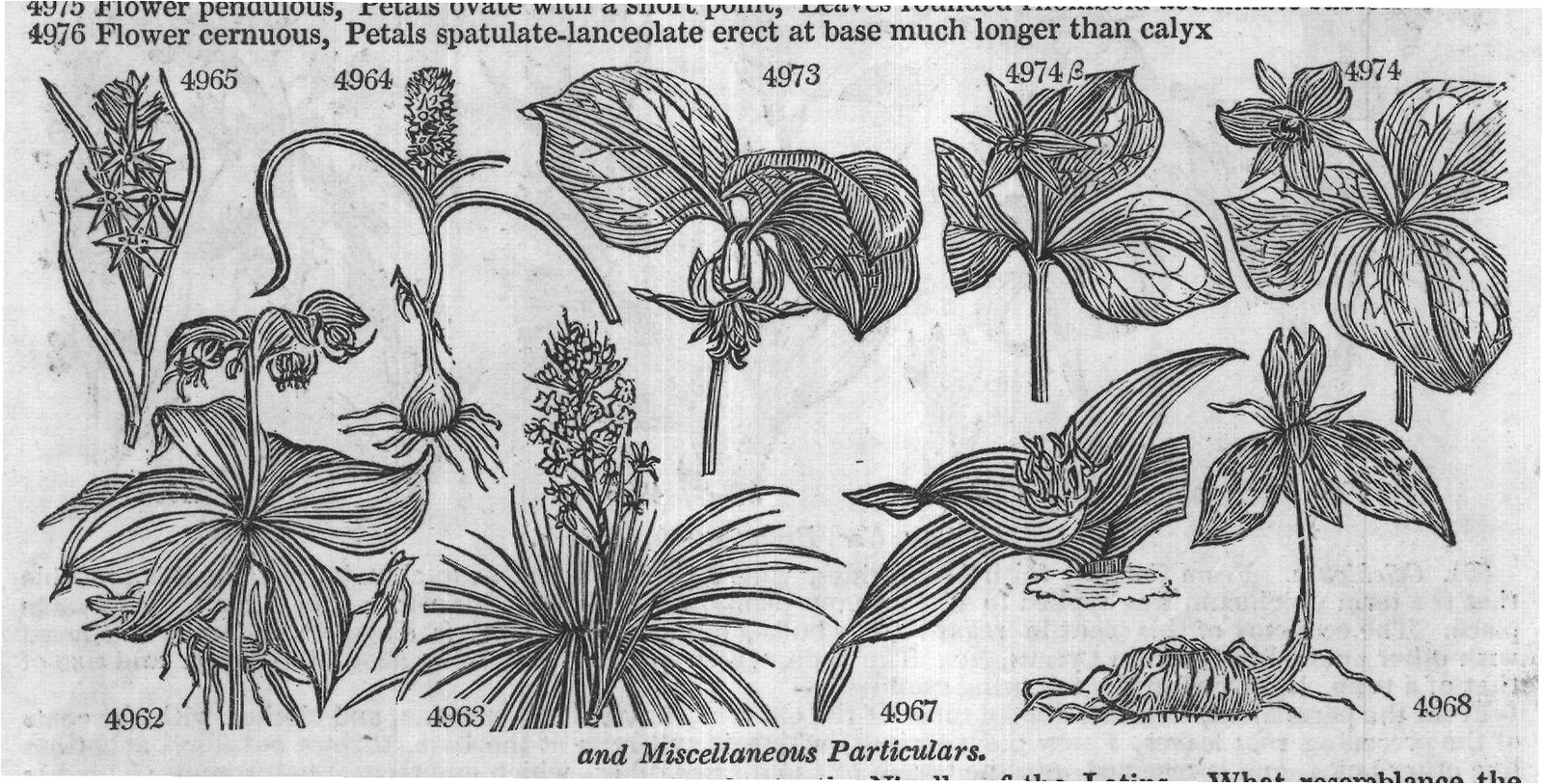
HEXANDRIA TRIGYNIA. 4946 A shrub with distichous branches, Leaves cirrhous at end 4947 A rushy aquatic plant 4948 Capsules 3-celled linear 4949 Capsules 3-celled smooth linear narrowed at end 4950 Capsules 6-celled ovate 4951 The only species, Sepals very narrow 4952 Leaves ovate cordate at base oblique 4953 Leaves alternate ovate-lanceolate 4954 Smooth, Flowers clustered in spikes, Sepals obtuse, Capsules oblong 4955 Scape rachis and leaf-stalks downy all over 4956 Leaves lanceolate bearded at base, Stem 3-flowered, Sepals sessile 4957 Stemless, Leaves imbricated grassy, Flowers sessile 4958 Leaves linear subulate, the upper dilated at base, Spike wavy, Sepals with claws 4959 Leaves linear, Spike one-sided, Sepals with claws 4960 Leaves lin. lanc. longer than one-flowered stem, Sepals lanc. with claws 4961 Peduncles one-flowered cernuous 4962 Leaves whorled in the middle of stem, in threes at the summit 4963 Leaves of the stem setaceous 4964 Spike many-flowered longer than leaves, Tube twice as long as limb 4965 Leaves lanceolate channelled upright, Tube shorter than stellate limb 4966 Leaves lanceolate hooded 4967 Leaves oblong lanceolate cucullate 4968 Flower sessile erect, Petals lanceolate erect twice as long as calyx 4969 Flower sessile erect, Petals linear lanceolate erect a little longer than calyx 4970 Stalk of flower nearly erect, Petals oval-lanceolate acute recurved about twice as long as narrow calyx 4971 Stalk of flower erect, Petals oblong acute spreading a little longer than calyx 4972 Stalk of flower erect, Petals scarcely longer than calyx, Leaves oval oblong obtuse sessile 4973 Stalk of flower recurved, Petals lanceolate acuminate flat reflexed the length and breadth of calyx 4974 Stalk of flower inclining, Flower nodding, Petals scarcely longer but much broader than calyx 4975 Flower pendulous, Petals ovate with a short point, Leaves rounded rhomboid acuminate subsessile 4976 Flower cernuous, Petals spatulate-lanceolate erect at base much longer than calyx 4965 4964 4973 4974 β. 4974 4962 4963 4967 and Miscellaneous Particulars. 4968 845. Melanthium. A name applied by the Greeks to the Nigella of the Latins. What resemblance the modern plant bears to the ancient has not been stated. 846. Medeola. A name in remembrance of Medea, the famous sorceress, given to this plant on account of supposed powerful effects in medicine, but which it is now thought not to possess. 847. Xerophyllum. From ξερoς, dry, and φuλλov, a leaf: its leaves appear as if withered. An American plant with a long spike of white flowers, resembling Helonias. 848. Wurmbea. So called by Thunberg, in gratitude for services rendered him at Batavia by one Wurmb, a Dutch agent there. Jussieu considers this not generically distinct from Melanthium. 849. Androcymbium. From avης avδρoς, a man, or, in botanical language, a stamen, and κuμβoς, a little boat, in allusion to the peculiar conformation of the stamens and their appendages. 850. Trillium. From trilix, triple; the calyx has three sepals, the corolla 3 petals, the pistil 3 styles, and the stem 3 leaves. These are curious little plants, somewhat difficult to keep. Sweet says, they do best on a bed of peat, and may be increased, though slowly, by the division of the root or by seeds.
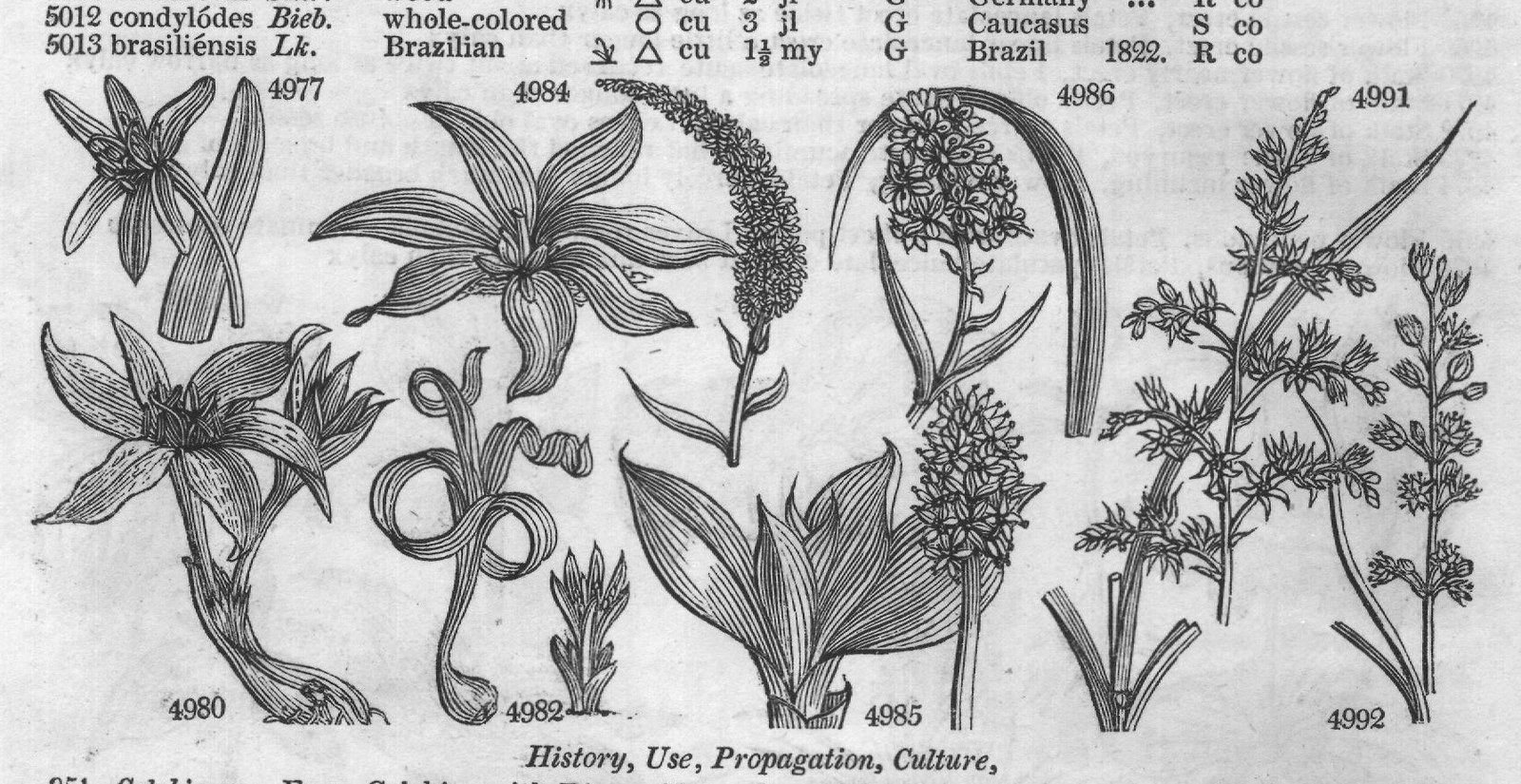
U2 common HEXANDRIA TRIGYNIA. 851. COL/CHICUM. W. MEADOW-SAFFRON. 4977 autumnále W.
Melanthaceæ. Sp. 7.
S.O Pu Britain mead. O s.p CLASS VI.