Home › E › Eng (Bot R co R co Bux cent t Lin)
Eng (Bot R co R co Bux cent t Lin)
bot. 169 1802. R co 1759. R co Bux. cent.4. t.46 Lin. fil. dec. t. 20 1559. O'CHRUS. Bauh.
OCHRUS.
Leguminosæ.
Sp. 1. 10379 pállida P. S. yellow-flowered or 3 jn.jl Y Pisum O'chrus W. 1560. PI'SUM. W. 10380 satívum W.
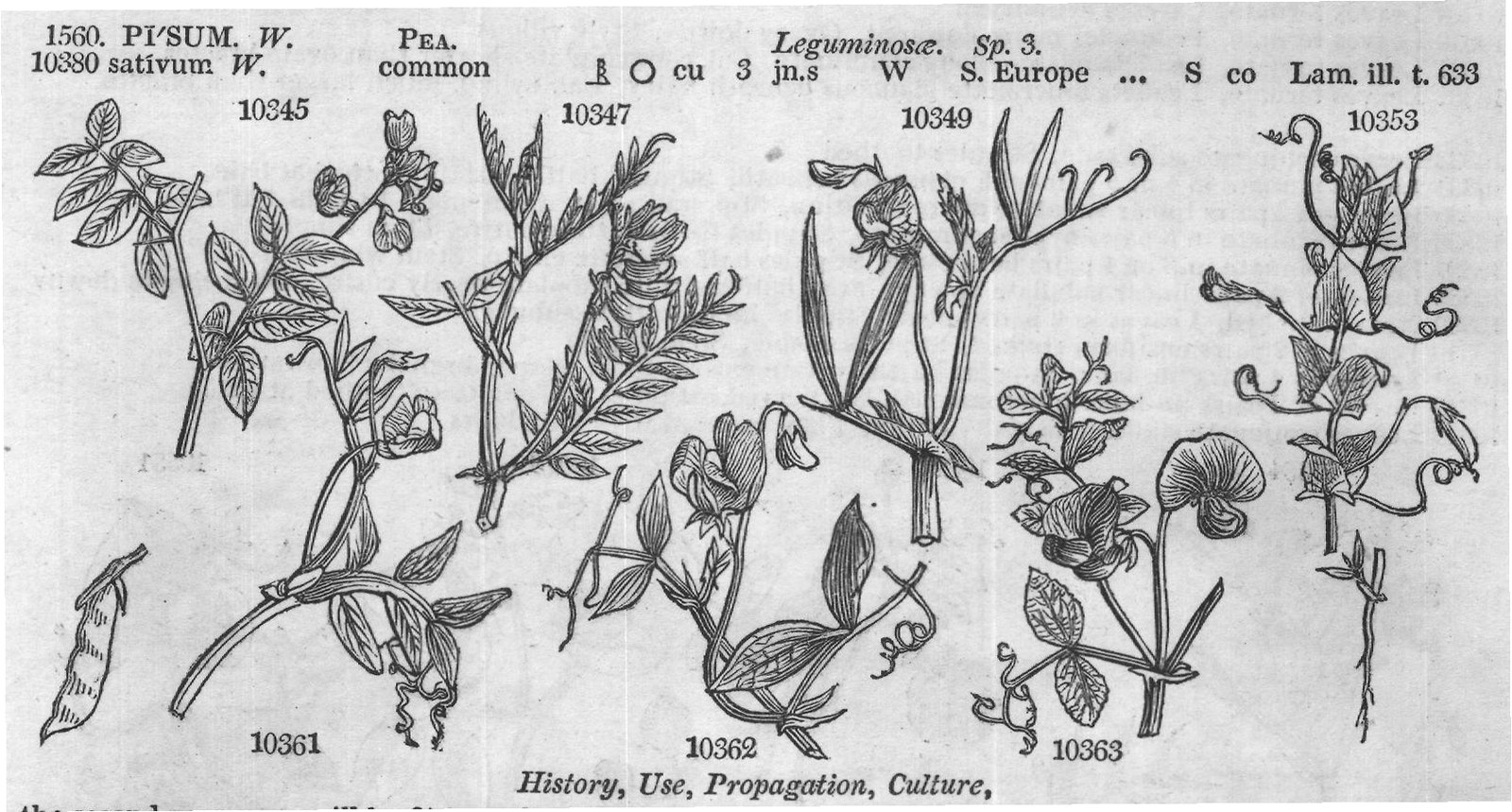
PEA. common cu 10345 10347 S. Europe 1633. S s.l Sch. han.2. t.200 Leguminosa. Sp. 3. 3 jn.s W S. Europe 10349 V ...
S co Lam. ill. t. 633 10353 10361 10362 10363 History, Use, Propagation, Culture, the second year some will be fit to gather, and by taking only the largest, the bed will continue productive for several years, adding some fresh compost every year. 1558. Lathyrus. A name employed by Theophrastus to designate a leguminous plant. It is said by his commentator Bodæus a Stapel, to have been derived from λa, an augmentative particle, and θoύρoς, any thing which is exciting; and to have been applied to this plant in consequence of certain aphrodisiacal qualities ascribed to it. L. sativus, Gesse, Fr., is frequently sown in Switzerland for soiling horses. In several parts of the continent, a white light pleasant bread is made from the flour of this pulse, but it produced such dreadful effects in the last century, that the use of it was forbid by an edict of George, Duke of Wurtemburg, in 1671; and this not being observed, was enforced by two other edicts under his successor Leopold, in 1705, and 1714.
Mixed with wheat flour in half the quantity, it makes a very good bread, that appears to be harmless. But bread made with this flour only has brought on a most surprising rigidity of the limbs in those who have bread made with this flour only has brought on a most surprising rigidity of the limbs in those who have used it for a continuance ; insomuch that the exterior muscles could not by any means be reduced, or have their natural action restored. These symptoms usually appeared on a sudden, without any previous pain; but sometimes they were preceded by a weakness and disagreeable sensation about the knees. Baths, both hot and cold, fomentations and ointments of various kinds have been tried without effect; insomuch that it is regarded as incurable, and being neither very painful nor fatal, those who are seized with it usually submit to it with patience.
Swine fattened with this meal lost the use of their limbs, but grew very fat lying on the ground. A horse fed some months on the dried herb, was said to have his legs perfectly rigid. Kine are reported to grow lean some months on the dried herb, was said to have his legs perfectly rigid. Kine are reported to grow lean on it, but sheep not to be affected. Pigeons, especially young ones, lose the power of walking by feeding on the seed. Poultry will not readily touch it, but geese eat it without any apparent damage. In some parts of Switzerland, cattle feed on the herb without any harm. It would be worth enquiring, therefore, whether the soil may not contribute something to the ill qualities of the plant: and it is remarked that the seed from a strong, fat, moist soil, is much more deleterious than from a light dry one. (Duvernoy.) Fabbroni, from Florence, in 1786, says, that the government there has cautioned the peasants against the ORDER IV.
DIADELPHIA DECANDRIA. 10345 Stem branched, Leaves in 6 pairs ovate oblong 10344 Leaves in 2 pairs ensiform, Stipules subulate, Stem simple 10346 Stem branched, Leaves in 2 pairs lanceolate nerved, Stipules somewhat spiny 10347 Leaves pinnate hairy of many pairs ovate lanc. Stip. half-sagitt. Stem branched decumbent hairy 10348 Leaves pinnate smooth of many pairs elliptical, Stipules ovate lanceol. Stem branched erect hairy 10349 Peduncles 1-flowered, Tendrils leafless, Stipules sagittate cordate 10350 Peduncles many-flowered, Leaves simple, Stipules subulate 10351 Peduncles 1-flowered longer than calyx, Tendrils 2-leaved simple 10352 Peduncles 1-flowered, Tendrils 2-leaved, Pods ovate compressed channelled at back 10353 Peduncles 1-flowered, Tendrils 2-leaved and 4-leaved, Pods ovate compressed with 2 edges at back 10354 Peduncles 1-flowered shorter than calyx, Tendrils 2-leaved simple, Leaflets lanceolate 10355 Peduncles 1-flowered, Tendrils 2-leaved, Leaflets setaceous linear 10356 Peduncles 1-flowered as long as cal. Petioles 2-leaved, Leaflets lanc. Pods linear roughish mucronate 10357 Peduncles 1-flowered awned, Tendrils 2-leaved simple ensiform 10358 Peduncles 1-flowered awned, Tendrils 2-leaved simple, Leaflets linear 10359 Peduncles 1-flowered, Tendrils 4-leaved, Petioles winged, Pods compressed 10360 Peduncles 1-flowered awned, Tendrils many-leaved, Leaflets linear truncate mucronate 10361 Peduncles about 1-fl. Tendrils many-leaved, Leaflets alternate lanceolate, Petioles winged 10362 Peduncles 2-flowered, Tendrils 2-leaved, Leaflets ovate oblong, Pods hairy 10363 Peduncles 2-flowered naked, Tendrils 2-leaved, Leaflets obovate wavy, Stems rigid 4-angled 10364 Peduncles 2-flowered, Tendrils 2-leaved, Leaflets ensiform, Pods smooth, Stipules 2-parted 10365 Peduncles 2-flowered, Tendrils 2-leaved, Leaflets altern. lanc. smooth, Stipules lunate 10366 Peduncles 2-flowered, Tendrils many-leaved, Leaflets lanceolate, Stipules toothed 10367 Peduncles about 3-flowered, Tendrils many-leaved, Leaves lanc. Pods hairy, Seeds rough 10368 Peduncles long many-fl. Stipules broad cordate sagittate, Tendrils 2-leaved 10369 Pedunc. many-fl. Tendrils 2-leaved, Leaflets oval, Joints naked 10370 Pedunc. 1-fl. shorter than stipules, Tendrils 2-4-leaved, Stip. toothed, Pods erect turgid and villous 10371 Pedunc. many-fl. Tendrils 2-leaved, Leaflets roundish, Joints membranous 10372 Pedunc. many-fl. Tendrils 2-leaved quite simple, Leaflets lanceolate 10373 Pedunc. many-fl. Tendrils 2-leaved, Leaflets ensiform, Joints membranous 10374 Pedunc. many-fl. Tendrils 2-leaved, Leaflets lanceolate, Joints membranous 10375 Pedunc. many-fl. Tendrils 2-leaved and 4-leaved, Leaflets lanc. Joints membranous 10376 Pedunc. many-fl. Tendrils many-leaved, Leaflets linear lanc. acute 10377 Pedunc. many-fl. Tendrils many-leaved, Leafl. lanc. obl. blunt mucronate, Joints membran. Pods curved 10378 Pedunc. many-fl. Tendrils many-leaved, Leafl. ellipt. blunt, Stipules half-sagitt. ovate broader than leaflet 10379 Petioles decurrent membranous 2-leaved, Peduncles 1-flowered 10380 Petioles round, Stipules rounded below crenate, Peduncles many-flowered 10367 10369 10372 10373 10374 10379 and Miscellaneous Particulars. 10380 use of Lathyrus sativus; swine having lost the use of their limbs, and become pitiable monsters by being fed on this pulse exclusively. The peasants, however, eat it boiled, or mixed with wheat flour, in the quantity of one-fourth, without any harm.
The poisonous Lathyrus from Barbary, is L. semine punctato of Casp. Bauhin, and seems to be only a variety; for in the crops of L. sativus in Italy, they find black seeds striped with white, as in the African seed. Fabbroni suspects it to be a mule between L. sativus and Cicera, for the flower and seed partake of the characters of both; having a black seed marked with white; and a white banner with a red keel to the corolla. (Fabbroni's Letters in MSS. Banks.) L. odoratus is one of our most esteemed border annuals, and is extensively grown in pots for decorating chambers and windows. L. tingitanus, articulatus, and annuus are also sown as border annuals. L. tuberosus produces tubers on the roots, like those of the earth nut (Bunium bulbocastanum); these are sold in the markets of Holland, like those of Orobus tuberosus and Trapa natans, and their flavor is highly esteemed.
L. latifolius is a very shewy plant for shrubberies, arbors, and trellis work, and yields a great quantity both of green fodder and seeds, which some botanists have suggested might be applied to agricultural purposes. 1559. Ochrus; oxeos, yellow, in allusion to the color of its flowers. A small annual plant with yellow flowers, native of hedges in the south of Europe. 1560. Pisum. From the Celtic pis, a pea. P. sativum, Pois, Fr., Erbse, Ger., and Pisello, Ital., is the most valuable of culinary legumes. Like most domestic plants of great antiquity, its native country is unknown, though it is commonly referred to the south of Europe. The varieties of the pea are numerous, and differ widely among themselves from the early frame, a low plant bearing only one white blossom on each footstalk, to the crown-bearing, having pink blossoms on a terminating corymb. The rouncival grows ten or twelve feet high, and the imperial not two feet. The sugar-pea has pods in which the inner film is wanting, or much less tough than usual, which admits of boiling the pods entire, and eating them in the same manner as kidney beans.
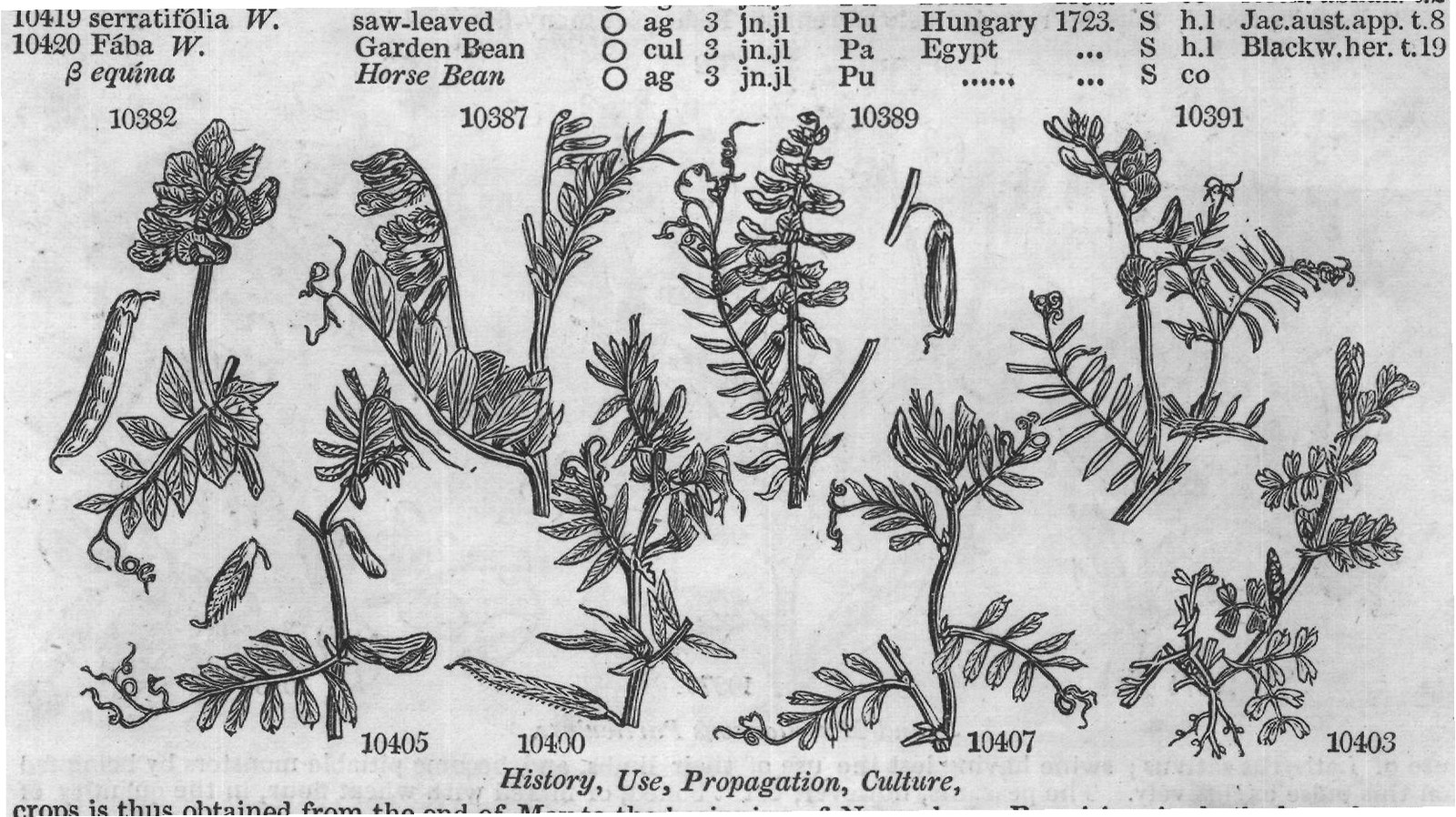
In the open garden, the pea is sown at intervals from January to the middle of July, and a succession of 10381 arven'se W. 10382 marítimum W. field sea or 1 jl 1561. VI CIA. W.
VETCH.
Leguminosæ. Sp. 38-100. 10383 pisifórmis W.
Pea-shaped or 2 jl.au DIADELPHIA DECANDRIA.
Bag 3 jn.s RS. Europe CLASS XVII.
Sco B England sea sh. D s.l Eng. bot. 1046 Pa. Y Austria 1739. R co 10384 dumetórum W. great-wood or 1 my.jn 10385 sylvática W. common-wood or 6 jl.au W 10386 cassúbica W.
Cassubian or 3 jn.jl L.B 10387 atropurpúrea W. dark-purple 10388 villósa W. or 3 jn.jl Pu Pu France 1752. R co Britain moi.w. R co Germany 1711. R co Algiers 1815. R co Jac. aust.4. t.364 Spreng.fl.hal. t.7