Home › E › Eng (Bot Jac aus t W et Kit t)
Eng (Bot Jac aus t W et Kit t)
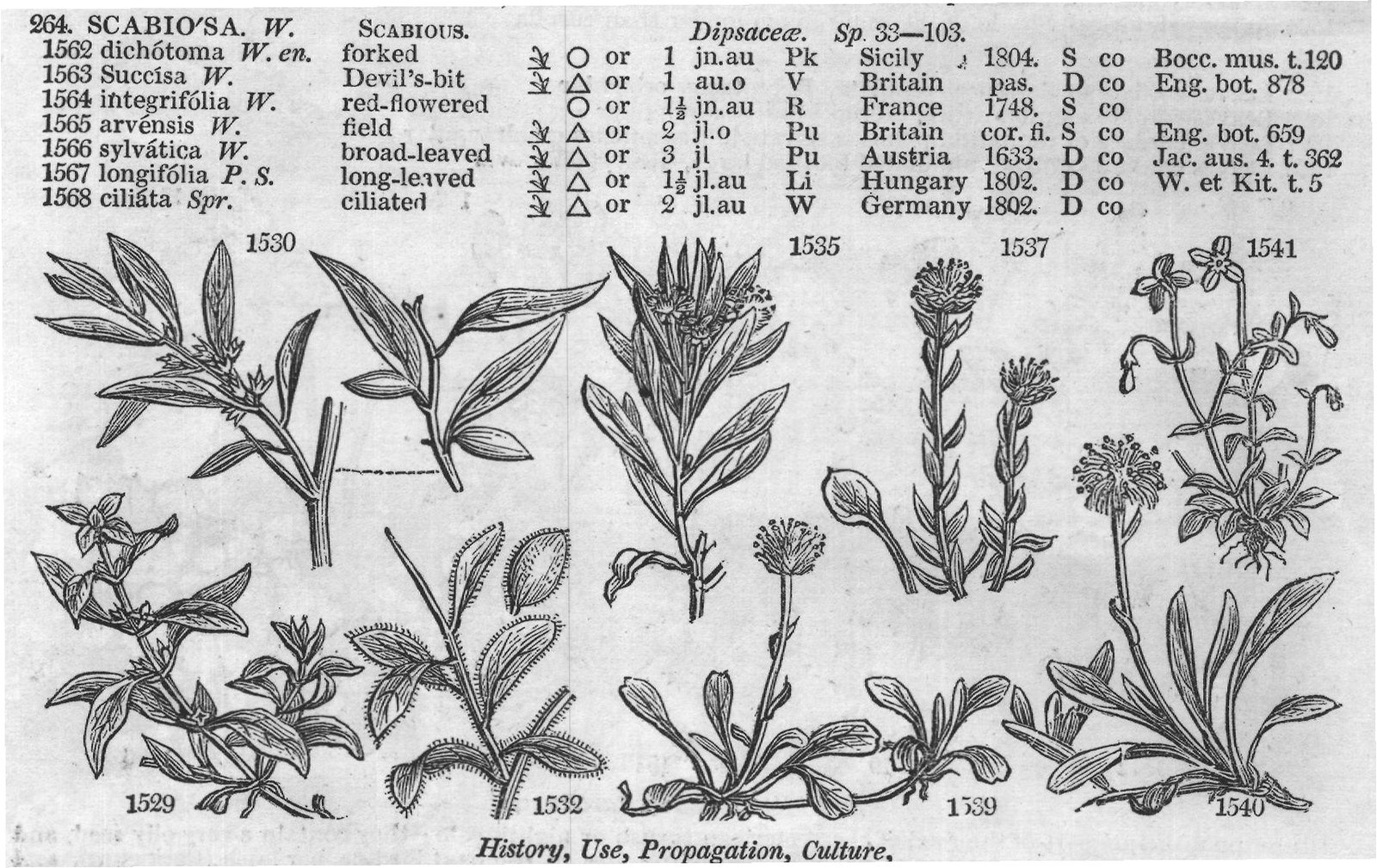
bot. 659 Jac. aus. 4. t. 362 W. et Kit. t. 5 1530 1535 1537 1541 1529 1532 1539 1540 History, Use, Propagation, Culture, 258. Isnarda. Antoine Tristan Danti d'Isnard was a French botanist, professor at the Jardin du Roi, and member of the Academy of Sciences, to which he communicated many memoirs upon plants from 1716 to 1724. of the Academy of Sciences, to which he communicated many memoirs upon plants from 1716 to 1724. An obscure marsh plant . 259. Elæagnus. From ελaia, an olive : the tree having a striking resemblance to the olive tree. E. angustifolia is a low tree with elegant silvery leaves and a brown bark, but not of long duration. All the hardy speis a low tree with elegant silvery leaves and a brown bark, but not of long duration. All the hardy species are commonly propagated by layers; but according to Sweet and Haynes, "cuttings will strike if taken off at a joint in ripened wood, and planted in a sheltered situation early in autumn." The green-house and stove species strike in sand under a bell-glass. 260. Globularia. From the flowers being packed in globose heads. The species called Alypum has been so named from ce, privative, and runn, pain used by way of antiphrasis, according to Dalechamp, because it is a dangerous a, privative, and λύπη, pain; used by way of antiphrasis, according to Dalechamp, because it is a dangerous purgative. Bauhin even calls it Frutex terribilis; but Clusius says, it was used by the Spanish quacks of his day as a cure for venereal diseases. It is however doubtful whether the Alypon of the old botanists is the same with the plant so called by the moderns. Cuttings of the shrubby green-house species, taken off before they begin to make new shoots, root freely in loam and peat under a bell-glass, and in moderate bottom heat. The hardy and herbaceous kinds may be propagated from seeds, or divided like daisies. Miller says, they prefer a shady situation and a moist loamy soil; but Sweet recommends a light sandy soil. The leaves of most of the species dry black. 261.
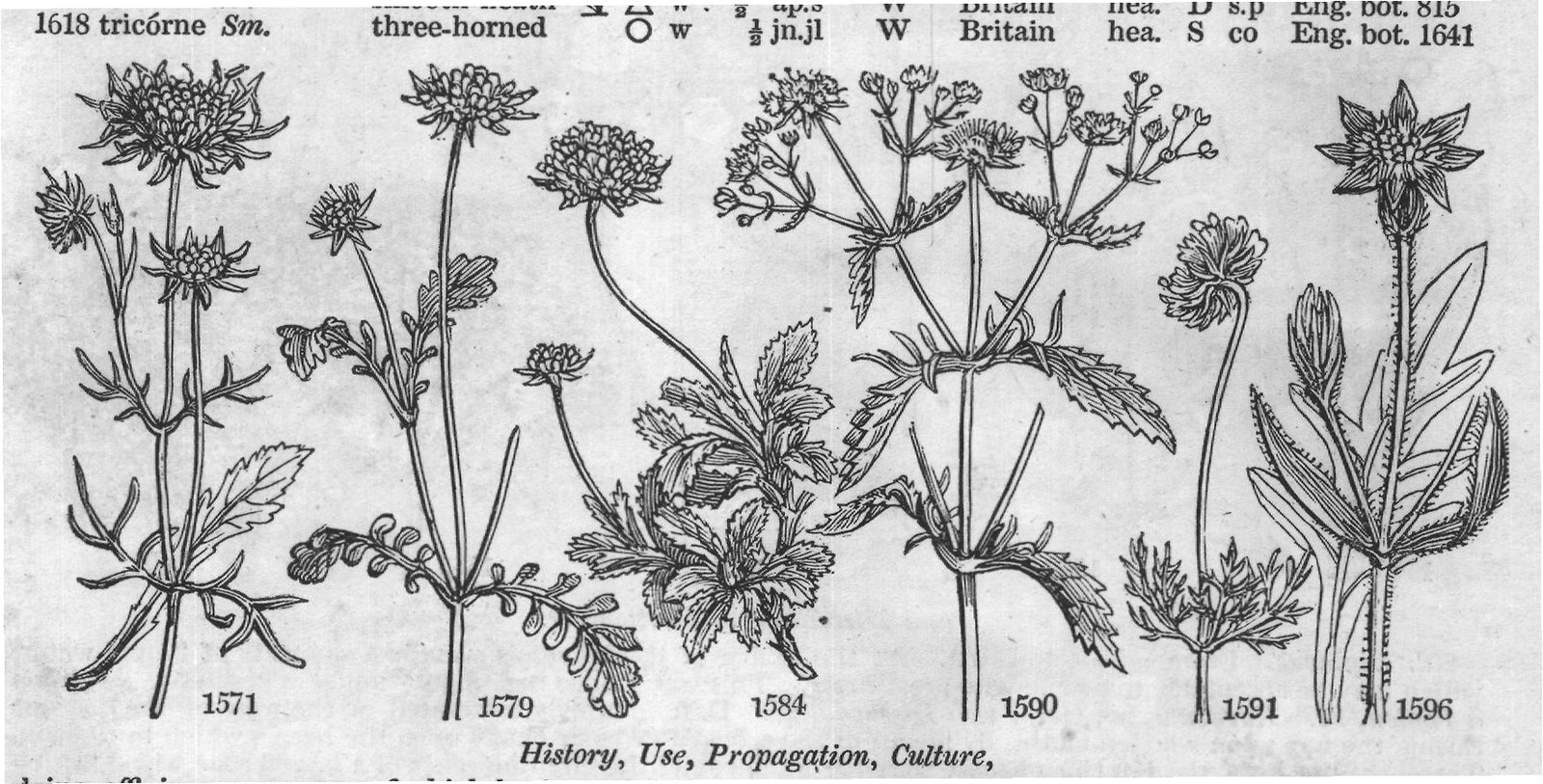
Houstonia. Named after Dr. Wm. Houston, the friend and correspondent of Miller: he died in 1733. The plants are small, elegant in their habits, and very fit for pots or rockwork. plants are small, elegant in their habits, and very fit for pots or rockwork. ORDER I. 1529 Leaves stalked ovate acute 1530 Leaves lanceolate TETRANDRIA MONOGYNIA. 1531 Leaves oblong acute at each end silvery, Flowers solitary nodding 1532 Leaves oblong ovate opaque 1533 Leaves ovate 1534 Leaves ovate acuminate wavy 1535 Stem shrubby, Leaves lanceolate linear entire, Flowers axillary subsessile solitary 1536 Stem shrubby, Leaves lanceolate 3-toothed and entire, Heads terminal 1537 Stem herbaceous, Radical leaves about 3-toothed much longer than the stalk, Cauline lanceolate 1538 Radical leaves crenate acuminate, Cauline entire mucronate 1539 Radical leaves wedge-shaped retuse toothed at end the intermediate tooth very small 1540 Stem naked, Leaves entire lanceolate 1541 Leaves radical ovate, Stem compound, First peduncles 2-flowered 1542 Leaves ovate lanceolate, Corymbs terminal 1543 Corona obsolete, Head cylindrical, Bractes recurved, Leaves connate entire subcoriaceous 1544 Corona obsolete, Head cylind. Bractes straight, Invol. weak longer than head, Lvs. conn. entire or jagged 1545 Leaves of involucre linear-lanceolate rigid about as long as the head, Leaves usually sinuately jagged 1546 Corona membranaceous, Head ovate, Involucre weak deflexed 1547 Leaves oblong serrate villous stalked sublobate, Cauline connate, Heads globular villous 1548 Corona obsolete, Head globose, Involucre deflexed not quite so long as bracteæ Corollas 4-cleft. 1549 Corona with 8 nearly eq. awned teeth, Anth. strip. with green at time of open. Br. acum. pub. Corol. radiant 1550 Corolla equal, Cal. imbr. Radical leaves pinnated, Leafl. lanc. cut toothed ciliat. Caul. tern. and sim. lin. 1551 Corollas 4-fid unequal, Scales of calyx obtuse, Leaves oblong serrated scabrous 1552 Corollas equal, Scales of calyx oblong obtuse, Leaves linear smooth entire trifid and at base pinnatifid 1553 Corona with 8 equal short teeth, Bractes awned, Awns purplish black 1554 Corona with 8 teeth of which 4 are awned and the other 4 very short, Br. awned, Awns rufous, Corol. equal 1555 Coroll. sub-equal, Scales of calyx ovate, Leaves pinnatifid 1556 Corona with 8 awned nearly equal teeth, Anth. str. with green at time of op. Br. acum. pub. Corol. radiant 1557 Coroll, radiant, Radical leaves simple, Cauline decurrent pinnated, Paleæ arid reflexed at end 1558 Corona with 4-8 obsolete teeth, Bractes awnless yellowish white the outer obtuse the inner acuminate Teeth of the corona distorted 1559 Coroll. radiant, Calyx imbricated, Leaves coriaceous smooth lanceolate entire: the upper lyrate 1560 Coroll. equal, Calyx and paleæ awned, Stem simple smoothish, Leaves lanceolate almost smooth Corollas 5-cleft. 1561 Coroll. unequal, Stem herbaceous erect, Leaves pinnatifid, Seeds bearded and feathery pappose Corollas 4-fid. 1562 Coroll. nearly equal, Stem dichotomous, Leaves oblong cauline entire subsessile radical toothed stalked 1563 Cor. equal, Stem simple, Branches approximated, Leaves lanc. ovate pubescent, Caul. lin. nearly entire Caul. lin. nearly entire 1564 Cor. radiant, Leaves undivided, Radical ovate serrated, Cauline lanceolate 1565 Coroll. radiant, Leaves entire pinnatifid and cut, Stem hispid 1566 Coroll. radiant, Leaves all undivided ovate oblong serrated, Stem hispid 1567 Coroll. radiant, Leaves oblong lanceolate entire, Stem below smooth above pilose 1568 Coroll. sub-radiant, Stem and leaves ovate hispid the lower leaves stalked entire auric. or pinn. Calyx cil. 1543 1548 1551 1553 1563 1566 1567 and Miscellaneous Particulars. 262. Dipsacus. From δiψaω, to thirst. At the axillæ of the leaves is usually a quantity of limpid water, which may be acceptable to people who are thirsty. This water once had reputation as a cosmetic. Chardon à Foulon, Fr. Kardendestel, Ger. and Dissaco, Ital. D. fullonum is cultivated in the west of England for raising the nap upon woollen cloths, by means of the crooked awns or chaffs upon the heads, which in the wild Teasel are not hooked. For this purpose they are fixed round the circumference of a large broad wheel, which is made to turn round, and the cloth is held against them. The seeds are sown in March, on well prepared strong clayey loam, broad-cast, and at the rate of one peck to the acre. They are hoed, like turnips, to a foot distance; and the second year, in August, the heads are fit to cut. They are sold by the bundle or stave, twenty-five in each, and the ordinary produce is 160 staves per acre. In Essex, carraway is often sown along with teasel, and the second year after the latter is pulled, the former is mown or reaped. (Young's Annals, vol. xxi. p. 53.) D. pilosus is the handsomest species; the seeds are eaten by small birds, and the flowers frequented by moths in great numbers. 263. Cephalaria. From κεφaλη, a head, in reference to the manner in which the flowers grow. A mere artificial division of the genus Scabiosa, from which it differs in no natural characters whatever. 264. Scabiosa. From scabies, leprosy. The sudorific qualities of this plant are said to be useful in cutaneous diseases. This is a vigorous-growing coarse-looking genus. S. succisa is one of the few examples of radix præmorsa or bitten-off root; an appearance, as Keith states, owing to the point or top of the seminal root 1574 sícula W. 1569 canéscens P. S. 1570 gramúntia W. 1571 columbária W. 1572 grandiflóra P. S. 1573 lúcida P. S. 1575 rutæfólia P. S. hoary or 1 jl.au cut-leaved or 1 jl.au fine-leaved or 1 jl.au Pu great-flowered or 3 jn.s W shining or 2 jn.s B Sicilian or 1 au Pk Rue-leaved or 1 jn.au 1576 marítima W. sea or 2 jl Pu 1577 Webbiána B. R.
Webb's or jl W 1578 holosericea Bert. silky or 1 jn.jl B 1579 stelláta W. starry 1 jl.au B 1580 prolífera W. prolific 1 jl.au Y 1581 atropurpúrea W. sweet 4 jl.s Br 1582 argentea W. silvery 2 jn.o W 1583 urceoláta P. S. jagged or 3 jl.au Y 1584 africána W.
African or 6 jl.o W 1585 nítens R. & S.
Masson's or ... jn.au Scabiósa lucida H. K. 1586 crética W.
Cretan or 1 jn.o Pu 1587 graminifólia W. grass-leaved or 1 jn B 1588 caucásea B. M.
Caucasian or 1 jl.au B 1589 lyráta W. lyrate-leaved or 1 jl.au Pu 1590 palæstína W.
Palestine or 1 jl.au Ci 1591 iseténsis W.
Siberian 1 jl.au W 1592 ucránica W.
Ukraine 1 s L.Y 1593 ochroleúca W. en. pale-flowered 1 jl.au 1594 banática P. S.
Hungarian or 3 jl.au Y Pk TETRANDRIA MONOGYNIA. 200 Hungary 1802. D co L.B S. Europe 1597. D p.l Britain dr. pa. S co Barbary 1804. S co Dauphiny 1800. D co Sicily 1783. S co Sicily 1804. D co Italy 1683. D co Mnt. Ida 1818. D co Pyrenees 1818. D co Spain 1596. S co Egypt 1683. S co 1629. S co 1713. D co Levant Barbary 1804. S co Africa 1690. S p.1 Azores 1779. D co Crete 1596. S p.1 Switzerl. 1683. D p.1 Caucasus 1803. D p.1 Turkey 1799. S s.l Palestine 1771. S s.l Siberia 1801. S s.1 Ukraine 1795. Cs.l Germany 1597. D s.l Hungary 1800. D co CLASS IV.
W.& K.hun. t.53 Ger. herb.582.f.2