Home › E › Eng (Bot mea D co America D s l)
Eng (Bot mea D co America D s l)
bot. 1048 mea. D co America 1798. D s.l Italy 1775. D co Carinthia 1804. D s.l England bar.he. S s.l Levant 1713. S s.l Montpel. 1750. S s.l 1800. S s.l Montpel. 1787. S s.l Hungary 1801. S s.l Pl.rar. hu. 1.t.50 Barr. ic. 859 Tauria Sp. 1.
Siberia Sp. 60-140.
Pon. bald. t. 340 10753 10759 10771 10755 10764 10769 10761 History, Use, Propagation, Culture, grow in the open air, but requires the protection of a frame to produce abundant crops of roots, which are used like those of the potatoe in the countries where it is a native. (Pursh. Amer. t. 22.) 1598. Melilotus. From Mel, honey, and Lotus. These plants are similar to the Lotus, and are the favorite resort of bees. M. officinalis is the chief ingredient in flavoring the Gruyère cheese. This cheese no doubt owes its chief excellence to the mixture of herbs in the mountain pasturage which surrounds the valley of Gruyère, but partly also to the flowers and seeds of this plant, which are bruised and mixed with the curd before it is pressed. 1599. Lupinaster. That is to say, Lupine-like. A pretty little herbaceous plant, with bright flowers. 1600. Trifolium. A plant with three leaves ; the τρiφuλλov, of the Greeks, trêfle, of the French, and trefoil, of the English. This genus includes the two most valuable herbage plants adopted in European agriculture, the white and red clover.
Notwithstanding all that has been said of the superiority of lucern to clover, and of the excellence of saintclover, and of the excellence of saint-foin, and various Leguminosæ of the pea kind, yet the red clover for are, and probably ever will be, found to excel all other plants in these respects. The yellow clover, T. procumbens, and the cow or meadow clover, T. medium, are also in cultivation, but are far inferior to the others. The meadow clover is a useful addition to the white sort in laying down permament pastures; the yellow grows on poor soils, but the herbage is not much liked by cattle. The soil best adapted for clover is a deep sandy loam, which is favorable to its long tap-roots: but it will grow in any soil, provided it be dry. So congenial is calcareous matter to clovers, that the mere strewing of lime on ORDER IV.
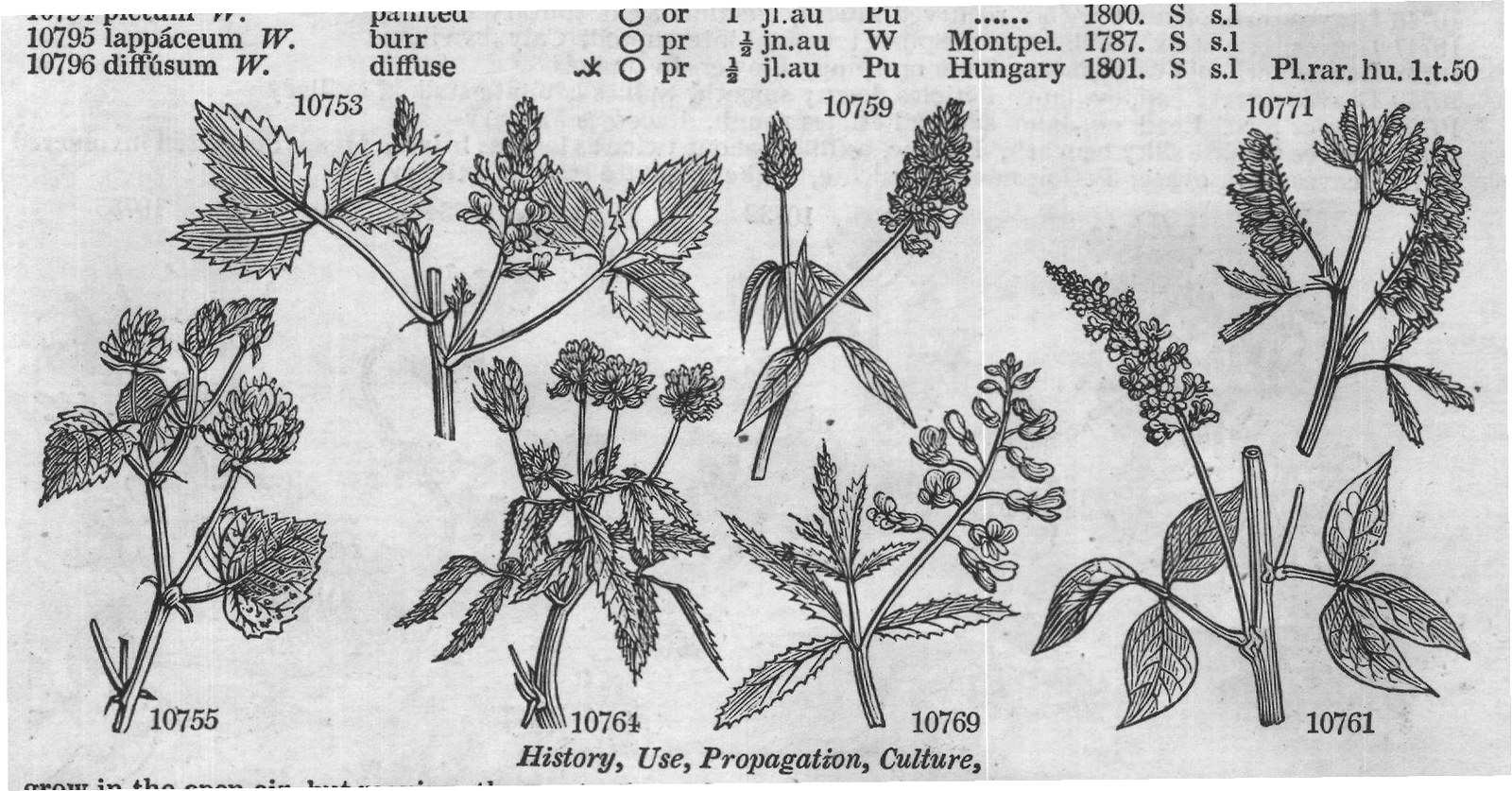
DIADELPHIA DECANDRIA. 10753 Leaves tern. roundish ovate repand at end, Spikes interrupted axillary 10754 Leaves tern. and simple linear, Head terminal 10755 Leaves simple ovate somewhat toothed, Spikes ovate 10756 Leaves digitate quinate lanc. unequal flat entire villous, Spikes axillary dense 10757 Leaves digitate quinate obovate mucro. entire, Spikes axillary dense 10758 Leaves digitate quinate very narrow, Spike few-flowered, Pods ovoid 10759 Leaves 3 lanc. Spikes obl. Bractes with long points, Pods round rugose 10760 Leaves pinnated of 5 pairs, Leaflets linear lanceolate, Pedunc. axillary 1-ff. longer than leaf 10761 Leaves ternate, Leaflets ovate-lanceolate somewhat downy, Racemes 1-sided on long stalks 10762 Leaves ternate lanc. smooth, Spikes interrupted stalked axill. longer than leaf 10763 Leaves tern. ovate-obl. downy, Spikes interrupted stalked axill. shorter than leaf 10764 Racemes obl. stalked, Stipules lanc. membranous 10765 Pods racemose naked smooth mucronate 1-seeded 10766 Pods racemose about 4-seeded oblong rugose, Leaflets ellipt. toothed 10767 Pods 1-seeded ovate acute naked rugose, Racemes shorter than leaf 10768 Pods racemose naked 2-seeded lanceolate 10769 Pods racemose naked rugose 1-seeded, Stems and branches ascending, Leafl. linear 10770 Pods racemose naked 2-seeded somewhat rugose acute, Stipules toothed at base 10771 Pods racemose naked 2-seeded rugose acute, Stipules lanc. subulate undivided 10772 Pods racemose naked 1-seeded rugose obovate acute, Stipules setaceous 10773 Pods racemose naked 2-seeded smoothish ovate acute compressed, Stipules toothed 10774 Pods racemose naked 1-seeded rugose obovate, Stipules setaceous 10775 Pods racemose naked 2-seeded rugose blunt, Leaflets entire 10776 Pods racemose naked 2-seeded membranous oval, Stem nearly erect 10777 Pods naked 8-seeded about 3 times as long as calyx, Stems declinate 10778 Pods 1-seeded obovate blunt naked rugose, Racemes longer than leaf, Stems diffuse 10779 Pods racemose naked compressed 1-seeded nerved hooked, Stipules subulate 10780 Heads halved, Leaves quinate sessile 10781 Heads in fruit reflexed, Pods 3-seeded 10782 Heads umbelled: in fruit reflexed, Pods 4-seeded, Stem angular with furrows flexuose 10783 Heads globose, Pods 2-seeded, Cal. the length of corolla, Leafl. serrulate, Stipules rhomboid 10784 Heads umbelled, Pods 4-seeded, Teeth of cal. nearly equal, Leafl. ovate-obl. emarg. serrulate 10785 Heads umbelled stalked, Teeth of cal, subulate equal, Leafl. obcord. serrate 10786 Heads umbelled, Pods 4-seeded, Teeth of calyx equal, Leafl. obovate blunt serrated 10787 Heads umbelled, Pods 4-seeded, Teeth of calyx nearly equal, Leafl. ovate obl. emarg. serrulate 10788 Heads in globose umbels imbricated, Standards deflexed persistent, Pods 4-seeded 10789 Heads umbelled, Scape naked, Pods 2-seeded pendulous, Leaves linear lanc. 10790 Heads umbelled, Pods 2-seeded, Teeth of cal. unequal, Leafl. obovate blunt toothed 10791 Heads villous 5-flowered, Central tuft reflexed rigid wrapping up the fruit 10792 Heads villous globose, Upper calyxes without florets 10793 Heads villous globose terminal solitary, Teeth of calyx setaceous longer than corolla 10794 Heads villous globose terminal solitary, Teeth of calyx setaceous shorter than corolla 10795 Heads subglobose hispid, Teeth of calyx subulate as long as cor. Leafl. obovate retuse 10796 Spikes roundish ovate villous, Teeth of calyx unequal setaceous as long as corolla 10777 10780 10782 10793 10787 10791 10783 10796 and Miscellaneous Particulars. some soils will call into action clover-seeds, which it would appear have lain dormant for ages. At least this appears the most obvious way of accounting for the well-known appearance of white clover in such cases. The climate most suitable for the clovers, as of most plants natives of Europe, is one neither very hot nor very dry and cold. Most leguminous plants delight both in a dry soil and climate, and warm temperature; and the clover will be found to produce most seed under such circumstances; but as the production of seed is only in some situations an object of the farmer's attention, a season rather moist, provided it be warm, is always attended by the most bulky crops of clover herbage.
The time of sowing seeds is generally the spring, during the corn-seed time, or from February to May; but they may also be sown from August to October; and when they are sown by themselves, that is, unaccompanied by any corn crop, this will be found the best season, as the young plants are less liable to be dried up and impeded in their progress by the sun, than when sown alone in spring, and remaining tender and unshaded during the hot and dry weather of July.
The manner of sowing is almost always broad-cast. When sown with spring corn, clover and grass-seeds are usually put in immediately after the land has been pulverized by harrowing in the corn-seed, and are themselves covered by one course more of the harrows; or, if the corn is drilled, the small seeds are sown immediately before or after hand-hoeing; and the land is then finished by a course of the harrows. In the operation of sowing, some consider it best to sow the clover and rye-grass separately, alleging that that the weight of the one seed and lightness of the other, are unfavorable to an equal distribution of both. Tt DIADELPHIA DECANDRIA. 10799 malacánthum Link. soft-flowered Al. of Eur. 1821. S s.l.
CLASS XVII.
Barbary 1817. S s.l Desf.atl.t.209.f.1 1824. S s.l Switzerl. 1816. S s.l S. Europe 1633. D co Britain me.pa. D h.l N. Amer. 1811. D l.p England dr.pa. Dh.l D.P Europe 1789. S co Pu Morocco 1804. S s.l W.Y Hungary 1752. S co W. Caucasus 1803. S co Pa.pu Britain sal.m. S s.1 1640. S s.l Pa.pu Spain 1596. S co Italy 10797 nóricum Pers. alpine prjl.au W 10798 híspidum Desf. hispid pr 1 jl.au Pu pr 1 jl.au Pa 10800 saxátile W. rock pr my.jl Pu 10801 rúbens W. long-spiked pr 2 jn.s D.R 10802 pratense W. common Clover ag 2 my.s Pu 10803 pensylvánicum W.en. Buffalo Clover pr 1½ jn.s R 10804 médium W.
Cow-grass ag 10805 alpéstre W. oval-spiked pr 2 jn.jl 1 jl Pu 10806 bracteatum W. en. large-bracted pr 1 jn.jl 10807 pannónicum W.
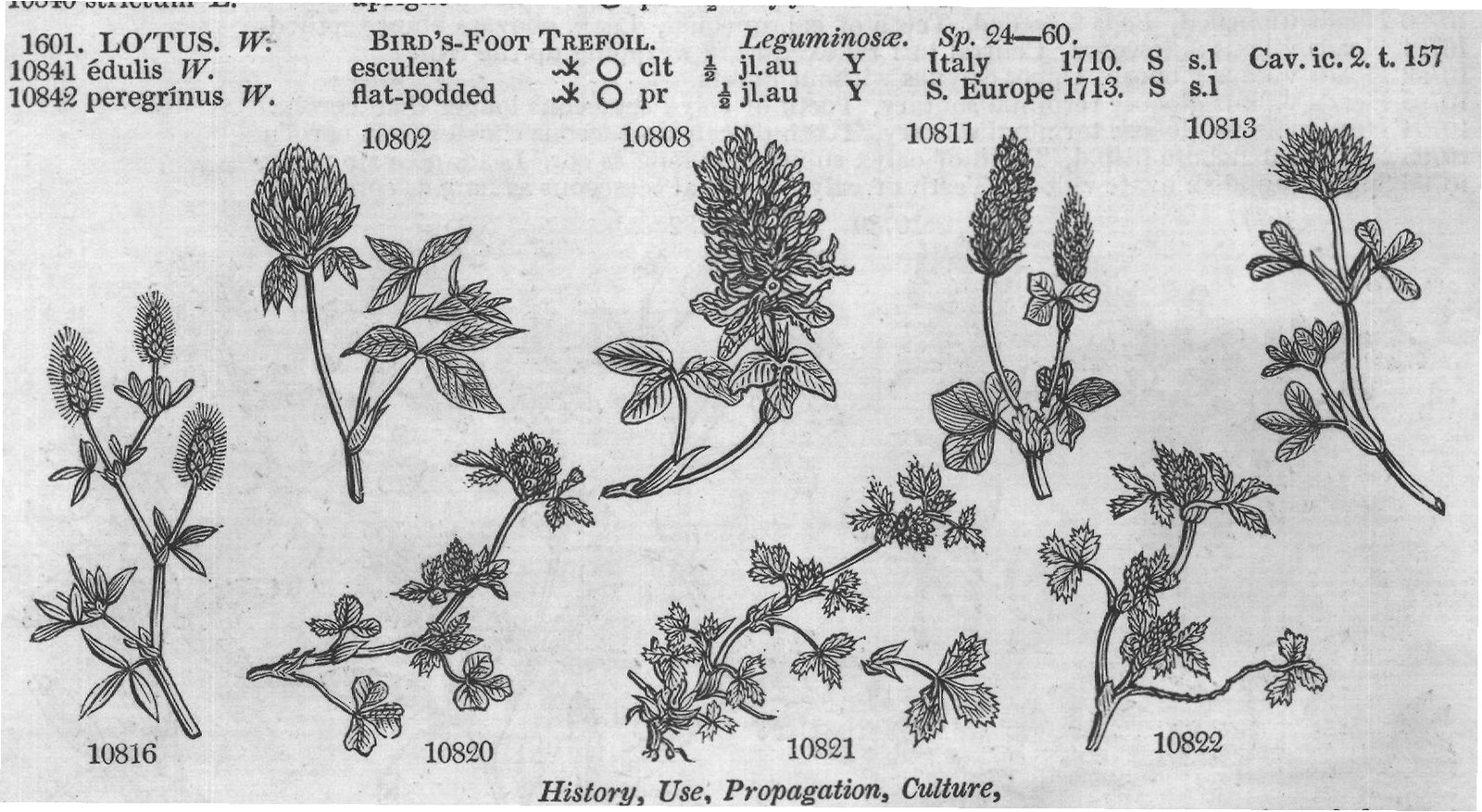
Hungarian Apr 1 jn.jl 10808 canéscens W. gray pr 1 my.jn 10809 marítimum W. teasel-headed pr jn.jl 10810 squarrósum W. various-leaved pr jl 10811 incarnátum W. flesh-colored Opr 1 jl F 10812 pállidum W. pale-flowered pr 1 jn.jl W 10813 ochroleúcum W. sulphur-colored pr 1 my.jl Sul 10814 angustifolium W. narrow-leaved 10815 lasiocéphalum Link. woolly-leaved Opr 1 jn.au Opr 1 jn.au Pu Pu 10816 arvénse W.
Hare's-foot W 1 jl.au F 10817 stellátum W. starry 10818 clypeátum W. oriental 10819 álbidum W. white pr pr 1 jn.au Opr 1 jl.au jl Pu W 10820 scábrum W. rough 10821 glomerátum W. round-headed 10822 striátum W. soft-knotted 10823 alexandrínum W.
Egyptian suffocated W Ow jn pr jn.jl 10824 suffocátum W. 10825 involucrátum W. 10826 spumósum W. 10827 resupinátum W. 10828 recúrvum P. S. 10829 tomentósum W. 10830 fragíferum W. involucrated bladdered Hungary 1803. S s.1 England dr.pa. D s.l S. Europe 1640. S s.1 C. G. H. 1823. S co Britain san.fi. S s.l England W.Y Levant prmy.jn W Pk Pu W Opr 1 ju.jl un jn.jl un jn.jl Oor 3 jn.il so.co. S s.l 1711. S s.1 1796. S s.l Britain san.fi. S s.l England gra.pa. S s.1 Britain bar.gr. S s.l Pa.Y Egypt 1798. S s.l W England sea sh. S s.l Pa.pu Morocco 1802. S co France 1771. S s.l R Pu Germany 1713. S s.l W Hungary 1805. S s.1 S. Europe 1640. S sl England moi.p. D s.l Europe 1786. D co Jac. aust. 4.t.385 All. ped. t 59.f.3