Important: Safety Warning
This page recommends preparations containing opium, laudanum, morphine, or similar narcotics — in some cases for children. These substances are dangerously addictive, easily fatal in overdose, and strictly controlled by law today.
This page gives first-aid or emergency advice that predates modern medicine and can make an emergency worse. Do not follow it. In any medical emergency, call emergency services and follow current first-aid guidance.
This page prescribes plants as medicine according to pre-modern medical theory. Several of the plants named are toxic, correct identification is difficult, and the doses given have no scientific basis. Do not ingest or apply any preparation described here.
This page presents medical treatment from an era before modern medicine. The remedies described are ineffective against the conditions named, and some of the ingredients or doses are harmful. Do not use them to treat any illness; consult a qualified medical professional.
This information has been left in for historical purposes but should not be acted upon.
Class XIII
- POLYANDRIA. STAMENS many, hypogynous, or inserted under the Ovary.
THIS class agrees with the last in having hermaphrodite flowers, with an indefinite number of stamens, which neither cohere in any part of their length, nor are distributed in distinct parcels; but it is distinguished by the stamens being inserted distinctly from the floral envelopes , immediately under the ovary, into what has been called the receptacle by Linnæus and his followers ; torus, by Mr. Salisbury; and thalamus, by some other botanists. The class consists of the greater part of several extensive natural orders, such as Ranunculace®, Magnoliaceæ, Cistineæ, &c. ; and, like the last, is replete with subjects of interest to gardeners and florists. The various kinds of Clematis form the most valuable portion of the hardy climbing plants of the verandah. The brilliant varieties of the ranunculus and anemone constitute the most attractive part of the flower garden. .
Pæonia, well known for the richness of its coloring, and the robustness of its constitution, is the ornament of every cottage; and the noble varieties of Magnolia, the pride of the North American forest, are the finest exotics of the shrubbery. Nymphæa and Nelumbium are beautiful genera of aquatic plants. Annona, or the custard apple, is one of the most important of the fruit trees of tropical countries; and the celebrated water vine of Sierra Leone is a species of Tetracera. Nor must Sarracenia, with its curious pitcher-like leaves Papaver, from which opium is extracted; Cimicifuga, whence is obtained the antidote to the dangerous bite of the rattle-snake; Bixa, or the arnotta tree, from the fruit of which the coloring matter for the red cheese of England is procured; nor Hepatica, with its modest beauties, be omitted.
The commencement of M. Decandolle's laborious Systema Vegetabilium has included nearly every thing contained in the class, and is followed in the discrimination of the species, as being the best authority which can be taken.
Order 1. MONOGYNIA.
Stamens many, hypogynous. Style 1. 1162. Capparis. Cal. 4-leaved, coriaceous, deciduous. Petals 4. Stamens long. Stigma capitate. Berry with a rind, 1-celled, stalked, subglobose, or like a pod. 1163. Marcgraavia. Cal. 6-leaved, imbricated.Corolla monopetalous, calyptriformis. Berry many-celled, many-seeded. Style O. 1164. Actea. Cal. 4-leaved, deciduous. Petals 4. Berry 1-celled. Seeds half orbicular. 1165. Sanguinaria. Cal. 2-leaved. Petals 8. Pod ovate, 1-celled. 1166. Podophyllum. Cal. 3-leaved. Petals 9. 1167. Chelidonium. Cal. 2-leaved. Petals 4.
Berry 1-celled, crowned with the stigma.
Pod 1-celled, linear. Dissepiment O. Seeds several, crested. 1168. Romeria. Petals 4. Caps. long, 2-3-4-valved; the valves opening from the vertex to the base. Seeds reniform, scurfy, without a glandular crest. 1169. Glaucium. Cal. 2-leaved. Petals 4. 1170. Papaver. Cal. 2-leaved. Petals 4. 1171. Meconopsis. Petals 4. Style short. 4-6 valves. 1172. Argemone. Cal. 3-leaved. Petals 6. Capsule half valved. 1173. Sarracenia. Cal. double, 3-5-leaved. 1174. Nymphæa. Sepals at the base of the discus, which covers the carpella.
Pod 2-celled, linear, 2-3-valved. Seeds several, dotted. Capsule 1-celled, opening by pores under the persistent stigma. Stigmas 4-6, radiating, convex, distinct. Capsule opening with Petals 5. Caps. 5-celled. Style with a clypeate stigma. discus. Petals and stamens connected with the whole of the 1175. Limnocharis. Sepals 3. Petals 3, very delicate, withering. Plant monocotyledonous. ORDER III.
ICOSANDRIA POLYGYNIA. 7635 Stem about 2-flowered, Awns straight naked, Cal. of fruit erect, Lvs. pinnate toothed 7636 Leaves pinnate: the outer leaflet very large round, lower smaller by degrees 7637 Leaves pinnate cut, Runners creeping 7633 β 7630 7632 7633 7634 7635 7636 7637 and Miscellaneous Particulars. 1161. Sieversia. Named by Willdenow, after M. Sievers, a well known Russian botanical collector. Plants resembling Geum in habit. 1176. Nuphar. Sepals, petals, and stamens inserted at the base of the discus. 1177. Euryale. Sepals, petals, and stamens united with the discus, which covers the carpella. 1178. Bixa. Cal. 5-toothed. Petals 10. Capsule hispid, 2-valved. 1179. Prockia. Cal. 3-leaved, besides two extra leaves at base. Cor. O. Berry 5-angled, many-seeded. the end. Caps. echinate, 3-6-celled, 3-6-valved. Seeds 2, with a berried arillus. -celled, 3-6-valved. Seeds 2, with a berried arillus. 1181. Apeiba. Cal. 5-leaved. Petals 5. Caps. echinate, many-celled. 1182. Sparmannia. Cal. 4-leaved. Petals 4. Filaments cohering at base, torulose. Capsule echinate, 5angled, 5-celled. Cells 2-seeded. 1183. Entelea.
Sepals 4-5. Petals 4. Stamens indefinite, uniform.
Stigma denticulate. Caps. roundish, echinate, 6-celled, half 6-valved, many-seeded. 1183. Entelea. Sepals 4-5. Petals 4. Stamens indefinite, uniform. Anthers roundish, incumbent. 1184. Muntingia. Cal. 5-parted. Petals 5. Berry 5-celled, 1-5-many-seeded. 1185. Grewia. Cal. 5-leaved, coriaceous, colored inside. Petals 5. Scales 5. Ovary usually stalked. Drupe 4-lobed, 4-celled. Nut 1-2-seeded. 1186. Tilia. Cal. 5-parted. Petals 5. Capsule coriaceous, globose, 5-celled, 4-valved, opening at base, I-seeded. 1187. Corchorus. Cal. 5-leaved, deciduous. Petals 5. Style scarcely any. Stigma 1-3. Capsule pod-shaped, 2-celled, 2-5-valved, many-seeded. celled, 2-5-valved, many-seeded. 1188. Grias. Cal. 4-cleft. Petals 4. Stigma sessile, cruciate. Drupe with an 8-furrowed nut. 1189. Calophyllum. Cal. 4-leaved, colored. Petals 4. Drupe globose. 1190. Mammea. Cal. 2-leaved. Petals 4. Berry very large, 4-seeded. 1191. Ochna. Cal. 5-leaved. Petals 5. Berries 1-seeded, with a large roundish receptacle. 1192. Elæocarpus. Cal. 5-leaved. Petals 5, torn. Anthers 2valved at end. Drupe with a curly nut. 1193. Alangium . Cal. 6-10-toothed, superior. Petals 6-10, linear. Berry coated, 1-3-seeded. 1194. Mentzelia. Cal. 5-leaved. Petals 5. Capsule inferior, cylindrical, many-seeded. 1195. Lagerstromia. Cal. 6-cleft, campanulate. Petals 6. Stamens many, of which the six outer are thickest. Caps. 4-6-celled, many-seeded. 1196. Ægle. Cal. 1-leaved, 5-lobed. Petals 5, spreading. Style short, thick. Berry coated, turbinate, globose, finally woody, with 12-16 cells. 1197. Cistus. Cal. 5-leaved, with two small leaflets. Petals 5. Caps. 5-celled; the valves bearing the dissepiments in the middle. 1198. Helianthemum. Divisions of the calyx often unequal: the two outer the smallest. Caps. 1-celled, 3-valved, with the dissepiment in the middle of the valves. valved, with the dissepiment in the middle of the valves. Order 2. DI-TRIGYNIA.
Stamens many, hypogynous. Styles 2-3. 1199. Bauera. Cal. 7-9-leaved, persistent. Petals 7-9, deciduous. Caps. inflated, 2-celled, many-seeded. 1200. Fothergilla. Cal. truncate, entire. Cor. O. Filaments very long, clavate. 1200. Fothergilla. Cal. truncate, entire. Cor. O. Filaments very long, clavate. Ovary bifid. Caps. 2-celled, 1201. Curatella. Cal. 5-leaved. Petals 4. Styles 2. 1202. Pæonia. Cal. 5-leaved. Petals 5. Style O. Caps. many-seeded, like a pod. 2-horned. Seeds solitary, bony.
Caps. 2-parted. Cells 2-seeded.
Anthers oval, oblong. Ovaries 1-15. Styles filiform, inflexed. Carpella membranous, generally 1-2-seeded. 1203. Hibbertia. Stamens distinct, filiform, equal. 1204. Delphinium. Cal. O. Petals 5. Nectary bifid, cornute behind. Siliques 3-1. 1205. Aconitum. Cal. O. Petals 5; the upper vaulted. Nectaries 2, hooded, stalked, recurved. Siliques 3-5. 1206. Trachytella. Carpella 1-2, berried, many-seeded; otherwise Tetracera. Order 3. PENTAGYNIA.
Stamens many, hypogynous. Styles 5. 1207. Cimicifuga. Cal. 4-leaved. Cor. with four urceolate nectaries. Caps. 4. Seeds scaly. 1208. Aquilegia. Cal. O. Petals 5. Nectaries 5, horned between the petals. Caps. 5, distinct. - POLYANDRIA.
CLASS XIII. 1209. Nigella. Cal. O. Petals 5. Nectaries 5, trifid between the corolla. 1210. Reaumuria. Cal. 5leaved. Petals reflexed, 5. Caps. 5-celled, 5valved, many-seeded. Seeds woolly. 1211. Colbertia. Ten stamens much longer than the others. Carpella 5, united? Stigma capitate. Seeds several in each cell, reniform, inclosed in a pellucid pulp. 1212. Tetracera. Flowers often diœcious or polygamous. Carpella 3-5, capsular, surrounded by the imbricated sepals. Seeds 1-2, shining, ovate, with an arillus. Order 4. POLYGYNIA. 1213. Nelumbium. Cal. 4-5-leaved. Petals many.
Styles many. Stamens many, hypogynous.
Fruit turbinate, in a truncate discus, with several -seeded hollows. Nuts ovate, crowned with the persistent style. 1214. Dillenia. Cal. 5-leaved. Petals 5. Capsules many-seeded, connate, replete with pulp. Petals 5. Capsules many-seeded , connate, replete with pulp. 1215. Illicium. Cal. 6-leaved.
Petals 27. Caps, many, placed in a circle, 2-valved, 1-seeded . 1216. Liriodendron. Cal . 3-leaved. Petals 6. : ttenuated. 1217. Magnolia. Cal. 5-leaved. Petals 6-9. dulous.
Samaræ imbricated in a cone. Caps. 1-2-seeded, not opening, Caps. 2-valved, 1-seeded, imbricated in a cone. Seeds pen- 1218. Michelia. Cal. 3-leaved. Petals 15. Berries many, 4-seeded. 1219. Uvaria. Cal. 3-leaved. Petals 6. Berries numerous, pendulous, 4-seeded. 1220. Annona. Sepals 3, united at base, concave, cordate, acute. Petals 6, thick; the interior thicker or none. Anthers subsessile, with a dilated angular end. Berry pulpy, many-celled towards the outside. 1221. Artabotrys. Cal. 3-parted. Petals 6. Stamens hypogynous. Ovaries distinct, 2-seeded. Berries 2-seeded. Seeds collateral erect, without arillus. 1222. Guatteria. Sepals 3, united at base, ovate, subcordate, acute. Petals 6, ovate or obovate. Berries dry, coriaceous, ovate or subglobose, stalked, 1-seeded. 1223. Asimina. Cal. 3-parted. Petals 6, spreading, ovate-oblong; the inner smallest. Anthers subsessile. Berries usually 3, sessile. Seeds several.
MONOGYNIA.
Capparideæ. Sp. 10-116. cul 3 my.au W ... 1162. CAP'PARIS. W.
CAPER-TREE. 7638 spinósa W. common 7639 jamaicénsis W.
Jamaica or 4 ... 7640 frondósa W. large-leaved or 7 ...
W G 7641 ováta W. acute-leaved or 3 my.au W 7642 salig'na P. S.
Willow-leaved or 8 ...
W 7643 lineáris W. linear-leaved or 15 W 7644 Bréynia W.
Oleaster-leav'd or 11 W ... 7645 cynophallóphora W. Bay-leaved or 8 ... 7646 odoratíssima W. sweet-scented or 6 ... 7647 ferruginea W. ferrugineous or 4 W W ... 1163. MARCGRAA VIA. W. MARCGRAAVIA. 7648 umbelláta W. umbelled cu 20 W ... 7638 7639 S. Europe 1596. C s.1 Jamaica 1793. Cr.m Carthag. 1800. C s.l S. Europe Sant. Cruz 1807.
W. Indies 1793. ...
W. Indies 1752.
G.w W. Indies 1752.
Caraccas 1814.
Jamaica Capparideæ. Sp. 1-2. ...
Bot. mag. 291 Jac.am. e.p.t.101 Jac. amer. t. 103 Boc. sic. t. 42. f.3 Cr.m Cr.m Jac. amer. t. 102 L l.p Jac. amer. t. 103 Cr.m Jac. amer. t. 98 Cr.m Jac.schœ.1.t.110 Cs.l Bro. jam.t.28.f.1 W. Indies 1792. C s.l.p Jac. amer. t. 96 7640 7643 7644 7645 History, Use, Propagation, Culture, 7646 7647 1162. Capparis. From its Arabic name Kabar, from which the Greeks made κaππaρiς. Caprier, Fr., Capriolo, Ital. and Kapernstrauch, Ger. This is a genus of low shrubs, some of which produce berries and others pods. C. spinosa has the habit of the common bramble; it grows in similar situations in the south of has the habit of the common bramble; it grows in similar situations in the south of Europe, and especially on rocks and ruins. The chief supply of caper buds is from Sicily but the plant is rocks and ruins. The chief supply of caper buds is from Sicily; but the plant is cultivated in the neighbourhood of Toulon in orchards, in the intervals between fig and olive trees, and in of Toulon in orchards, in the intervals between fig and olive trees, and in the neighbourhood of Paris, where it is trained on low walls, and the shoots during winter laid down and Paris, where it is trained on low walls, and the shoots during winter laid down and covered with soil to protect them from the frost. In this country it is generally treated as a stove plant them from the frost. In this country it is generally treated as a stove plant; though it has stood the winter in the open air in some situations, and by raising from the seed for several winter in the open air in some situations, and by raising from the seed for several generations might probably be naturalized. A plant stood near a century against the wall of the garden of be naturalized. A plant stood near a century against the wall of the garden of Camden House, Kensington ; it produced many flowers annually, though the young shoots were frequently ; it produced many flowers annually, though the young shoots were frequently killed to the stump during winter.
As a pickle, the flower buds of the caper are in great esteem throughout Europe. In Italy, the unripe fruit is prepared in the same way as the flower buds both are highly acrid and burning to the taste. In the isles of the Mediterranean, and near Toulon, the flower buds of the caper are gathered just before they , and near Toulon, the flower buds of the caper are gathered just before they begin to expand, which forms a daily occupation during six months, when the plants are in a flowering state. forms a daily occupation during six months, when the plants are in a flowering state.
As the buds are gathered they are thrown into a cask among as much salt and vinegar as is sufficient to cover they are thrown into a cask among as much salt and vinegar as is sufficient to cover CLASS XIII.
POLYANDRIA. 1224. Xylopia. Cal. 3-5-lobed. Petals 6; the exterior largest. Stamens usually inserted in a globose receptacle. Berries 2-15, on short stalks, compressed, frequently dry and opening. Seeds shining. 1225. Hepatica. Invol. 3-leaved, 1-flowered, resembling a calyx, entire. Sepals petaloid, 6-9, arranged in 2 or rows. Ovaries many. Grains without an awn. 3 rows. Ovaries many. Grains without an awn. 1226. Anemone. Invol. 3-leaved, distant from the flower, cut. Sepals 5-15, petaloid. Petals O. 1227. Clematis. Invol. O, or like a calyx under the flower. Sepals 4-8, colored. Petals O, or shorter than the sepals. Grains terminating in a feathery awn. sepals. Grains terminating in a feathery awn. 1228. Naravelia. Petals 6-12, longer than calyx. Grains seated on a thick hollow stalk. 1229. Thalictrum. Invol. O.
Petals O. Grains dry, not awned, sometimes stalked, sometimes with a longitudinal furrow. 1230. Adonis. Sepals 5, appressed. Petals 5-15, with a naked claw. Grains many, 1-seeded, spiked, ovate, pointed with the persistent hardened style. 1231. Knowltonia. Sepals 5. Petals 5-15, with a naked claw. Ovaries upon a globose receptacle. Grains 1-seeded, berried, with a deciduous style. seeded, berried, with a deciduous style. 1232. Ficaria. Sepals 3, deciduous. Petals 9, with a honey-pore at base. Grains obtuse. 1233. Ranunculus. Sepals 5, not deciduous. Petals 5, rarely 10, with a honey-scale at base. Grains pointed. 1234. Trollius. Sepals colored, 5-10-15, deciduous, petaloid. Capsules many, subcylindrical, many-seeded. 1235. Isopyrum. Sepals 5, deciduous. Petals 5, equal, tubular, 2-lipped. Ovaries 2-20. Capsules compressed, membranous, many-seeded. Seeds minute, dotted 1236. Eranthis. Involucre under the flower, cut into many divisions. Sepals 5-8, colored, oblong, deciduous. Petals 6-8, tubular. Capsules stalked. Seeds globose. 1237. Helleborus. Sepals 5, persistent, roundish, obtuse, large, usually green. Petals 8-10, tubular, nectariferous. Stigmas orbicular. Capsules coriaceous. 1238. Coptis. Sepals 5-6, colored, petaloid, deciduous. Petals small, cucullate. Stamens 20-25. Caps. 6-10, on long stalks, membranous, 4-6-seeded. 1239. Caltha. Sepals 5, colored, round. Petals O. Stamens many. Capsule spreading, 1-celled, many. seeded. 1240. Hydropeltis. Sepals 3-4. Petals 3-4. Ovaries 6-18. Seeds in a pendulous ovate globose capsule. 1241. Hydrastis. Sepals 3, ovate. Petals O.
Cariopsides berried, many in a head, terminated by the style, 1-celled, 1-2-seeded. celled, 1-2-seeded.
MONOGYNIA. 7638 Pedunc. 1-fl. solitary, Stipules spiny, Leaves roundish obtuse smooth, Caps. oval 7639 Pedunc. many-fl. Leaves obl. obt. emarginate downy beneath, Cor. campanulate 7640 Pedunc. umbelled, Leaves clustered in parcels 7641 Pedunc. 1-fl. solitary, Stipules spiny, Leaves roundish ovate acute smooth, Capsules oval 7642 Leaves linear lanceolate dilated downwards obtuse at each end smooth, Fruit round torulose 7643 Pedunc. racemose, Leaves linear 7644 Pedunc. racemose, Leaves perennial oblong, Cal. and pedunc. downy, FL octandrous 7645 Pedunc. many-fl. terminal, Leaves elliptical blunt smooth, Glands axillary, Fruit cylindrical torulose 7646 Pedunc. many-fl. Leaves obl. lanceolate acute dotted with scales beneath 7647 Pedunc. umbelled, Leaves persistent lanceolate downy beneath, Flowers octandrous 7648 Leaves ovate-oblong acuminate veiny 7649 7650 7653 7652 7648 7654 7651 When the caper season closes, the the smallest and greenest being They will in this state keep fit and Miscellaneous Particulars. them, and as the supply of capers is increased more vinegar is added. casks are emptied , and the buds sorted according to their size and color, reckoned the best, and put into small casks of fresh vinegar for commerce. for use for 'five or six years. It is said to be a common practice to put filings of copper in the first pickle to save vinegar, and give the buds a green color. The best capers are called nonpareilles, and the second best capucines. (N. Cours complet d'Agr.; art. Caprier.) Most of the species are very shewy when in flower: C. cynophallophora has large petals, and stamens upwards of four inches long. Ripe cuttings of all the species grow readily in sand. 1163. Marcgraavia. In memory of George Marcgraaf, of Leibstadt, author of a voyage to Brazil in 1648. A sub -parasitical creeping shrub: at first it is radicant like some ferns, but as it advances, the stem becomes shrubby, adhering still by its fibres to the trunk of some tree, to the top of which it frequently runs, at length dividing into several subdivided loose pendulous branches, commonly terminated by flowering umbels. It is frequent in the cool wooded mountains of Jamaica, and , according to Browne, appears in such various forms, that it has been mistaken for different plants in the different stages of its growth. It grows freely in British stoves, and cuttings root in sand under a glass. The genus is remarkable for the transformation of part of the bracteæ into fistular bodies, resembling the pitchers of some other plants.
CLASS XIII. 1164. ACTÆ'A. Ph.
ACTEA.
Ranunculacea. Sp. 2. 7649 spicáta W. en.
Bane-berry or 3 ap.jn W 7650 americana Ph.
American or 3 ap.jn W N. Amer. a álba white-berried or B rúbra red-berried or 3 ap.jn W N. Amer. 3 ap.jn RN. Amer.
Britain m. wo. R s.l Rp.l R p.l R p.l Eng. bot. 918 Corn.canad. t.77 1165. SANGUINA RIA. W. PUCCOON.
Papaveraceæ. Sp. 1. 7651 canadénsis W. Bloodwort pr mr.ap W N. Amer. 1680. R s.p Bot. mag. 162 1166. PODOPHYLLUM. W. DUCK'S-FOOT.
Podophyllaceæ. Sp. 1-2. 7652 peltátum W.
May-Apple cu my W N. Amer. 1664. D s.p Bot. mag. 1819 1167. CHELIDO'NIUM. W. CELANDINE.
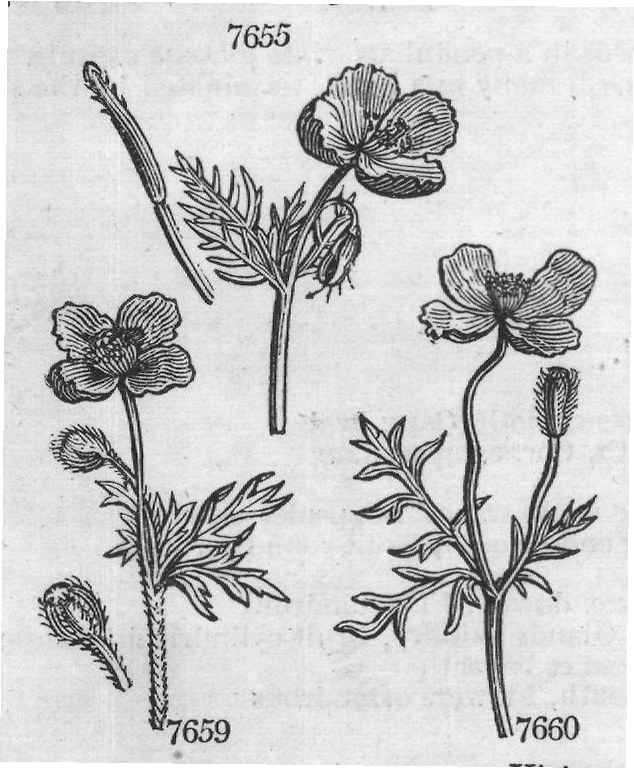
Papaveraceæ. Sp. 2-5. 7653 május W. common W 2 ap.o Y Britain 7654 laciniátum W.en. jagged or 2 ap.o Y S. Europe Britain sha.ba.. D co Eng. bot. 1581 Mill.ic.1. t.92. f.2 ... 1168. RÖME/RIA. Med. ROMERIA Papaverace. Sp. 1-3. 7655 hýbrida Dec. hybrid or 2 my.jn Pu Britain hed. S co Eng. bot. t. 201 Chelidonium hybridum L. 1169. GLAUCIUM. J.
HORN-POPPY.
Papaveraceæ.
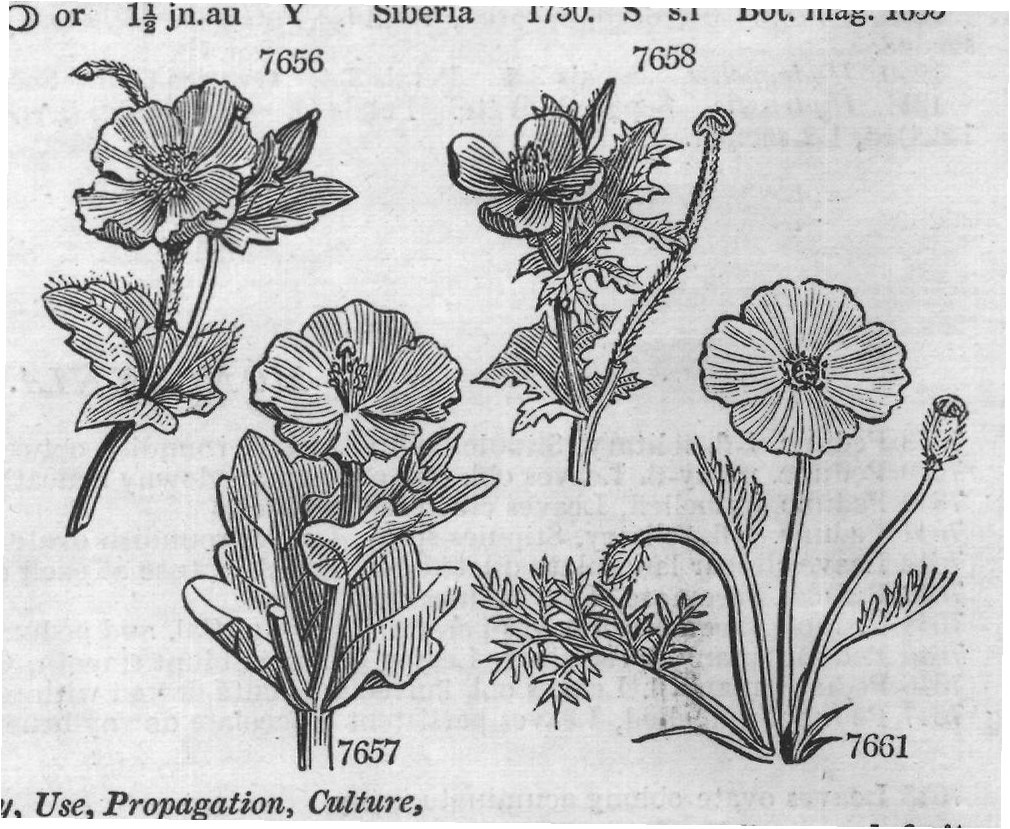
Sp. 3-5. 7656 lúteum H. K. yellow or 2 jn.o Y Britain san.sh. S co Eng. bot. 8 7657 fúlvum H. K. orange or 2 au.s Or 7658 phœníceum H. K. red or 2 jn.jl R 1170. PAPA'VER. W.
POPPY.
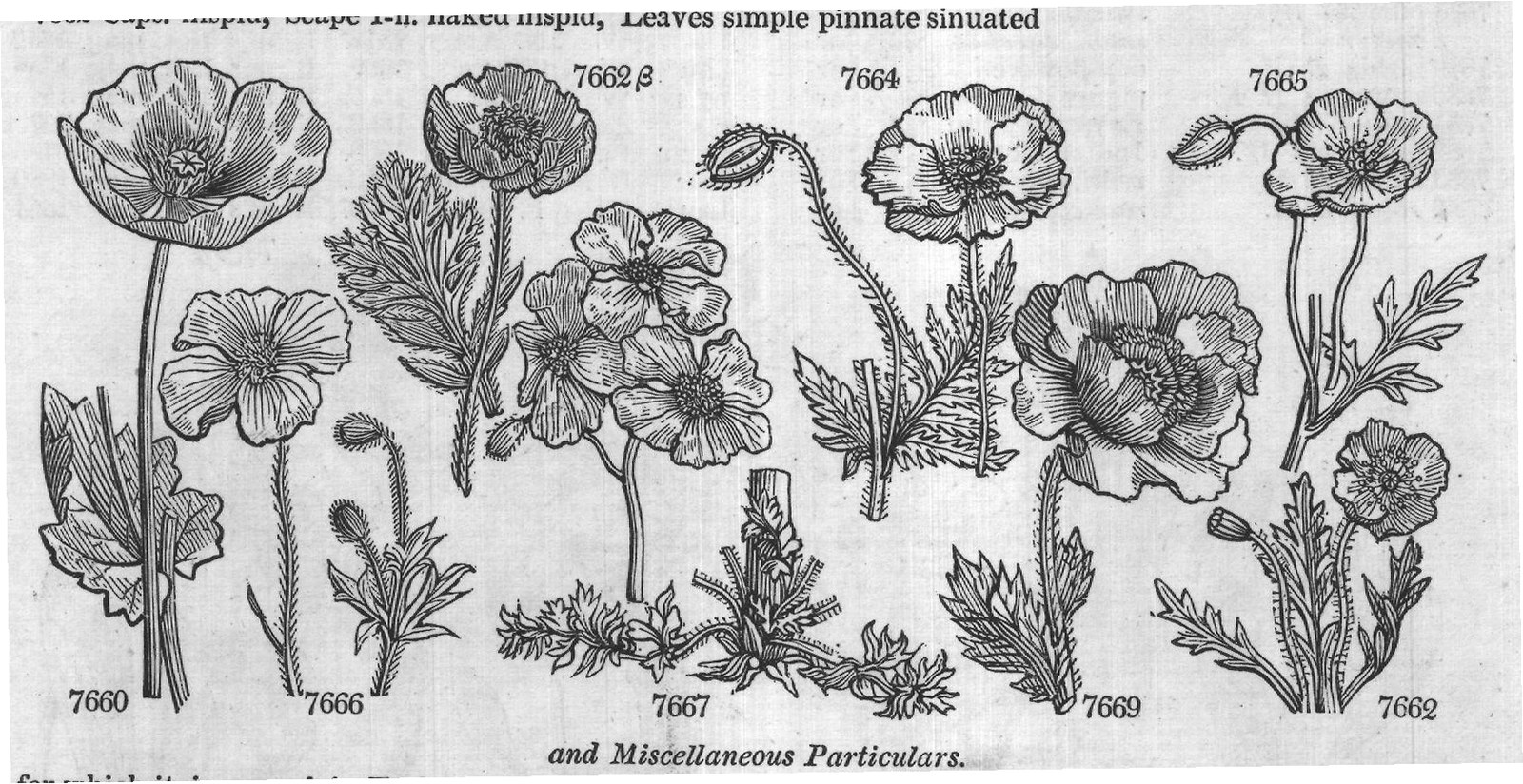
Sp. 11-26. 7659 hýbridum W. mongrel Oor 1 jn.jl 7660 Argemóne W. rough 7661 alpínum W.
Alpine or 7662 nudicaúle W. naked-stalked or ẞ lúteum yellow-flowered or or 1 jn.jl 1 jn.au Or 1 jn.au Y 7655 7656 S. Europe 1802. Sco England san. fi. S co Papaveracea. England chal.fi. S co Eng. bot. 43 S Y Britain corn fi. R co Austria 1759. S co Siberia 1730. S s.1 Siberia 1730. S s.l 7658 Sweet fl. gard.35 Eng. bot. 1433 Eng. bot. 643 Jac. aus. 1. t. 83 Bot. mag. 2344 Bot. mag. 1633 7659 7660 7657 History, Use, Propagation, Culture, 7661 1164. Actea. Aκτη was the Greek name of the elder, which this plant resembles in foliage and fruit. Weed-like plants seldom seen in gardens. The berries of A. spicata are poisonous, and with alum yield a black dye. The tubers of A. racemosa are called snake root, and much used in North America by selfpractitioners, and as an antidote against poison and the bite of the rattle snake. 1165. Sanguinaria. From sanguis, blood. All parts of the plant on being wounded discharge a bloodcolored fluid. This is a singular and very delicate looking plant. It has a tuberous fleshy root with red fibres and a reddish juice from each bud of the root there springs only a single fig-like glaucous leaf, with a one-flowered scape the flower has no smell, and is very fugacious. It abounds in the woods of Canada, and in the back settlements, where the Indians stain themselves with its red juice. 1166. Podophyllum. From πες πoδoς, a foot, and φuλλov, a leaf; in allusion to the long firm stalk on which the leaves are placed. Low neat herbaceous plants, with white flowers hidden by the overshadowing broad leaves. that flowers hidden by the overshadowing broad leaves. 1167. Chelidonium. From χελiδωv, the swallow, because it was thought to flower with the arrival of that bird, and to perish with its departure. The English word celandine appears to be a corruption and of English word celandine appears to be a corruption of chelidonium. The juice of C. majus is of an orange color and very acrimonious. It cures tetters and ringworms. Diluted with milk it consumes white opake spots on the eyes. It destroys warts, and cures the itch. There is no doubt but a medicine of such activity will one day be converted to more important purposes. (Withering.) The root, according to Loureiro, is extremely bitter, and greatly esteemed among the natives of Cochin-China, for a variety of uses in medicine . 1168. Römeria. Named after J. J. Römer, professor of botany at Landshut, and the collaborator of Schultz in an edition of the Species Plantarum of Willdenow. He died in 1820. A genus intermediate between Chelidonium, Glaucium, and Papaver. 1169. Glaucium. All the parts of the species appear covered with a glaucous bloom. Handsome sea-coast plants. G. luteum has large and numerous flowers, which, although of short duration, succeed one another in great abundance during most part of the summer, make a fine contrast with the sea-green dew-bespangled and summer, make a fine contrast with the sea-green dew-bespangled leaves, and are a great ornament to our sandy shores. The whole plant abounds in a yellow juice, is foetid, whole plant abounds in a yellow juice, is fœtid, and of a poisonous quality, and said to occasion madness. 1170. Papaver. Said by De Theis to have been so called from the Celtic papa, which signifies pap, or the soft food given to children, in which the seeds were formerly boiled to make the infants sleep. Opium is derived from wos, juice; it is supposed, to have been the Nepenthes of Homer. Rhœas, the name of one of the species, is from ῥεω, to flow or fall, in allusion to the quickly perishable nature of the flowers. The poppy produces a great quantity of seeds, for which reason Cybele, the mother of the gods, is represented crowned with poppy-heads as a symbol of fecundity.
The species of this genus are all shewy, with large, brilliant, but fugacious flowers. They are all easy of culture in almost any soil and one species affords that singular medicine opium. P. Rhœas is one of the is singular medicine opium. P. Rheas is one of the commonest weeds among corn on gravelly soils; but in its double and semidouble variegated varieties, it is also one of the handsomest of garden annuals. The capsules, as in P. somniferum, contain a milky juice of a narcotic quality an extract from them has been successfully employed as a sedative; and some foreign practitioners are said to prefer this extract to opium. P. somniferum, although it is found growing wild in the southern parts of Europe, and even in England, yet there is every reason for thinking that its seed must have been carried to these parts from Asia. It was very early cultivated in Greece, perhaps at first solely for the sake of its seed, which was used as food. It is extensively cultivated in most of the states of Europe in the present age, not only on account of the opium, ORDER 1.
POLYANDRIA MONOGYNIA. 7649 Berries roundish, Petals length of stamens, Raceme ovate, Leaves 2-3 ternate 7650 Berries ovate-oblong , Petals shorter than stamens, Raceme ovate, Leaves bi-triternate 7651 The only species 7652 Stem erect 2-leaved 1-flowered, Fruit ovate 7653 Peduncles umbelled, Leaves pinnated with roundish toothed lobed segments, Petals elliptical entire 7654 Peduncles umbelled, Leaves pinnated with finely cut segments, Petals serrated or cut 7655 Pods 3-4-valved erect with rigid bristles at end 7656 Stem smooth, Cauline leaves repand, Pod warted roughish 7657 Stem smooth, Cauline leaves roundish sinuated, Pods rough, Flowers subsessile 7658 Stem hairy, Cauline leaves pinnatifid cut, Pod bristly 7659 Caps. subglobose torose hispid, Stem leafy many-flowered 7660 Caps. clavate hispid, Stem leafy many-flowered 7661 Caps. hispid, Scape 1-fl. naked hispid, Leaves bipinnate 7662 Caps. hispid, Scape 1-fl. naked hispid, Leaves simple pinnate sinuated 7660 7666 7662 β 7667 7664 7669 7665 7662 and Miscellaneous Particulars. for which it is reared in Turkey, Persia, and India, but also on account of the capsules, and of the bland oil obtained from the seeds. All the parts of the poppy contain a white, opaque, narcotic juice; but it abounds more in the capsules: hence these are the only officinal parts of the plant, and for them chiefly is the plant cultivated in this country. They are gathered as they ripen; and as this happens at different times, there are annually three or four gatherings. They are brought to market in bags, each containing about 3000 capsules, and sold to the druggists. The London market is chiefly The the druggists. The London market is chiefly supplied from Mitcham in Surrey. The milky juice of the poppy, in its more perfect state, which is the case in warm climates only, is extracted mode by of made in the capsules, and inspissated and in this state forms the opium of commerce. The incisions made in the capsules, and inspissated; and in this state forms the opium of commerce. The mode of obtaining it appears to have been nearly the same in the time of Dioscorides as is at this day adopted. The plants, plants, during their growth, are carefully watered and manured, the watering being more profuse as the period of flowering approaches, and until the capsules are half grown, when it profuse and the as collection period of flowering approaches, and until the capsules are half grown, when it is discontinued, more longitudinal incisions are made upon each half-ripe capsule, passing from below upwards, and not penetrating to the internal cavity. The night dews favor the exudation of the juice, which is collected in the morning by wounds of the juice, which is collected in the morning by women and children, who it from off the in an earthen pot, where it is worked by wooden spatules in the sunshine, until it attains a considerable degree of thickness. It is then formed by the hand into cakes, which are laid in earthen basins to be further exsiccated, when it is covered over with poppy or tobacco leaves. Such is the mode followed in India, and according to Kampfer's account, nearly the same is practised in Persia; and when the juice is drawn in a similar manner in this country and inspissated, it has all the characters of pure opium.
Opium is brought to this country in chests from Turkey and India. The Turkey opium is in flat pieces, covered with leaves. East Indian opium is in round masses , covered with the petals of the poppy in successive layers, to the thickness nearly of one-fourth of an inch. Mr. Kerr relates, that at Bahar, it is frequently adulterated with cow-dung, the extract of the poppy procured by boiling, and various other substances. In Malava it is mixed with oil of sesamum, which is often one half of the mass; ashes and the dried leaves of the plant are also used. It is also adulterated with the aquecus extract of the capsules, the extracts of Chelidonium glaucum, Lactuca virosa, and Glycyrrhiza glabra, and sometimes with gum arabic, tragacanth, aloes, and many other articles.
Poppy heads or capsules possess anodyne properties; they are chiefly employed, boiled in water, as fomentations to inflamed and ulcerated surfaces; and a syrup, prepared with the inspissated decoction, is used as an anodyne for children, and to allay the tickling cough in chronic catarrh and phthisis.
Opium operates as a powerful and very diffusible stimulus, but its primary operation is followed by narcotic and It acts effects in a degree much greater than could be expected from the previous excitement it induces. sedative effects in a degree much greater than could be expected from the previous excitement it induces.
It acts directly on the nervous system, and when taken into the stomach destroys irritability, and allays pain in the most distant parts of the body, independent of the circulation, and without inducing any change on the composition of the blood. As the principle, therefore, on which opium acts is the same over all the body, the topical application of it is capable of producing similar effects, only in a diminished degree, to those resulting from it when it is taken into the stomach. In moderate doses, opium increases the fulness, the force, and the frequency of the pulse, augments the heat of the body, quickens respiration, and invigorates both the corporeal and mental functions, exhilarating even to intoxication; but by degrees these effects are succeeded instances but by degrees these effects are succeeded by langour, lassitude, and sleep; and in excessive use POLYANDRIA MONOGYNIA. 7663 armeníacum Lam. Armenian or 1½ jn.s Y Armenia 1815. S s.p 7664 Rhœ'as W. common-corn or 2 jn.jl Sc 7665 dúbium W. smooth or 2 jn.jl Sc 7666 caucásicum M. B.
Caucasian Oor 1 jn.jl Y 7667 floribúndum Desf. many-flowered or 1 jn.jl Sc Britain corn fi. S co Britain san. fi. S CO Caucasus 1813. S. co Levant 1815. S co CLASS XIII.
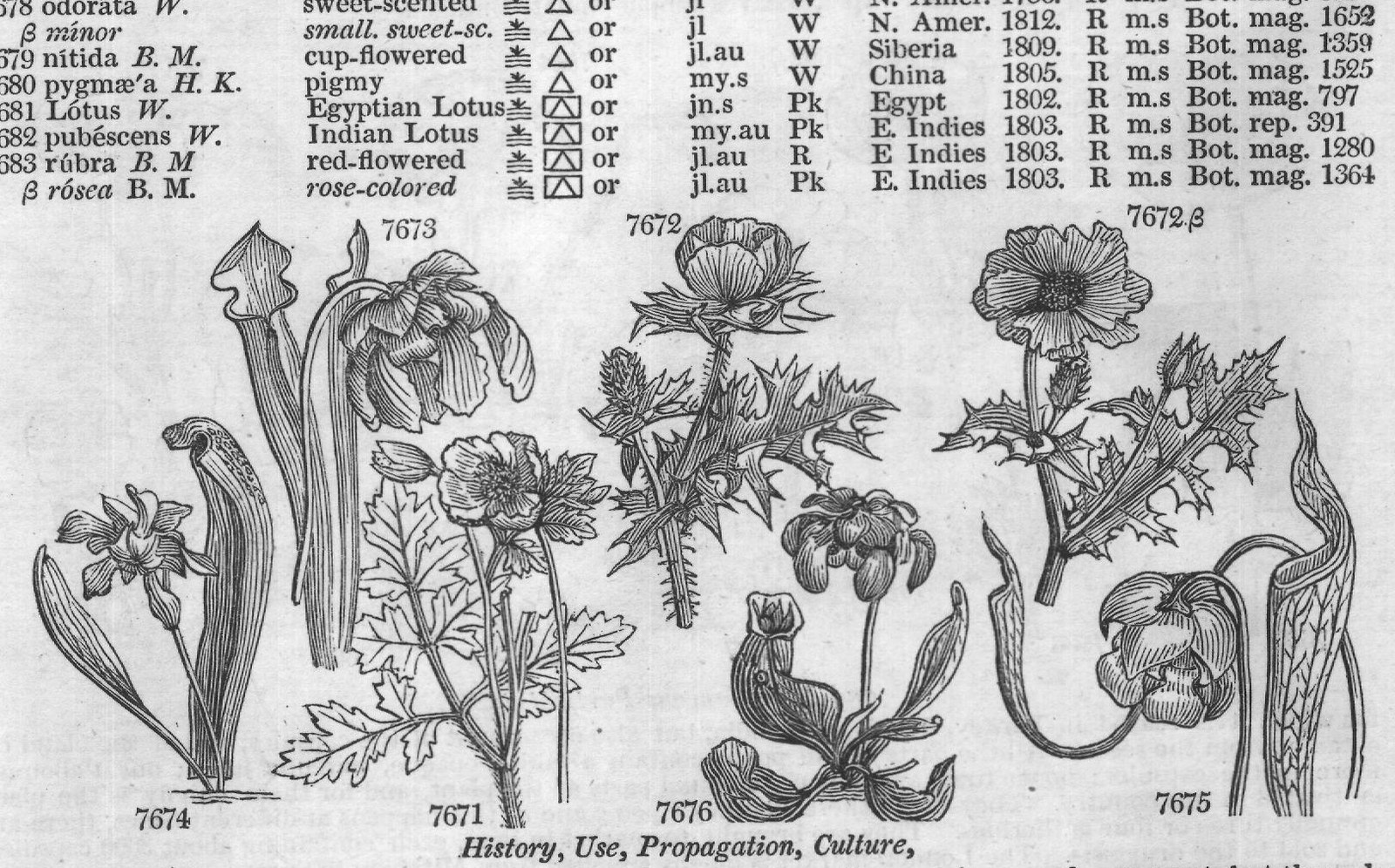
Eng. bot. 645 Eng. bot. 644 Bot. mag. 1675 Bot. reg. 134 7668 somníferum W. garden m 4 jl.au W 7669 orientále W. oriental or 3 my.jn R England corn fi. R co Levant 1714. R co Eng. bot. 2145 Bot. mag. 57 7670 bracteátum Lindl. bracted or 3 my.jn R Siberia 1818. R co Lindl. coll. 23 1171. MECONOPSIS. Vig. MECONOPSIS.
Papaveracea. Sp. 1-4. 7671 cámbrica Vig.
Welsh or 1 my.au Y England al.roc. R s.p Eng. bot. 66 1172. ARGEMO'NE. W. ARGEMONE. 7672 mexicána W.
Papaveracea. Sp. 1.
Mexican or ẞ albiflóra Sims. white-flowered or 2 jl.au Y Mexico 1592. S s.p Bot. mag. 243 2 jl.au W Mexico 1821. S s.p Bot. mag. 2342 1173. SARRACE NIA.
W. SIDE-SADDLE-FLOWER.
Papaveraceis affinis. Sp. 4-6. 7673 fláva W. yellow cu 2 jn.jl Y 7674 varioláris Ph. hook-leaved cu 1 jn.jl Y N. Amer. 1752. R m.s Bot. mag. 780 N. Amer. 1803. R m.s Bot. mag. 1710 7800 adúnca Ex. bot. t. 53 7675 rúbra W. red cu 1 jn.jl Pu N. Amer. 1786.
R m.s Hook. ex. fl. 13 psittacina Ph. 7676 purpúrea W. purple cu 1 jn.jl Pu N. Amer. 1640.
R m.s Bot. mag. 849 1174. NYMPHÆ'A. W. WATER-LILY.
Nymphæacea. Sp. 10-20. 7677 álba W. white or jn.jl W Britain riv., &c.
R m.s Eng. bot. 160 7678 odoráta W. sweet-scented or jl W N. Amer. 1786.
R m.s Bot. mag. 819 ẞ minor small. sweet-sc.or jl W N. Amer. 1812.
R m.s Bot. mag. 1652 7679 nítida B. M. cup-flowered or jl.au W Siberia 1809.
R m.s Bot. mag. 1359 7680 pygmæ'a H. K. pigmy or my.s W China 1805.
R m.s Bot. mag. 1525 7681 Lótus W.
Egyptian Lotus or jn.s Pk Egypt 1802.
R m.s Bot. mag. 797 7682 pubéscens W.
Indian Lotus or my.au Pk E. Indies 1803.
R m.s Bot. rep. 391 7683 rúbra B. M red-flowered or jl.au R E Indies 1803.
R m.s Bot. mag. 1280 ẞ rósea B. M. rose-colored or jl.au Pk E. Indies 1803.
R m.s Bot. mag. 1364 7673 7672 7672.β 7674 7671 7676 7675 History, Use, Propagation, Culture, of ardent spirits, supervene. In very large doses the primary excitement is scarcely apparent, but the pulse seems to be at once diminished, drowsiness and stupor immediately come on, and are followed by delirium, sighing, deep and stertorous breathing, cold sweats, convulsions, apoplexy, and death. The appearances on dissection are those which indicate the previous existence of violent inflammation of the stomach and bowels; but notwithstanding the symptoms of apoplexy which an overdose, when it proves fatal, occasions, no particular appearance of an inflammatory state or fulness of the vessels of the brain are perceived. The Turks call opium afioni; and in the teriakihana, or opium shops of Constantinople, they take it in graduated doses from ten grains to one hundred grains in a day. It is mixed with rich syrup and the inspissated juices of fruit, to render it more palatable and less intoxicating; and is taken with a spoon, or made up into small lozenges stamped with the words, Mash Allah, literally, " The work of God." The Tartar couriers, who travel great distances, and with astonishing rapidity, take nothing else to support them during their journeys. (Dallaway's Constantinople, quarto, 78.) There is, however, some reason for supposing that the Mash Allah, or Maslach of the Turks, contains other narcotics, as those of hemp and of lolium, as well as opium.
The use of opium for the purpose of exhilarating the spirits has long been known in Turkey, Syria, and China; and of late years it has been unfortunately adopted by many, particularly females, in this country. Russell says, that in Syria, when combined with spices and aromatics, he has known it taken to the amount of three drachms in twenty-four hours. Its habitual use cannot be too much reprobated. It impairs the digestive organs, consequently the vigour of the whole body, and destroys also gradually the mental energies. The effects of opium on those addicted to its use, says Russell, are at first obstinate costiveness, succeeded by diarrhea and flatulence, with the loss of appetite and a sottish appearance. The memories of those who take it soon fail, they become prematurely old, and then sink into the grave, objects of scorn and pity. Mustapha Shatoor, an opium eater in Smyrna, took daily three drachms of crude opium. The visible effects at the time, were the sparkling of his eyes, and great exhilaration of spirits. He found the desire of increasing his dose growing upon him. He seemed twenty years older than he really was; his complexion was very sallow, his legs small, his gums eaten away, and the teeth laid bare to the sockets. He could not rise without first swallowing half a drachm of opium. (Phil. Trans. xix. 289.) When opium has been taken in an overdose, the first thing to be done for counteracting its bad effect, is the exhibition of a powerful emetic; and for this purpose sulphate of zinc, or sulphate of copper dissolved in water, should be immediately swallowed, and the vomiting kept up for a considerable time, and urged by irritation of the fauces. Large draughts of vinegar and water, or other acidulated fluids, should afterwards be frequently taken; and the powers of the habit supported by brandy, coffee, and cordials. The sufferer should be kept awake, and, if possible, in continued gentle motion. Currie recommends the affusion of warm water at 106 degrees or 108 degrees for removing the drowsiness. (London Dispensatory, 426.) Medical men have of late sought to discover the sedative principle of opium, and have found it in the extractive, from which a crystallized salt called morphia is obtained. Some foreign physicians, and Mr. ORDER I.
POLYANDRIA MONOGYNIA. 7663 Caps. ellipt. obl. and calyxes smooth, Stem much branch. smoothish, Lvs. pinnated, Lobes lin. terminated 7664 Caps. smooth globose, Stem hairy many-fl. Leaves pinnatifid cut 7665 Caps. oblong smooth, Stem many-fl. with appressed bristles, Leaves pinnatifid cut [by a bristle 7666 Caps. ov.-obl. smooth, Stem much branched and pedunc. covered with decid. setæ, Lvs. glauc. pinnatifid 7667 Caps. smooth obl. Sepals hairy, Stem many-fl. hispid, Leaves pilose: the lower pinnate 7668 Calyxes and caps. smooth, Leaves stem-clasping cut 7669 Caps. smooth, Stems 1-fl. rough, Leaves scabrous pinnate serrate 7670 Caps. smooth, Stems 1-fl. rough, Leaves scabrous pinnate serrate, Flowers subtended by leafy bractes 7671 Caps. smooth obl. Stem many-fl. smooth, Leaves pinnate cut 7672 Caps. 6-valved, Leaves spiny 7673 Leaves erect tubular, Valve with a contracted neck, at the end flat erect 7674 Leaves long, their tube dotted at back, Appendage short vaulted incurved 7675 Lvs. short colored upwards with netted veins, Tube of leaf ending in a recurv. vaulted mucron. appendix 7676 Leaves cucullate ventricose spreading arcuate 7677 Leaves cordate entire, Lobes imbricated round, Calyx 4-leaved nd, Calyx 4-leaved 7678 Leaves cordate entire emarginate, Lobes divaricating, Point obtuse, Calyx 4-leaved 7679 Leaves cordate entire, Lateral nerves beneath level, Petioles smooth, Pet. acute, Rays of stigma 12-20 7680 Leaves cordate entire, Lateral nerves beneath level, Petioles smooth, Pet. acute , Rays of stigma 8 7681 Leaves cordate toothed very smooth , Lobes approximating, Calyx 4-leaved 7682 Leaves reniform toothed downy beneath, Lobes round, Calyx 4-leaved 7683 Leaves peltate finely toothed, beneath downy without spots 7679 7677 7683 7681 7685 7678 7678 β and Miscellaneous Particulars.
Thomson, the author of The London Dispensatory, have found that a quarter of a grain of the acetate of morphia produces the most beneficial effects that can be expected from an anodyne, allaying pain, and procuring sleep without in any degree affecting the central functions. (London Dispensatory curing sleep without in any degree affecting the central functions. (London Dispensatory, 420.) A variety of P. somniferum, known as the black poppy, from the color of its seeds, is cultivated for these to some extent; they are called maw seed, and generally stained of a light blue color. P. Rhœas (œillette, Fr.) and also somniferum are cultivated in Flanders and Germany for their seeds, which are bruised for an oil used in cookery as a substitute for that of olives. In Poland and some parts of Russia, the seeds are used as a seasoning to soups, gruels, and porridge.
Professor Martyn, in his edition of Miller's Dictionary, has collected a body of facts, which clearly prove that opium may be produced to any extent in Britain, and of equal quality to that procured from abroad; opium may be produced to any extent in Britain, and of equal quality to that procured from abroad; the value of labor in this country, however, does not admit of such a thing. We have the value of labor in this country, however, does not admit of such a thing. We have seen samples of opium made in the south of England quite equal to that of foreign growth, but we understood that the labor of collecting it was greater than could be afforded for its market price.
P. cambricum is admired for its yellow petals, and orientale and bracteatum are very splendid plants. 1171. Meconopsis. From μηκωv, a poppy, and ofis, resemblance. A genus of herbaceous shade-loving plants, just intermediate between Papaver and Argemone. The flowers are yellow. 1172. Argemone. From argema, the name by which the cataract of the eye was known, and which was thought to be cured by this plant. A. mexicana is a troublesome weed in the West Indies, with a fig-like fruit, armed with prickles, and thence, by the Spaniards, called Figo del inferno.
The whole plant abounds with a milky glutinous juice, which turns in the air to a fine bright yellow, and when reduced to consistence is not distinguishable from gamboge. In very small doses its probably of equal efficacy , given in dropsies, jaundice, and cutaneous eruptions. It is esteemed very detersive, and generally used in diseases of the eyes : but the infusion is looked upon as a sudorific and resolutive, which may be used with success on many occasions. The seeds are said to be a much stronger narcotic than opium. 1173. Sarracenia. So named by Tournefort in honor of Dr. Sarrazin, a French physician of rank residing in Quebec, who sent this genus to him from Canada it is called side-saddle flower from the resemblance of Quebec, who sent this genus to him from Canada: it is called side-saddle flower from the resemblance of the stigma to a woman's pillion. These plants are remarkable for the singular form of the leaves, which are tubular and hold water, and some species have lids or covers, which it is alleged shrink and close over the mouth of the tribe in dry weather, so as to prevent the exhalation of the water. In great drought birds and and other animals resort to them. They grow in bogs in Carolina and Virginia, and in British gardens thrive very well in pots with turfy peat at the bottom, and the upper part filled with sphagnum, or water-moss, in which the plants must be set, and then placed in pans of water; they succeed best in frames in a shady situation. (Bot. Cult. 417.) 1174. Nymphæa. The Nymph, or Naiad of the streams. The species are beautiful aquatics, especially N. alba, which has a large flower filled with petals, so as almost to appear double: it raises itself out of the alba, which has a large flower filled with petals, so as almost to appear double: it raises itself out of the water and expands about seven o'clock in the morning, and closes again, reposing upon the surface, about 7684 versicolor H. K. 7685 cærúlea H. K. changeable blue or au Pk or 7686 stelláta W. star-flowered or 1175. LIMNOCHA'RIS. Rich. LIMNOCHARIS. 7687 Plumiéri Rich.
Plumier's or 1½ jn.n 1176. NU'PHAR. H. K.
NUPHAR. 7688 lútea H. K. common-yellow 7689 Kalmiána H. K.
Canadian △ or △or 7690 Inínima E. B. least yellow or 7691 ádvena H. K. three-colored or 1177. EURY'ALE. H. K. EURYALE. 7692 férox H. K. prickly or 1178. BI'XA. W.
ARNOTTA. 7693 Orellána W. heart-leaved오 m 20 my.au Pk 1179. PROCKIA. L.
PROCKIA.
Bixineæ. Sp. 1-7. 7694 Crúcis L. ovate cu 1180. SLO ANEA. W.
SLOANEA.
POLYANDRIA MONOGYNIA. jn.s B jn.s B Y E. Indies 1807.
C. G. H. 1792.
E. Indies 1803.
Hydrocharideæ. Sp. 1-2.
Brazil Nymphæaceæ. Sp. 4-6. jn.jl Y jl.au Y jl.au Y jl.au Y Brit. pools, &c. R m.s Eng. bot. 159 Canada 1807. R m.s Bot. mag. 1243 Bot. mag. 1243 Scotland al.lak. R m.s Eng. bot. 2292 N. Amer. 1772. R m.s Bot. mag. 684 Nymphæaceæ. Sp. 1.
India jl.s R Bixineæ. Sp. 1-2.
W. Indies 1690. S s.p Bot. mag. 1456 3 jl.au Y W. Indies 1822. Cs.p Vah.symb.3.t.64 Tiliacea. Sp. 1-8.
CLASS XIII.
R m.s Bot. mag. 1189 R m.s Bot. mag. 552 R m.s Bot. rep. 330 1822. Sm.s Bot. mag. 2525 1809. R m.s Bot. mag. 1447 7695 dentáta W.
Chestnut-leav'd tm 40 W ...
S. Amer. 1752. S p.1 Plum. ic. 244 1181. APEI BA. W.
APEIBA.
Tiliacea. Sp. 4-7. 7699 lævis W. 7696 Tibóurbou W. 7697 Petoúmo W. 7698 áspera W. 1182. SPARRMAN'NIA. W. SPARRMANNIA. 7700 africána W. 1183. ENTELEA. R. Br. ENTELEA. 7701 arboréscens R. Br. arborescent hairy or 7 Y ...
S. Amer. 1756. C p.l Aub. gui.1. t.213 hoary tm 40 ...
Y prickly-capsul'd tm SO ...
Y S. Amer. 1817. C p.l Cayenne 1792. C p.I Aub. gui.1. t.215 smooth-leaved or 10 G ...
Cayenne 1817. C p.l Aub. gui.1. t.216 Aub. gui. 1. t.214 Tiliaceæ. Sp. 1.
African or 10 mr.jl W C. G. H. 1790. C p.l Bot. mag. 516 Tiliacea. Sp. 1. or 20 my W N. Zeal. 1820. C p.1 Bot. mag. 2480 1184. MUNTIN'GIA. W. MUNTINGIA. 7702 Calabúra W.
Tiliaceæ. Sp. 1.
Jamaica cu 3 jn.jl 7684 7687 cu 3 jn.jl W Jamaica 1690. C p.l Jac. amer. t. 107 7688 7689 7690 7692 7693 7691 History, Use, Propagation, Culture, four in the afternoon. The roots have an astringent bitter taste; they are used in Ireland, in the Highlands of Scotland, in the island of Jura, &c. to dye a dark brown or chesnut color. Swine are said to eat it, goats not to be fond of it, kine and horses to refuse it. The flowers, the herb, and the root were formerly used in to refuse it. The flowers, the herb, and the root were formerly used in medicine, but are all now obsolete .
N. lotus resembles our common white species very much in the form of the flower and leaves, but the latter are toothed about the edge. It is native of the hot parts of the East Indies, Africa, and America. It is very common in ponds, lakes, and rivers in Jamaica and grows in vast quantities in the plains of Lower Egypt in Jamaica; and grows in vast quantities in the plains of Lower Egypt near Cairo, during the time they are under water. It flowers there about the middle of September, and ripens are under water. It flowers there about the middle of September , and ripens towards the end of October. The Arabians call it Nuphar. The ancient Egyptians made a bread of the seed . The Arabians call it Nuphar. The ancient Egyptians made a bread of the seed of the Lotus dried and ground.
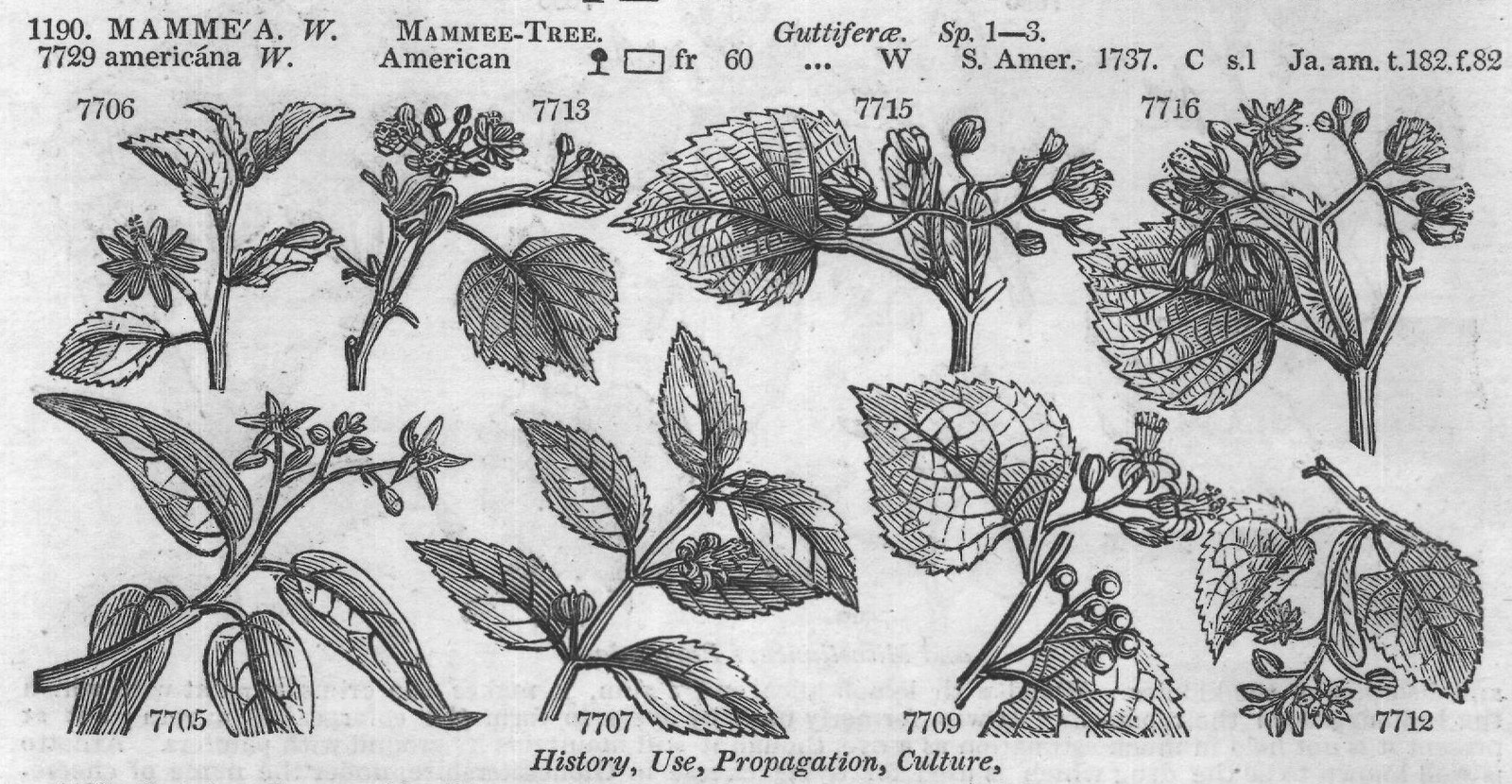
All the species grow well in large pots of water with a few inches of rich soil at the bottom: they are propagated by dividing the root, and some sorts which produce bulbs are increased by offsets from these. Mr. Kent, of Clapton, who cultivated exotic aquatics to great perfection, found that the bulbous rooted Nymphæas, if checked in their growth for want of water, from cold, or excessive heat, were apt to form bulbs at the roots for want of water, from cold, or excessive heat, were apt to form bulbs at the roots and cease growing for the season. Hence the necessity of a regular and powerful moist heat to make them Hence the necessity of a regular and powerful moist heat to make them flower freely. 1175. Limnocharis. From λiμvoς, a marsh, and χaρiς, dear, so called because the species are marsh plants. They have beautiful umbels of yellow flowers, and are very easily cultivated in a stove. They are increased by seeds. 1176. Nuphar. The Arabic name is naùfar, according to Forskahl. The species are shewy plants closely resembling Nymphæa. N. lutea is a native of most parts of Europe, and also of America. Linnæus states, that swine are fond both of the leaves and root that goats are not fond of it; and that kine, sheep, and horses leaves and root; that goats are not fond of it; and that kine, sheep, and horses refuse it also that crickets are driven out of houses by the smoke in burning it, and that both they and out of houses by the smoke in burning it, and that both they and cock-roaches are destroyed by the roots rubbed or bruised with milk. Ray observes, that the flowers smell roots rubbed or bruised with milk. Ray observes, that the flowers smell like brandy. 1177. Euryale. From εuρuaλoς, broad, in allusion to the enormous broad floating leaves of the plant. A noble aquatic, easily cultivated in a good stove. 1178. Bίχa. The American name of the tree. The drug called Terra Orellana, or Orleana, Roucon or Arnotto, is prepared from the red pulp which covers the seeds of this plant. By maceration in hot water, the seeds are separated from the pulp, the latter is then made into balls or cakes, which when dry are fit for use. Arnotto of a good quality is of the color of fire, bright within, soft to the touch, and dissolves entirely in of the color of fire, bright within, soft to the touch, and dissolves entirely in water. It is reputed to be cooling and cordial, and is much used by the Spaniards in their chocolate and and cordial, and is much used by the Spaniards in their chocolate and soups, both to heighten the flavor and to give them an agreeable color. It is esteemed good in bloody fluxes to give them an agreeable color. It is esteemed good in bloody fluxes ORDER POLYANDRIA MONOGYNIA. [end 7684 Leaves peltate at the edge and within the fissure sinuate toothed blistered smooth on each side 7685 Leaves peltate nearly entire not dotted smooth on each side 2-lobed at base, Anthers with appendages at 7686 Leaves cordate entire, Lobes divaricating acute, Calyx acute 4-leaved longer than the acute petals 7687 Leaves oblong very blunt at each end, Flowers in umbels 7688 Leaves cordate entire, Lobes approximating, Cal. 5-leaved longer than petals 7689 Sepals 5, Stigma cut with 8-10 rays, Leaves cordate a little out of the water, Petioles roundish 7890 Sepals 5, Stigma lobed with 10 rays, Lvs. obl. cord. dott. sub-pubesc. Petioles at base round, at end nearly 7691 Leaves cordate entire half erect, Lobes divaricating, Cal. 6-leaved longer than petals 7692 Petioles and calyxes covered over with stiff prickles, Leaves sometimes 3 feet across 7693 Leaves smooth on each side 7694 Leaves cordate ovate toothed, Peduncles terminal racemose 7695 Leaves ovate, Stipules cordate triangular serrated 7696 Leaves cordate lanceol. serrate hirsute beneath, Capsules bristly 7697 Leaves obl. subcordate serrulate hoary beneath, Caps. bristly 7698 Leaves obl. subcordate entire pubescent beneath, Caps. muricated 7699 Leaves obl. obovate acuminate entire smooth, Petals obtuse, Caps. scabrous 7700 The only species 7701 The only species 7702 Leaves serrated oblong oblique [3-cornered 7694 7695 7696 7698 7701 7699 7700 7702 and Miscellaneous Particulars. and disorders of the kidnies. Mixed with lemon-juice and a gum, it makes the crimson paint with which the Indians adorn their persons. It was formerly used by dyers to form the color called aurora; but at present it is not held in much estimation as a dye, though it still maintains its ground with painters. Arnotto is well known to be the drug which is used for dying cheese in Gloucestershire, under the name of cheesecoloring. It is used in Holland for coloring their butter. The bark makes good ropes for the common plantation uses in the West Indies; and pieces of the wood are used by the Indians to procure fire by friction. 1179. Prockia. A name of unknown meaning. American or Isle of France plants with alternate entire or toothed leaves, and yellow flowers, which are occasionally unisexual. Jamaica 1180. Sloanea. Named by Plumier, in memory of the famous Sir Hans Sloane, Bart., physician to the king, and president to the Royal Society; author of the Natural History of Jamaica, and founder of Chelsea garden and hospital. The leaves are like those of the chesnut; the flowers very large, and the fruit as big as a tennis ball, armed all over with strong spines, and divided regularly into four cells, each containing one small chesnut. It grows freely in our stoves, and ripened cuttings root in sand under a hand-glass. 1181. Apeiba. The vernacular name of the plant in Guiana. Tibourbou and Petoumo are vernacular names among the Caribs. The species grow freely in light loamy soil. Cuttings must be well ripened, and the glass they are put under should have a little air given it occasionally, or they will damp off. The best way of flowering it, is to cut a ring round the bark of a large branch, which stagnates it and throws it into flower. (Bot. Cult. 20.) 1182. Sparmannia. In memory of Anders or Andrew Sparrman, a Swede, fellow of the Academy of Sciences at Stockholm, who travelled into China, the Cape of Good Hope, and the islands of the South Sea. His travels were published in London, 1785, quarto, and there are many descriptions by him in the Philosophical and other transactions. It is a beautiful shrub with snowy white petals, and singular nectaries. It grows freely in loam and peat, and cuttings root in sand under a hand-glass. 1183. Entelea. From εvτελῆς, perfect. So named by Mr. Brown, because all its filaments are fertile; by which character, among others, it is distinguished from Sparmannia. A fine New Zealand plant, discovered originally by the botanists with Sir Joseph Banks in Cook's second voyage. 1184. Muntingia. Named by Plumier, after Abraham Munting, professor of botany at Groeningen, died in 1682. Calabura is an American name. The flowers resemble those of the bramble, and the fruit cherries. It grows in Jamaica on calcareous subalpine hills, flowering in spring; and in St. Domingo in the wet parts of woods, flowering in August and September. In our stoves it grows freely in light loam. and cuttings root in sand under a hand-glass.
Hh 1185. GRE/WIA, W. 7703 hirsúta W.
GREWIA. soft-leaved 오디 or 10 7704 Mallacócca W. 7705 Microcos H. K. 7706 occidentális W. 7707 orientális W. rough-fruited ☐ or 10 au.s panicled 오디 or 7 Elm-leaved or 10 jl.s Pu oriental 7708 pilósa P. S. pilose 7709 asiática W.
Asiatic or 10 jl.au or 10 or 12 jl.au Pu ... ...
Pu POLYANDRIA MONOGYNIA.
Tiliacea. Sp. 8-65.
Pu E. Indies 1816. C p.l Pa.pu E. Indies 1792. C c.p G CLASS XIII.
Bot. mag. 422 Rhee. mal.5. t.46 Sonn. it. 2. t. 138 E. Indies 1779. C c.p C. G. H. 1690. C p.l E. Indies 1767. C p.l E. Indies 1804. C p.l E. Indies 1792. C p.1 Rhee. mal.1. t.56 7710 tiliæfólia W.
Lime-tree-leav. or 12 ... ...
E. Indies 1812. C p.1 1186. TILIA. W.
LIME-TREE.
Tiliacea. Sp. 8-10. 7711 rúbra Dec. common tm 50 jn.au Y.G Britain woods. L co 7712 intermédia Hayne. intermediate tm 50 jn.au Y.G Britain woods. L co Fl. dan. 553 7713 parvifólia Ehr. small-leaved tm 50 au.s Y.G Britain woods. L co Eng. bot. 1705. 7714 platyphýlla Scop. broad-leaved tm 50 au.s Y.G Britain woods. L co Vent. diss. t. 1.f.2 7715 americána W. broad-leaved tm 30 jn.jl Y.G N. Amer. 1752.
Lco