Important: Safety Warning
This page gives first-aid or emergency advice that predates modern medicine and can make an emergency worse. Do not follow it. In any medical emergency, call emergency services and follow current first-aid guidance.
This page prescribes plants as medicine according to pre-modern medical theory. Several of the plants named are toxic, correct identification is difficult, and the doses given have no scientific basis. Do not ingest or apply any preparation described here.
This information has been left in for historical purposes but should not be acted upon.
Home › E › Eng (Bot Jac ic t Corn canad t Herm)
Eng (Bot Jac ic t Corn canad t Herm)
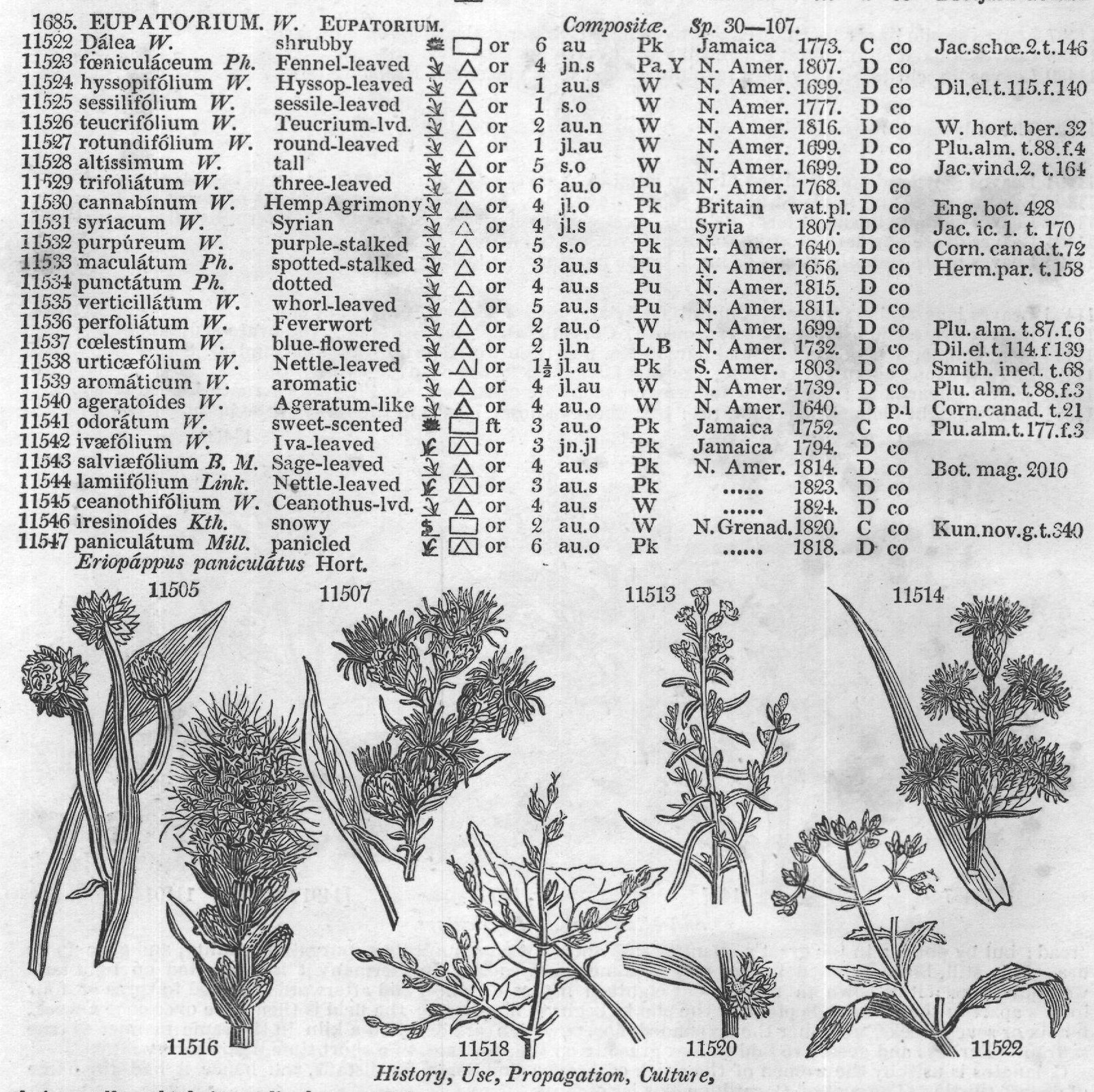
bot. 428 Jac. ic. 1. t. 170 Corn.canad.t.72 Herm.par. t. 158 Plu. alm. t.87.f.6 Dil.el.t. 114. f.139 Smith. ined. t.68 Plu. alm. t.88.f.3 Corn.canad. t.21 Plu.alm.t. 177.f.3 Bot. mag. 2010 N. Grenad. 1820. C co Kun.nov.g.t.340 1818. D co ...... ...... 1823. D co 1824. D co 11513 11514 11516 11518 11520 History, Use, Propagation, Culture, 11522 their corolla, which is not ligulate, and from every other tribe by their style, which is absolutely the same as that of Lactuceæ. The greater part of Vernonieæ are found in America; a few in Asia and Africa, but none in Europe. 1681. Ammobium. From aμμoς, sand, and βiω, to live, in allusion to the places where it grows. A pretty half-hardy New Holland herbaceous plant, with dry white involucral scales, like a Gnaphalium. 1682. Liatris. A word of unknown meaning. A genus of charming North American herbaceous plants. They should be taken out of the borders in the autumn, and preserved in pots till the succeeding spring. Of Liatris odoratissima, the leaves when dry give out a very pleasant smell resembling Vanilla, and which lasts for years. It is called the Carolina Vanilla plant.
Liatris squarrosa is a very handsome species, with large heads of most beautiful flowers of a rich purple. It and L. scariosa are known in North America under the name of rattlesnake's master. In case of being bitten by this reptile, the bruised bulbs of the plants are applied to the wound, while, at the same time, a decoction in milk is taken inwardly.
ORDER I.
SYNGENESIA ÆQUALIS. 11502 Leaves oval blunt serrate-crenate: lower with a winged amplexicaul. stalk, Fl. subcorymbose 11503 Leaves ovate entire acute downy beneath, Spikes recurved 1-sided, Bractes reflexed 11504 Leaves ovate-lanc. narrowed at each end serrated roughish pubescent beneath, Fl. term. about 3 11505 Leaves oblong wavy decurrent 11506 Stem simple pubescent, Leaves very long linear nerved roughish at edge, Racemes few-fl. leafy 11507 Stem simple pubescent, Lvs. lanc. narrowed at each end smooth rough at edge, Inv. squarrose at bottom 11508 Stem simple pubescent, Leaves smooth: lower stalked broad-lanc. Invol. subglobose with scarious scales 11509 Stem simp. vill.
Lvs. lin. subfalc. dott. rough, Spike somew. leafy, Pedic. short, Inner scales ligul. colored 11510 Stem simple pubesc. Lvs. lin. pilose ciliated, Invol. racemose lax, Scales lin. obl. bluntish [mucronate 11511 Slender all over hairy, Lvs. grassy, Spike few-fl. Inv. subsess. cylindr. few-fl. Scales round. at end abruptly 11512 Stem simple smooth, Leaves lanc. smooth: upper lin. lanc. very small, Invol. spiked subsquarrose 11513 Stem simple hirsute, Lvs. straight narrow-lin. downy, Spike long, Fl. closely cluster. Inv. appress. squarrose 11514 Stem simple tall, Lvs. lin. smooth ciliated at base nerved and dotted, Spike very long, Fl. sessile 11515 Quite smooth, Stem simple, Rad. leaves obl.: cauline amplexicaul. Panicle corymbose lax spreading 11516 Dwarf, Leaves linear, Stem simple, Flowers spiked 11517 Stem climbing, Leaves ovate entire, Flowers spiked 11518 Stem climbing, Leaves subcordate hastate toothed, Flowers in spikes [at end 11519 Stem climbing smooth, Lvs. cord. repand toothed acuminate with spreading unequal lobes, Fl. corymbose 11520 Flowers sessile lateral 11521 Flowers axillary sessile, Corollas all trifid 11522 Leaves lanc. veiny obsoletely serrate smooth, Invol. 4-fl. Stem shrubby 11523 Stem panicled, Leaves smooth: lower pinnated, upper fascicled, all filiform 11524 Leaves opp. subverticill. linear entire pubescent 3-nerved dotted: radical somewhat toothed 11525 Leaves sessile amplexicaul. distinct ovate-lanc. rounded at base serrated smooth, Stem smoothish 11526 Leaves sessile distinct ovate scabrous: upper coarsely serrated at base; uppermost entire 11527 Leaves sessile distinct roundish cordate bluntly serrate veiny 11528 Leaves subsessile lanceolate 3-nerved narrowed at each end downy: lower serrated in middle 11529 Leaves stalked 3 or 4-nate ovate narrowed at each end serrated roughish 11530 Leaves opposite subpetiolate tri-quinque-partite: their segments lanceol. deeply serrate 11531 Leaves petiolate ternate and simple downy beneath unequally serrate, Stem smooth 11532 Leaves stalked 4 or 5-nate ovate lanceolate serrate rugose veiny roughish, Stem hollow 11533 Leaves stalked 4 or 5-nate ovate lanceolate unequally serrate downy beneath, Stem solid furrowed 11534 Leaves stalked 4 or 5-nate ovate acuminate serrated scabrous on each side, Stem solid round 11535 Leaves stalked 3 or 4-nate ovate-lanceol. cuneate at base unequally serrate smoothish, Stem solid smooth 11536 Leaves connate perfoliate downy 11537 Leaves stalked cordate ovate bluntish 3-nerved bluntly serrate, Fl. corymbose 11538 Hispid, Leaves stalked cordate cut serrate, Panic. terminal, Invol. many-fl. subulate pungent 11539 Leaves stalked ovate acute 3-nerved bluntly serrate glabrous, Stem panicled upwards, Fl. corymbose 11540 Leaves stalked ovate acuminate 3-nerved unequally coarsely serrated smooth, Corymb many-fl. spreading 11541 Leaves stalked triangular ovate serrated entire at end downy beneath, Corymbs spreading term. sessile 11542 Leaves narrow lanceol. 3-nerved subserrated, Invol. squarrose many-flowered 11543 Leaves amplexicaul. lanc. acuminate rugose serrated, Flowers panicled clustered 11544 Leaves stalked ovate acuminate unequally and bluntly crenated pubescent, Panicle contracted 11545 Leaves stalked ovate acuminate toothed 3-nerved glabrous 11546 Stem twining villous, Lvs. deltoid ovate acute 3-nerved soft beneath, Panicle term. trichotomous diffuse 11547 Like E. lamiifolium, but the flowers smaller and panicled 11533 11540 11524 11539 11530 11543 11536 and Miscellaneous Particulars. 1683. Mikania. Named by Willdenow, after Professor Mikan, of Prague. Climbing tropical plants, one of which, M. Guaca, is employed in South American medicine as a powerful febrifuge. 1684. Sparganophorus. From σπaργavov, a fillet, and φερω, to bear, because the seed is crowned with a membranous band or border. 1685. Eupatorium. This plant, says Pliny, derives its name from Eupator King of Pontus, who first used it in medicine. Aya-pana is the vernacular name of the species so called among the natives of the banks of the river Amazon. The tribe of Eupatorieæ is distinguished from Vernonieæ by its style. They are chiefly found in America, very few inhabit Asia, scarcely any Africa, and not one has been found in Europe. The Eupatorium perfoliatum has some reputation as a medicinal plant. A dissertation upon the subject of its merits was published a few years since by an American physician, from which it appears that the virtues of the plant reside chiefly in the leaves, and that the most efficient mode of exhibiting it is by means of a simple decoction. The medical powers of Eupatorium are, as its sensible properties would seem to indicate, those of a tonic stimulant. Given in moderate quantities, either in substance, or in cold infusion or decoction, it promotes digestion, strengthens the viscera, and restores tone to the system. Like other vegetable bitters, Y y 11548 pubéscens W. downy 11549 mólle Swz. soft or 4 jl.au W SYNGENESIA ÆQUALIS. or 4 jl.au W N. Amer. 1819. D co Jamaica 1823. D co CLASS XIX. 11550 deltoídeum Jacq. deltoid or 3 jl.au Pu 11551 scándens Link. climbing or 6 au.s Y 1822. D co 1821. D co 1686. DUMERI LIA. Lag. DUMERILIA.
Compositæ. Sp. 1. 11552 paniculáta Lag. panicled or 3 au Pu Colombia 1825. C co Ann. mus. 19. t.7 1687. AGE'RATUM. W. AGERATUM.
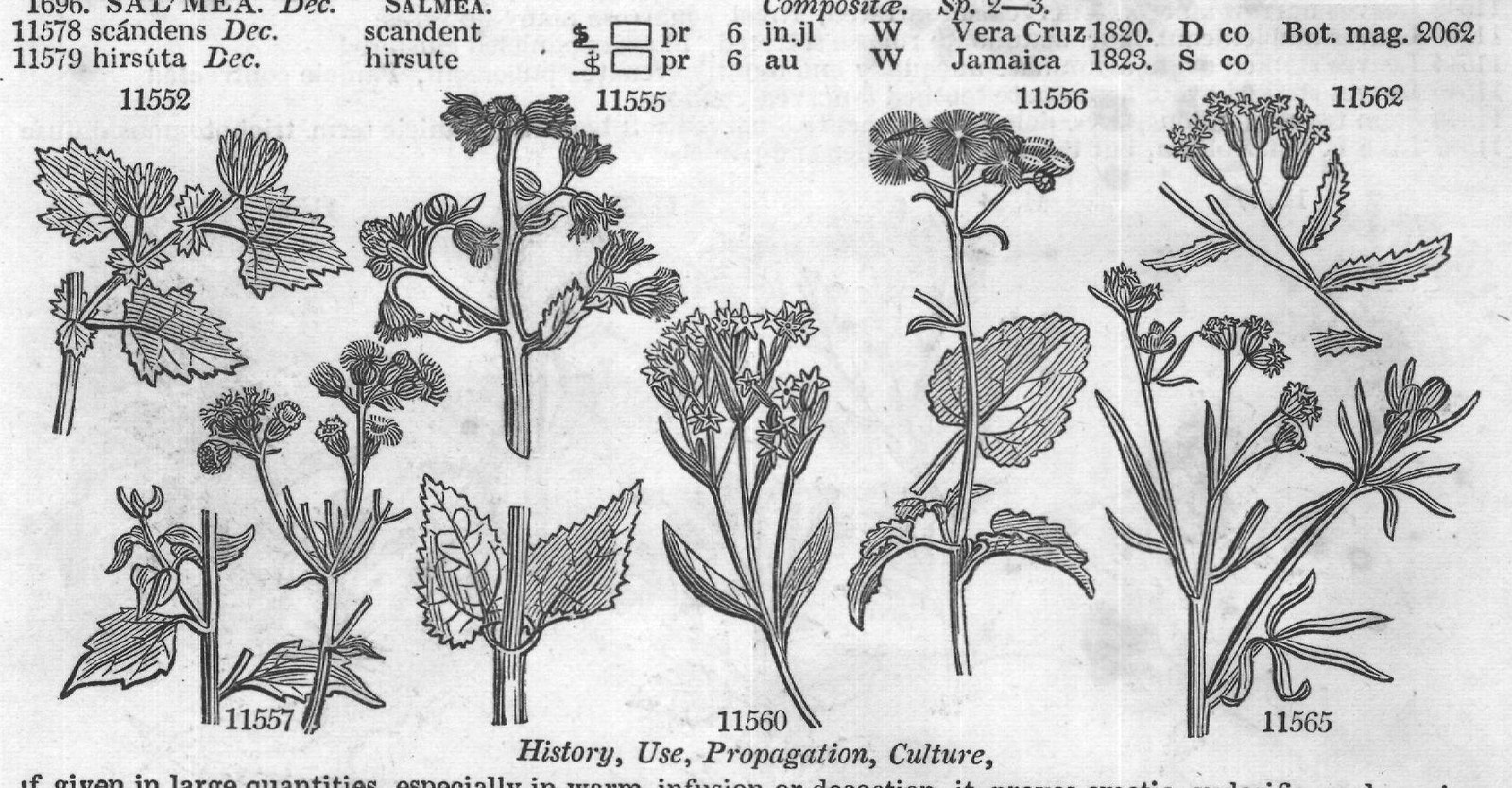
Compositæ. Sp. 4-8. 11553 conyzoídes W. hairy 11554 latifólium W. broad-leaved 11555 strictum B. M. upright 11556 mexicánum B. M. Mexican 1688. CÆLESTI'NA. Cass. CÆLESTINA. 0000 or 1 jl.au L.B America 1714. S p.1 Ex. fl. 15 O or 1½ jl.au W Peru 1800. S co Cav. ic. 4. t. 357 or 2 jn.jl W Nepal or 1½ jn.jl B Mexico 1821. S co 1822. S co Bot. mag. 2410 Bot. mag. 2524 Compositæ.
Sp. 1-2. 11557 ageratoídes Cass. blue-flowered or 1 jl.o B ...... ...
C co Bot. mag. 1730 1689. STEVIA. W.
STEVIA.
Compositæ.
Sp. 10-14. 11558 purpúrea W.en. purple Apr 1½ au.s Pu Mexico 1812. D co Bot. reg. 93 11559 Eupatória W. entire-leaved Apr 2 jl.s Pk Mexico 1798. S p.l Bot. mag. 1849 11560 hyssopifólia B. M.
Hyssop-leaved Apr 1 au.s Pk Mexico ...
D co Bot. mag. 1861 11561 salicifólia W.
Willow-leaved Apr 1½ au.s Pk Mexico 1803. S p.l Cav. ic. 4. t. 354 11562 serráta W. saw-leaved Apr 12 jl.s F Mexico 1799. D s.p Jac.schœ.3.t.300 Iva-leaved oval-leaved 11565 pedáta W. multifid lanceolate pubescent 11568 glaúca W. glaucous 11563 ivæfólia W. en. 11564 ováta W.en. 11566 lanceoláta Lag. 11567 pubéscens Lag. 1690. CEPHALO PHORA. W. CEPHALOPHORA. 1691. AMPHE REPHIS. Kth. AMPHEREPHIS. 11569 intermédia Link. intermediate Opr1 jl.au Pu 1692. HYMENOPAPPUS. J. HYMENOPAPPUS. Compositæ. 11570 tenuifólius Ph. slender-leaved ☐ un 2 jn.au W Apr 2 jl.s W Mexico 1816. D s.p Apr 2 au.s W Mexico 1816. D s.p Opr 1 jl.s W Mexico 1803. S s.p Bot. mag. 2040 Apr 1 jl.s Pu Mexico 1822. D co pr 1½ jl.s Pu Mexico 1823. D co Compositæ.
Sp. 1. un 2 jl.au Y Chili 1798. D co Cav. ic. 6. t. 599 Compositæ.
Sp. 1-3.
Brazil 1821. S co Pla.sel.H.B. f 29 Sp. 1-2. snowy 1693. MELANANTHERA. Mi. MELANANTHERA. Compositæ. 11571 hastáta Ph.
Louisiana 1811. S co Sp. 2-5. un 2 jn.jl W N. Amer. 1732. D co Dill.elt. t.47.f.55 Bidens nivea W. e panduráta fiddle-leaved Calea áspera W. 11572 deltoídea Mich. 1694. MARSHAL/LIA, Ph. MARSHALLIA. rough-leaved un 2 jn.jl un 3 jl.au Y W N. Amer. 1732. D co S. Amer. 1799. S co Dill.elt. t.46.f.54 Jac. ic. 3. t. 583 Composite. Sp. 2-3. 11573 lanceoláta Ph. spear-leaved pr 1½ jn.jl Pu Carolina 1812. D co 11574 latifólia Ph. broad-leaved pr 1 jn.jl Pa.pu Carolina 1806. D co Mich.ame.2.t.43 1695. SPILAN THES. W. SPILANTHES. 11575 Pseudo-Acmélla W. spear-leaved un 1 jl Y 11576 álba W. white-flowered un 1 jn.jl W 11577 olerácea W. esculent cul 1 jl.s Y 1696. SAL/MEA. Dec.
SALMEA.
Compositæ. 11578 scándens Dec. scandent $ 11579 hirsúta Dec. hirsute 8 pr 6 jn.jl W pr 6 au W 11552 11555 Composite. Sp. 3-14.
Ceylon 1768. S. s.l Peru 1783. S co E. Indies 1770. S co Sp. 2-3.
Vera Cruz 1820. D co Jamaica 1823. S co 11556 Bot. mag. 2062 11562 Pluk.al. t. 159.f.4 L'He.stirp.7. t.4 Jac.vind.2 t.135 11557 11560 History, Use, Propagation, Culture, 11565 if given in large quantities, especially in warm infusion or decoction, it proves emetic, sudorific, and aperient. Even in cold infusion, it tends to bring on diaphoresis. The plant is also stated to be an excellent remedy for the cure of intermittent fevers. When employed as a tonic, this plant may be taken in doses of twenty or thirty grains, or å teacup full may be used of the infusion rendered moderately bitter. When intended to act as an emetic, a strong decoction may be made from an ounce of the plant in a quart of water boiled to a pint. (Bigelow.) 1686. Dumerilia. Named after M. A. M. Constant Duméril, author of an Elementary Treatise upon Natural History, published in one volume octavo, at Paris, in 1804. Small half-shrubby South American plants, with firm hairy leaves. 1687. Ageratum. A name employed by Dioscorides, and probably applied by him to some plants similar to what we call properly "everlastings;" it is derived from a, privative, and γηρaς, old age, because it never grows old; that is to say, always preserves its color. 1688. Cælestina. From cælestis, blue, in allusion to the color of the flowers. 1689. Stevia. Dedicated by Cavanilles to the memory of Peter James Esteve, a Spanish physician of the sixteenth century. He left behind him a dictionary of the plants natives of the kingdom of Valentia. 1690. Cephalophora. From κεφaλη, a head, and φερω, to bear, its flowers being united in little heads. 1691. Ampherephis. From ἀμφηρεφής, which signifies well covered, on account of the double involucrum of the genus, ORDER I.
SYNGENESIA ÆQUALIS. 11548 Lvs. sessile distinct ovate scabrous veiny: lower doubly serrate; upper subserrate, Stem panicled downy 11549 Leaves stalked cordate acute subserrate villous beneath, Invol. 8-15-fl. Stem shrubby 11550 Leaves stalked hastate triangular 3-nerved unequally serrate downy beneath, Panic. corymbose 11551 Stem twining, Leaves reniform ovate acuminate serrate-toothed, Panicle axillary 11552 Leaves roundish 7-lobed: lobes crenate, Panicle corymbose terminal 11553 Leaves ovate subcordate, Stem hairy, Paleæ of pappus awned toothletted 11554 Leaves ovate cuneate at base, Stem pilose, Paleæ of pappus lanceolate acute 11555 Stem erect simple scabrous, Leaves cordate rugose unequally serrated 11556 Hispid, Leaves cordate ovate crenate rugose, Corymb compound, Paleæ of pappus lanccolate awned 11557 Leaves stalked ovate acute rounded at base serrated pilose above hairy beneath 11558 Leaves lanc. channelled narrowed into the footstalk 3-nerved, Corymb fastigiate 11559 Leaves lanc. 3-nerved entire. Corymb fastigiate, Pappus paleaceous and awned 11560 Leaves oblong ovate entire, Corymbs spreading, Pappus awned as long as corolla 11561 Leaves lanc. narrowed at each end serrated in the middle, Corymb spreading, Pappus with 2 awns 11562 Leaves lin. lanc. serrated at end, Corymbs fastigiate, Pappus paleaceous and awned 11563 Leaves lanc. narrowed into the footstalk 3-nerved finely serrated at end, Corymbs fastigiate 11564 Leaves ovate 3-nerved serrated cuneate and entire at the base, Pappus chaffy and awned 11565 Leaves stalked digitate pedate entire, Pappus paleaceous. (Florestina, Cass.) 11566 Leaves sessile narrowed at base rough with minute hairs, Pappus with 3 awns 11567 Leaves 10 lines long 4 lines broad finely downy beneath, Flowers purple 11568 The only species 11569 Leaves of invol. foliaceous: inner ovate obl. rounded; outer awned 11570 Hoary, Leaves sub-bipinnatifid, Flowers in compound corymbs 11571 Leaves 3-nerved ovate acuminate scabrous unequally toothed 11572 Flowers solitary stalked winged, Leaves oblong triple-nerved unequally serrated scabrous 11573 Leaves long-lanc. Leaves of invol. blunt, Paleæ spatulate 11574 Leaves lanc. oval acuminate 3-nerved, Paleæ narrow linear 11575 Leaves lanceolate serrate, Stem erect 11576 Leaves ovate repand: lower alternate, Stem branched ascending, Invol. many-leaved 11577 Leaves ovate subcordate serrated, Stem branched diffuse 11578 Leaves opp. ovate-acumin. serrate, Pedunc. panicled, Heads ovate 11579 Leaves opp. ovate-lanceolate entire downy, Pedunc. opp. diverging many-flowered 11568 11569 11570 11575 11571 β 11574 and Miscellaneous Particulars. 11571 11578 1692. Hyteпopappus. From ὑμηv, a membrane, and πaππoς, pappus, in allusion to the membranous pappus of its seeds. 1693. Melananthera. From μελaς, black, and anthera. A plant with black anthers, a very unusual character in this tribe of plants, the anthers of which are usually either white or yellow, according to the color of the corolla. 1694. Marshallia. Named after Henry Marshall, an Englishman, author of a sort of history of the trees and shrubs of North America, published in 1778. 1695. Spilanthes. From σπiλoς, a spot, and avθoς, a flower, in allusion to the heads of flowers of the original species, which are yellow with a brown disk. Jacquin says he so called it, because the flowers are spotted with black points. S. salivaria is used by the natives of South America to relieve the tooth-ache by the salivation which it produces copiously. The flower-heads of S. oleracea are an excellent ingredient in salads, on account of their agreeable and lasting piquancy.
The leaves of Spilanthes tinctoria of Loureiro, which is said to be very similar to the Abcedaria figured by Rumphius, vol. ii. t. 65., give out when bruised a beautiful blue color, quite equal to indigo. 1696. Salmea. This name was originally given by Cavanilles to a genus related to Aloe, and was named after Prince Charles of Salm-Salm, a great promoter of botanical science. It was transferred to the genus which now bears the name by Professor Decandolle, in the appendix to his Hortus Monspeliensis.
Yy 2 un 2 jl.s un 2 au.s un 1 jl.au un 1 un 2 jn.jl Oun 1 jl un 3 jl.au 11589 bipinnáta W.
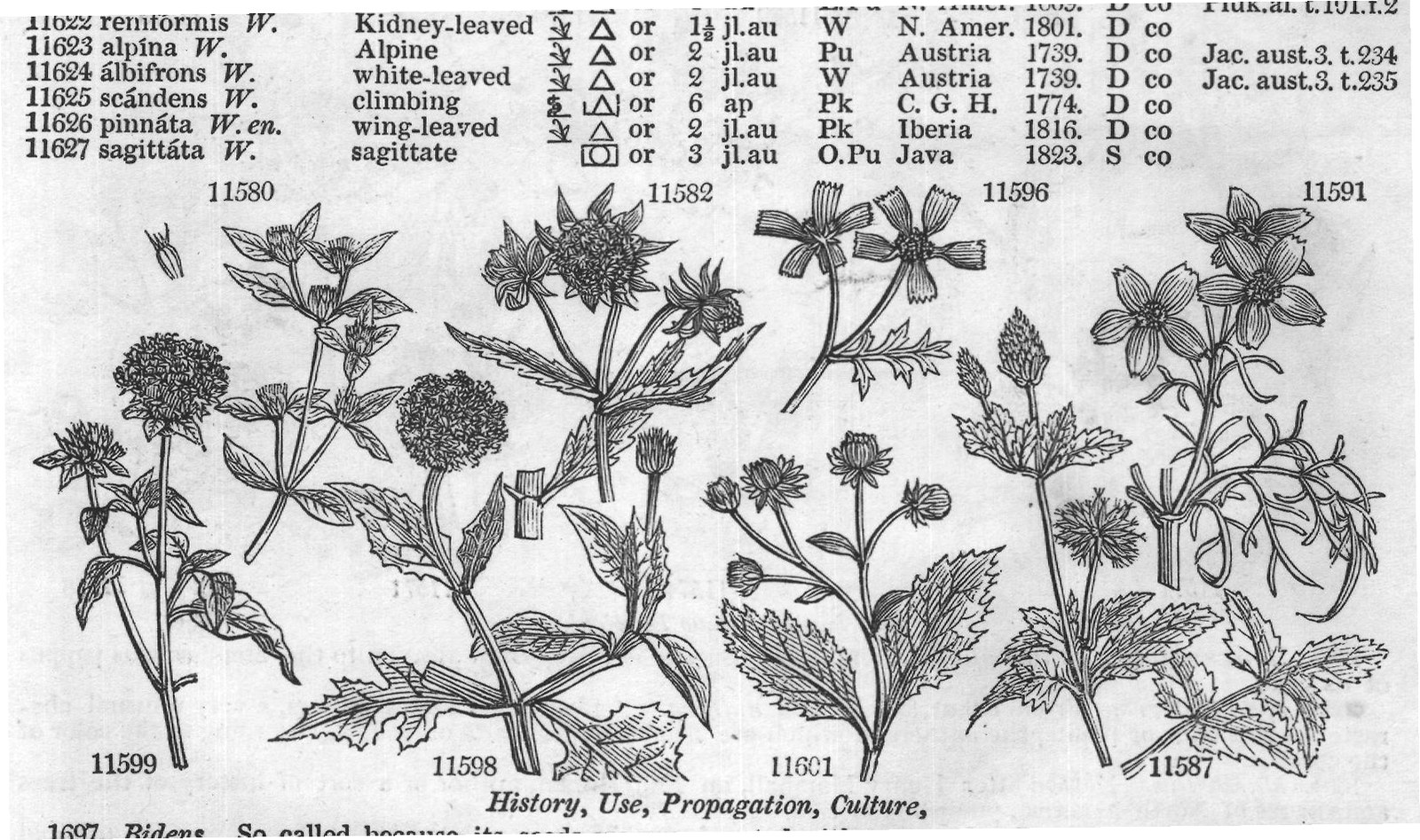
Hemlock-leav. un 2 jl.au 11590 bulláta W. rough-leaved un 2 jl.au 11591 prócera B. Reg. 11592 luxúrians W. tall or 6 n luxuriant un 3 jl.au 11593 foliósa W. leafy O un 3 jn.jl 11594 connáta W. connate ☐ un 2 jn.jl 11595 parviflóra W. small-flowered un 1 jn.jl 11596 odoráta Cav. sweet-scented ft 1697. BI'DENS. W. 11580 nodiflóra W. 11581 tripartita W. 11582 cérnua W. 11583 heterophýlla W. 11584 frondósa W. 11585 leucántha W. 11586 chinénsis W. 11587 pilósa W. 11588 sambucifólia W.
BIDENS.
SYNGENESIA ÆQUALIS. sessile-flowered trifid nodding various-leaved smooth-stalked white-flowered Chinese hairy Elder-leaved Compositæ. ☐ un 1 jl.au Y un 2 jl.s Sp. 18-25. ...
E. Indies 1732. S co Britain wat.pl. S co Britain dit. S co Mexico 1803. D s.l N. Amer. 1710. S co S. Amer.
Sco China 1801. S co N. Amer. 1732. S co S. Amer. 1801. D co N. Amer. 1687. S co N. Amer. 1759. S co Mexico 1822. S co Mexico D co ...... ... 1818. S co N. Amer. 1817. S co Baical 1823. S co Mexico 1825. S co CLASS XIX.
Dill.elt. t.44.f.52