Home › E › Eng (Bot Jac vind t Roth abhan t)
Eng (Bot Jac vind t Roth abhan t)
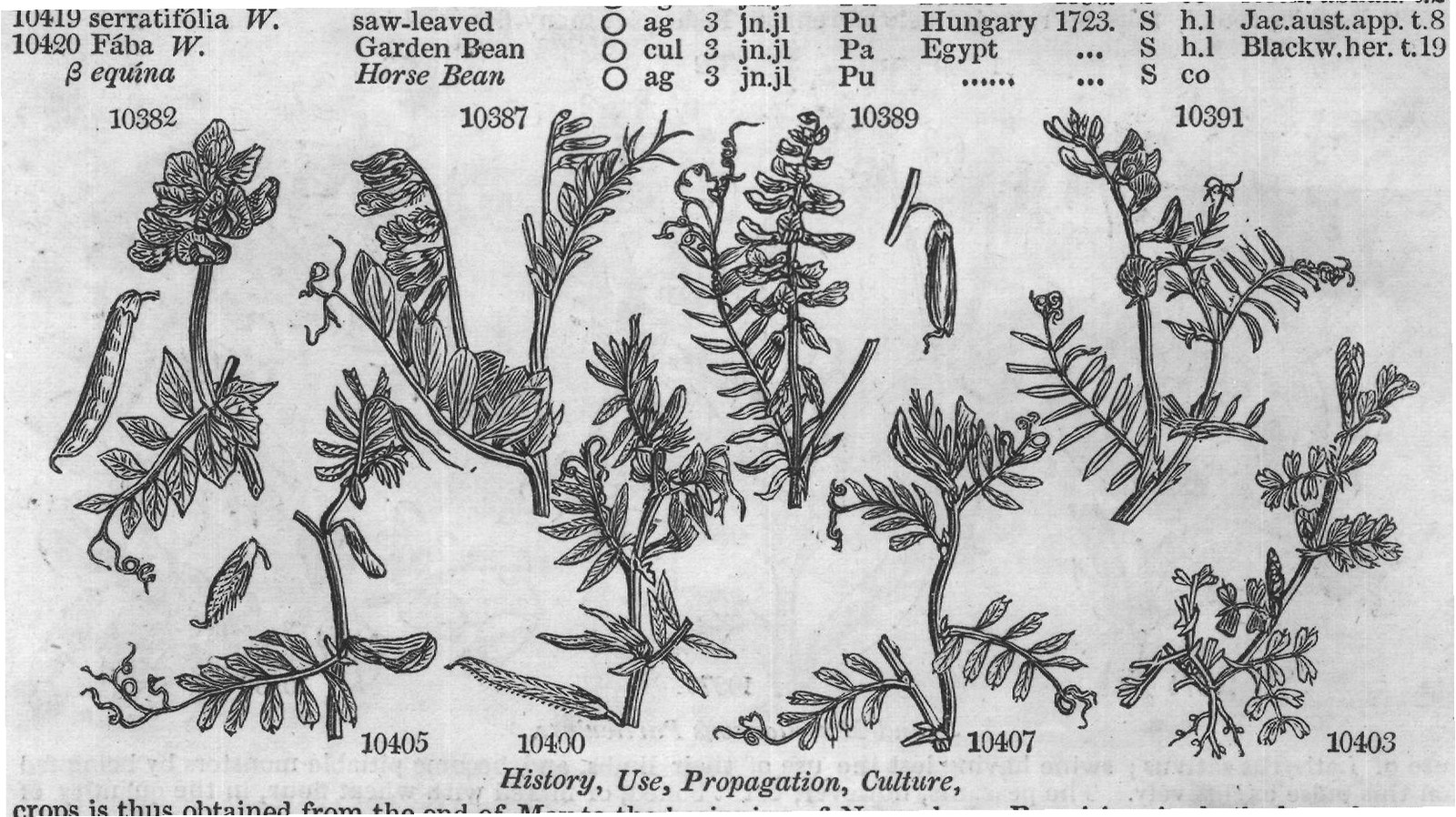
bot. 1515 Jac.vind. 2.t.147 Roth. abhan. t.1 Roth. abhan. t.2 Jac.aust.app. t.8 Sh.l Blackw.her. t. 19 Sco 10391 10405 10400 10407 10403 History, Use, Propagation, Culture, crops is thus obtained from the end of May to the beginning of November. By raising in hotbeds and transplanting, the first crop may be gathered in the beginning of May; and by raising and maturing in pits, pease may be gathered in April. The pea, however, does not force well, and requires extraordinary attention to giving air, otherwise the blossoms will not set. The culture of the pea is known to every countryman. The grey pea, cultivated in agriculture, is by some considered as a species, though it is obviously a mere variety, not further removed from the frame pea than is the blue Prussian, or the crown pea. A dry soil and season is essential for a good crop, unless the plants can be supported by sticks like the garden crops. The seed is chiefly used for feeding pigs, and splitting for soup. In boiling split pease, some samples, without reference to variety, fall or moulder down freely into pulp, while others continue to maintain their form. The former are called boilers. This property of boiling depends on the soil; stiff land, or sandy land that has been limed or marled, uniformly produces pease that will not melt in boiling, no matter what the variety may be. Pease straw cut green and dried, is reckoned as nourishing as hay, and is considered as excellent for sheep. The produce of pease in flour is as three to two of the bulk in grain, and husked and split for soups as four to two. A thousand parts of pea flour afforded Sir H. Davy 574 parts of nutritive or soluble matter; viz. 501 of mucilage, or vegetable animal matter, 22 of sugar, 35 of gluten, and 16 of extract, or matter rendered insoluble during the operation.
P. maritimum has seeds of a bitterish disagreeable taste, but are reported nevertheless to have been eaten in times of scarcity. (Turner's Herbal.) in times of scarcity. ( Turner's Herbal.) 1561. Vicia. From gwig, Celtic; whence βiκiov, Greek, vicia, Latin, vesce, French, vetch, English, &c. V. sylvatica and cracca, where they occur in meadows, are considered valuable herbage plants. They yield sylvatica and cracca, where they occur in meadows, are considered valuable herbage plants. They yield great bulk of fodder, which is allowed to be very nutritive. Some have proposed to cultivate them alone, but Curtis observes, they would probably in that case choke themselves for want of support. V. sativa, the winter and summer tare, fetch or vetch, is a valuable agricultural plant. Some consider the winter variety as a distinct species; but Professor Martyn proved, by cultivating both, that they were not ORDER IV.
DIADELPHIA DECANDRIA. 10381 Petioles 4-leaved, Stipules crenate, Peduncles 1-flowered 10382 Petioles flat above, Stem angular, Stipules sagittate, Peduncles many-flowered 10383 Peduncles many-fl. Petioles many-leaved, Leaflets ovate: lower sessile 10384 Peduncles many-fl. Leaflets reflexed ovate mucronate, Stipules somewhat toothed 10385 Peduncles many -fl. longer than leaf, Leaflets ellipt. Stipules lunate with setaceous teeth 10386 Peduncles many-fl. shorter than leaf, Leaflets oblong subpubesc. Stipules half sagittate entire lanceolate 10387 Peduncles many-fl. shorter than leaf, Teeth of calyx setaceous very villous, Leaflets lanceolate villous 10388 Peduncles many-fl. longer than leaf, Flowers imbricated, Leaflets obl. ovate villous, Stip. half-sagittate 10389 Peduncles many-fl. longer than leaf, Flowers imbricated, Leafl. lanc. blunt, Stip. half-sagitt. lin. subulate 10390 Peduncles many-fl. longer than leaf, Flowers imbricated, Leafl. lin. smoothish 3-nerved, Stip. lin. entire 10391 Peduncles many-fl. longer than leaf, Flowers distant, Leafl. lin. Stip. half-sagitt. lin. lanc. toothed at base 10392 Peduncles many-fl. Petioles suleate 12-leaved, Leaflets lanc. smooth, Stip. half-sagittate stalked leaved, Leaflets lanc. smooth, Stip. half-sagittate stalked 10393 Peduncles many-fl. Leaflets obl. Stipules entire, Pods villous ovate oblong. 10394 Peduncles many-fl. Leaves entire, Stipules entire, Pods nearly erect 10395 Peduncles many-fl. long, Upper leaves subcirrhous, Stipules half-sagittate entire, Leafl. oval-obl. hoary 10396 Peduncles many-fl. long, Leaves not cirrhous, Leafl. obl. lanc. silky beneath, Stip. lanceol. entire 10397 Peduncles many-fl. 10397 Peduncles many-fl. shorter than leaf which is not cirrhous, Leaflets obovate emarginate, Stip. oblong than leaf, Leaflets linear narrowed at each end, Stip. half-sagittate 10399 Pods subsessile solitary, Leaflets ovate, Stipules marked 4-toothed 10400 Pods sessile sub-binate, Leaflets obl. ovate truncate mucronate, Stipules toothed marked 10401 Pods sessile sub-binate spreading, Lower leafiets ovate emarginate: upper lin. entire, Seeds globose 10402 Pods sessile: lower subterranean, Leaflets linear truncate, Stipules half-sagittate 10403 Pods sessile solitary erect smooth, Leaflets 6: lower subcordate 10404 Pods sessile solitary reflexed hairy, Stems diffuse, Stipules colored, Standard smooth 10405 Pods sessile solitary reflexed hairy 5-seeded, Standard villous 10406 Pods stalked reflexed, Standard silky, Stipules lanceolate marked, Upper leaflets obl. elliptical acute 10407 Pods sessile solitary reflexed smooth, Stems nearly erect, Leaves quite smooth 10408 Pods sessile solitary reflexed downy, Leaflets linear blunt, Stipules half-sagittate entire 10409 Pedunc. 1-fl. in fruit longer than leaf and awned, Leaflets linear blunt mucronate, Stipules multifid 10410 Pods stalked about 3, and the standard hairy, Stipules lanceolate marked 10411 Pods subsessile twin reflexed smooth, Leaflets obl. ovate retuse, Stipules marked 10412 Pedunc. 1-fl. very short, Leafl. lin. lanc, truncate, Stipules lanc. undivided, Pods finely downy 10413 Pods subsessile pendulous smooth 4-seeded, Leaflets linear emarginate 10414 Pedunc. 1-fl. awned, Leaflets lanceolate blunt, Stipules bifid 10415 Pods stalked about 4 erect, Leaflets ovate entire 10416 Pods stalked solitary erect, Leaflets 4 oval-lanceolate, Stipules toothed 10417 Pods subsessile solitary compressed somewhat inflated, Leaflets ovate toothed at end, Stip. cil. toothed 10418 Pods subsessile subternate compressed, Leaflets ovate entire, Stipules ciliate toothed at base 10419 Pods subsessile subternate, Leaves and stipules serrate 10420 Pods subsess. subtern. torulose, Leaflets ovate entire, Petioles not cirrhous, Stip, sagittate toothed at base 10383 10386 10397 10402 10411 10416 10419 10415 and Miscellaneous Particulars. even very distinct varieties. The winter variety is sown in September and October, and the summer at different periods, from February to June, for successional cuttings. The soil requires to be in a good heart, otherwise they will produce but a poor crop of herbage: on a good soil they will yield ten or twelve tons, which is found excellent for milch cows and working stock. The crop is seldom left to ripen its seeds, but when seeds are wanted; the only use made of them being for sowing or feeding pigeons. V. narbonensis and serratifolia are cultivated in Germany in the same manner as our tare. Vicia sepium has been recommended to be sown among clover for mowing. been recommended to be sown among clover for mowing.
V. Faba is a well known legume both of the garden and the field. The garden varieties are numerous; the earliest is a small seeded variety, the Mazagan, and the largest the Windsor. Beans are planted at the various times in which pease are sown; but the late sowings of this plant do not answer so well as those of the pea. When the ground is properly pulverised and in good heart, they succeed well when transplanted; and where a first crop is injured by insects, if the stems are cut down to the ground during their flowering season, they will send up a succession of shoots, which will bear a crop. In this way, according to some, the bean may be rendered perennial, as it is certain the scarlet kidney bean may by merely protecting the roots from the frost.
The field bean, of which there is a larger and smaller sort, the latter called ticks, is sown in drills by a machine, so as to admit of horse hoeing, and otherwise ploughing or stirring between the rows. By this means a larger crop is produced, and the land cleaned and brought into a better state for a succeeding corn crop. Beans are excellent food for hard working horses, and för fatting hogs for bacon. The flower of beans and pease is more nutritive than that of oats, but less easy of digestion. A bushel of beans is supposed to yield fourteen pounds more of flour than a bushel of oats, and a bushel of pease eighteen pounds more, or, according to some, twenty pounds. A thousand parts of bean flour were found, by Sir H. Davey, to yield 570 parts of nutritive matter, of which 426 were mucilage or starch, 103 gluten, and 41 extract, or matter rendered insoluble during the process. 1562. ER'VUM. W.
TARE.
DIADELPHIA DECANDRIA.
Leguminosæ. Sp. 4-16.
CLASS XVII. 10421 Lens L.
Lentil 10422 tetraspérmum W. smooth 10423 hirsútum W. hairy 10424 dispérmum W. two-seeded O clt 1 my Pa France 1548. S r.m Oun 1 jn Pu un 2 jn.jl B Britain corn fi. S Britain corn fi. S h.l h.l Rivini tet. t. 35